
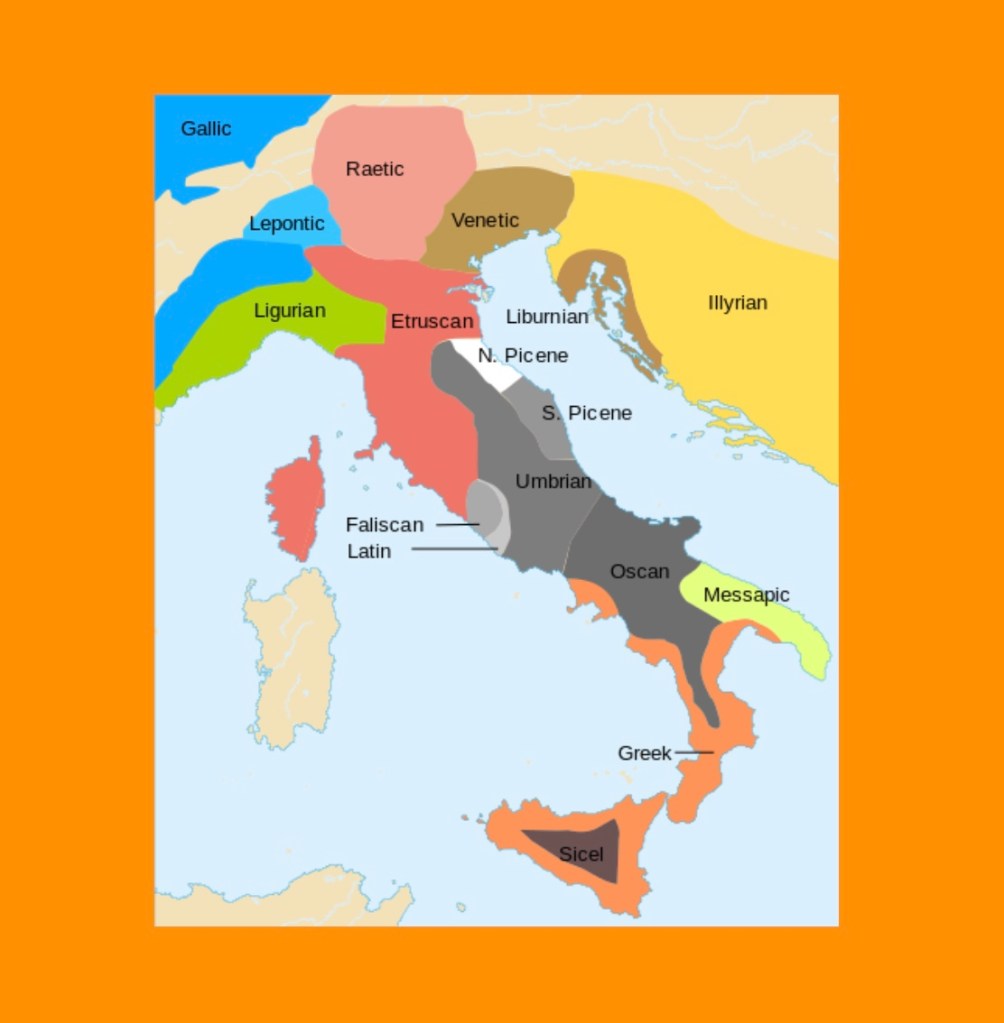


Oscan (Italian: osco… 💿sc🌀) is an extinct Italic language of southern Italy. It belongs to the Osco-Umbrian or Sabellic branch of the Italic family. It was most closely related to Umbrian and Volsci. The Italic languages are the “Refined” Tongues. The Oscan and Umbrian languages are often considered mere dialects of the same overall language. Either way, of course, they were very closely related. Oscan was about as similar to Latin as English is to Dutch today, let’s say. The Oscan-Umbrian branch is widely considered to be the second branch of the Italic family, after Latino-Faliscan which contains Latin and therefore the modern Romance languages (inc. Italian, French, Spanish, Portuguese and Romanian, all descending from Latin and spread via the Roman Empire). It includes, of course, Oscan and Umbrian, as well as the minor dialects of central Italy Marsian, Marrucinian, Paelignian, Sabine, Vestinian, and Volscian. The other noteworthy Italic languages South Picene and Venetic are considered Osco-Umbrian.
The language is only known from some 250 documents and inscriptions written in different alphabets: a rustic or colonial Latin alphabet, the Greek alphabet, and a native Etruscan-derived alphabet. But beyond that, text written in Oscan has not materialised except for a few fragments and token excerpts of Roman writers and literary men, such as on the Tablet of Agnone, the Abellano Boundary Stone and the Tabula Bantina. Inscriptions from which the Osco-Umbrian group is known date between 400 and 89 BC.
The Oscan language was spoken until approximately CE 100. It was spoken by different tribes, including the Samnites (Oscan: Safineis), the Aurunci (Ausones) and the Sidicini. The Aurunci and the Sidicini are often grouped together under the name Osci, or Oscans/Opici/Opsci/Obsci/Opicans. It was shared between the Osci people of Campania and Latium adiectum and the Samnites of Southern Italy, apparently imposed on the former by the latter. The Samnites rivalled Rome for about 50 years in the second half of the 4th century BC. They were all of course eventually assimilated by the Romans. The Osci, meanwhile, sought to maintain their independence by playing one state against the other, especially the Romans and the Samnites. According to Aristotle, the Opici were also called the Ausones. Aurunci is the Roman name for Ausones. The Aurunci and the Ausones were perhaps the same people in the early Roman Republic, but in the 4th century BC the names came to be applied to distinct tribes. In the last half of the 4th century BC, surviving Oscan populations -who were not Samnites– were divided between three independent sovereign states: the Sidicini, the Aurunci and the Ausones.
The Osci were known among neighbouring peoples for their debauched festivals, games and plays. Their lasciviousness was in time absorbed by wider Roman society, the term Osci loqui or Obsci loqui coming to refer to licentious or lewd language.
Oscan was similar to Latin yet shows a distinct vocabulary and a series of differing sound shifts – Oscan aasa: Latin āra “altar”; Oscan pid: Latin quid “what”. Other striking similarities with Latin included volo, velle, volui, etc. from the Proto-Indo-European root *wel-(‘to will’) – represented by words derived from *gher (‘to desire’): Oscan herest (‘(s)he shall want, (s)he shall desire’, German cognate ‘begehren’, English cognate ‘yearn’) as opposed to Latin volent (id.). Place was represented by the hapax (one-off term) slaagid (place), which Italian linguist Alberto Manco has indicated to be a surviving local toponym. It was surely a distant cognate of the Latin locus, both derived from Proto-Italic “stlokos”. We have the Oscan ‘p’ in place of Latin ‘qu’ (Osc. pis, Lat. quis); ‘b’ in place of Latin ‘v’; medial ‘f’ in contrast to Latin ‘b’ or ‘d’ (Osc. mefiai, Lat. mediae). Oscan carn- “part, piece” is related to Latin carn- “meat” (as in English ‘carnivore’), both from an Indo-European root *ker- supposedly meaning ‘cut’ – the Latin word apparently originally meaning ‘piece (of meat).’ Oscan tangin- “judgement, assent” is ultimately related to English ‘think’.
Osco-Umbrian was the Language of Authenticity. Also the Language of Perspective, even the Language of Worldliness. Oscan is considered to be the most conservative of all the known Italic languages. Yet, the Osco-Umbrians and whoever else ultimately makes this grouping were the idiosyncratic Italics. Alternatively: the heartfelt ones. They were conversely, more ~relatably~, obsessed with buzz, flight, and consistency.
An important fact is that to remain independent, the other peoples of the Italian peninsula would have to dull down their own culture and patrimony in order to deter the Romans from wanting to assimilate them and annex their culture. The memory of this dimension of early peninsular society is preserved in Italian folk tradition, contradictory and converse though it is to the Roman tradition of refinement and advanced civilisation.


Oscan was originally written in a special adapted Oscan alphabet, derived from an Old Italic script based on the Etruscan script. It would later be written in the Greek and Latin alphabets.
Variants of Osco-Umbrian include Hernican, Marrucinian and Paelignian, known by inscriptions left by the corresponding minor tribes of eastern central Italy. A few inscriptions of the Marrucinian language of the Marrucini survive, indeed indicating that it was a Sabellian language closely related to Paelignian, and most of these very short. “Aes Rapinum” (“Bronze of Rapino”), is the longest of these with 35 words, and is dated to about the middle of the 3rd century BC. It names the city or tribe as touta marouca, presumably the derivation of the name Marrucini. The known Paeligni inscriptions indicate that the dialect of these tribes closely resembled Oscan of Lucania and Samnium, with some unique peculiarities. The -nus/-ni/-no suffix of the name Paeligni may be a parallel with the suffix of the Latin privignus ‘stepson’. It may also have a connection with the Latin paelex “concubine”, indicating that it meant “halfbreeds” and was thus a name coined in contempt by conquering Sabines – who also turned the touta marouca into the buzzing community of the Marrucini.
Meanwhile in 📀scan…
Geddit? Because normally when you mix it up people end up losing their faith in humanity… this flip-side is literally the premise of the Oscan language…!
Oscan words:
- az – ad – to, towards, at [IE *ad- ‘to, towards’]
- carneis – partis – a part (gen.sg.)
- embratur – imperator
- famelo – familia – a family
- fangvam – lingua – tongue [IE *dng’hu- ‘tongue’]
- kerssnais – cenis – meals (abl.pl.)
- loufrud – libero – freeman (dat.sg.) [IE *leudh- ‘free, free people’]
- maatreís – Matris – the name of the feminine deity [IE *mátér ‘a mother’]
- miricatud – mercato – trade, merchant
- moltaum – multare – to increase, to multiply
- múíníkad – communi – common (nom.pl.)
- nei – non – not, no [IE *@n- ‘not’]
- nú – novius – new [IE *newo- ‘new’]
- pru – pro – for, instead of
- prúfatted – probavit – he has shown, proven
- púuttram – pontem – a bridge (acc.sg.)
- saahtúm – sanctum – saint (acc.sg.)
- slaagid – loco, regione – a place, a region (abl.sg.)
- tangineis – sententiae – opinions (nom.pl.)
- teerúm – terra – land [IE *Irish tír ‘a country’]
- toutíks – publicus – public [Oscan touto ‘people’, Gaulish teuto- ‘people, a tribe’,
- touto – civitas, populus – people, a country [Oscan touto ‘people’, Gaulish teuto- ‘people, a tribe’,
- tríbarakavúm – aedificare – to build
- tríbúm – domum – a house, home (acc.sg.)
- úíním – omnium – all, every (gen.pl.)
- úíttiuf – usus – used (participle)
- víteliú – Italia – Italy [Italic *vitell- ‘a little bull’]
- volloíom – exstruere – to destroy
The Italic languages are a widely accepted branch of the Indo-European macrofamily. I classify it to be Western Indo-European i.e. European, alongside the Celtic, Germanic, Slavic, Hellenic, and Albanian branches. As opposed to the Eastern branches, Armenian and Indo-Iranian. There is a theory that the Italic languages are more closely related to the Celtic languages, within a common Italo-Celtic branch of the Indo-European language family. The only surviving Celtic languages are the Insular Celtic languages of the British Isles, the “Noteworthy” Tongues, but there used to be many more in use throughout the European continent. Surviving Insular Celtic languages include Irish Gaelic, Scottish Gaelic and Welsh. This hypothetical proposed grouping remains controversial. Celtologist Peter Schrijver would argue in 2016 that the Celtic languages perhaps arose in the Italian peninsula as the first branch of Italo-Celtic to split off. He linked Proto-Celtic from an archaeological standpoint with the Canegrate culture of the Late Bronze Age of Italy (c. 1300–1100 BC). What surely happened was that at some point Proto-Italic and Proto-Celtic tribes opted to collaborate for the sake of a shared ideology and vision, probably leading first to a Sprachbund which then produced a technical relationship between their languages. Note that the Proto-Celts were the pinnacular Indo-Europeans, and the Proto-Italic peoples the pinnacular Western Indo-Europeans. I, myself, do see a noteworthy formational resemblance, particularly with Oscan as explored here. Together the Italo-Celtic languages are the “Dignified” Tongues. The Osco-Umbrians were THE “Italo-Celtics”.
The four layers of Osco-Umbrian:
- [1] delicacy > to promote refinement in human manner and activity
- (2) groundedness > to keep it i.e. emotion real
- [3] Osco-Umbrian-ness > for obvious reasons: to foster identity
- (4) openness > to keep culture and outlooks open in spite of enmity
 The Buzz-Concept Project