- belis/beles sheep; belisho/belishu sheep (pl.)
- shadi/bula monkey; shadimuts/bulamo monkeys
- tshiir/tshigir/tsigir goat; tshiirisho/tshigirisho/tsigira goats
- huk dog; hukai/huka dogs
- bush cat; bushongo cats
- buwa cow; buweynts cows
- utt camel; uttaints camels
- tshiyar/har ox; tshiyarisho/haro oxen
- tshindar bull; tshindarisho bulls
- busroosro calf; busrowants calves
- hasto elephant; hastumuts elephants
- haghur horse; haghurisho horses
- sar rabbit; saro rabbits
- hal fox; haljo foxes
- bepayr yak; bepayr yaks
- ta tiger; tamuts tigers
- sheer lion; sheerisho lions
- baaz falcon
- batbat swan
- bulbul nightingale
- crhin sparrow
- tootaan parrot
- asrcring my lower back
- ool my belly
- alpur my eyelash
- aphatti my forehead
- ayattis my head
- eyiling my lips
- axurpat my lungs
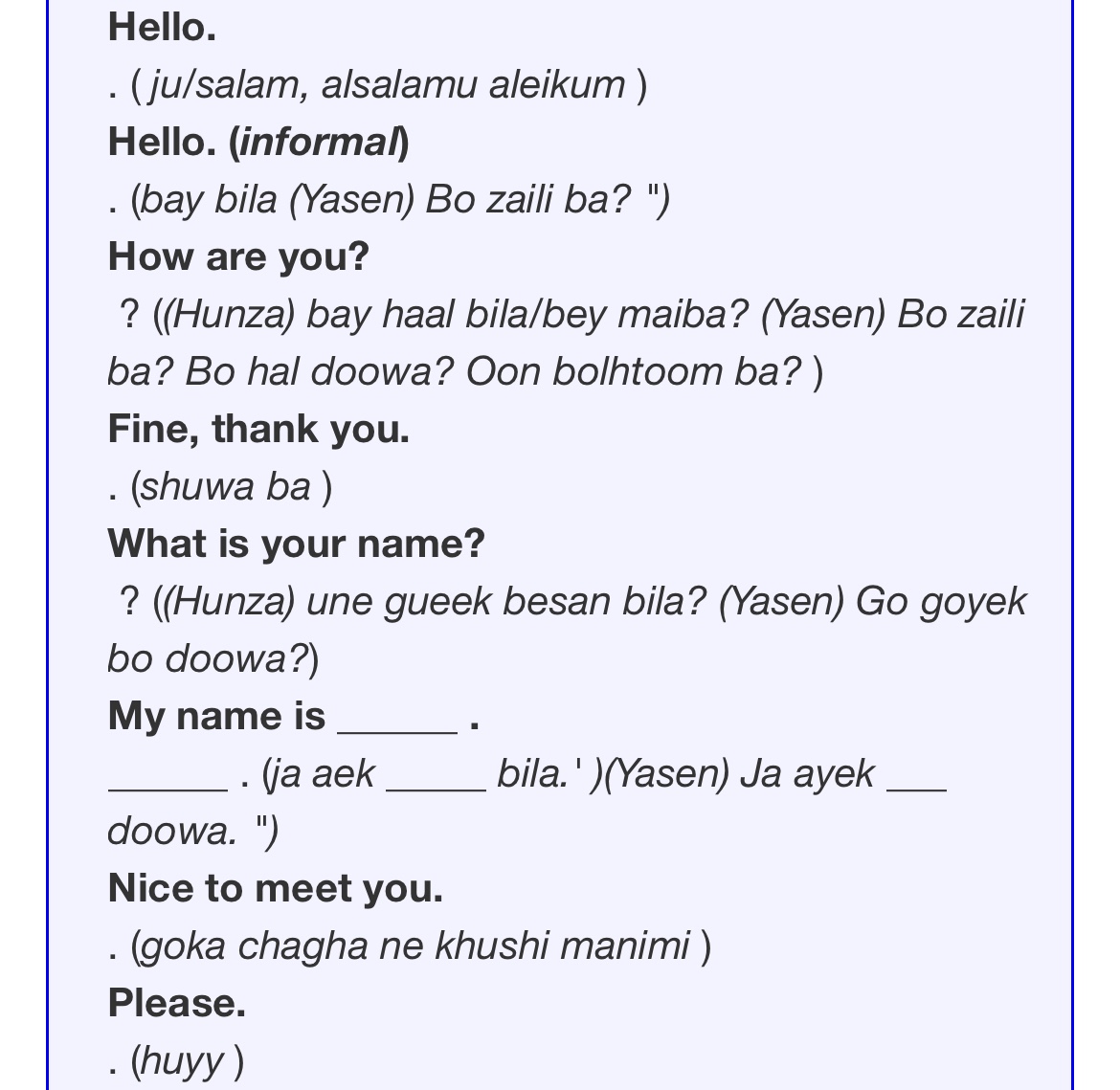
- be gumay baa? / be mamay baan? How are you? (Singular) / how are you? (Plural, or Formal singular)
- aman bila, damane meerbaani. It is fine (lit. peaceful), thank the Lord.
- araam bila, un sen / araam bila, ma senin. I am fine, you tell (informal)/ I am fine, you tell (formal).
- be bila? What’s up?
- bes ke be / xaas besan api Nothing at all / Nothing special
- nukuycin xoš amanam / namaycin xoš amanam Nice to meet you (Informal) / Nice to meet you (Formal).
- gokguyuu šuwaa baana How are your kids?
- (xudaaye) umur gučʰiṣ May God give you long life!
- ulo ẓu/ ulo ẓuyin naa Come in/ Please come in
- xawrut/ pʰaat maneyin naa sit down/please have a seat!
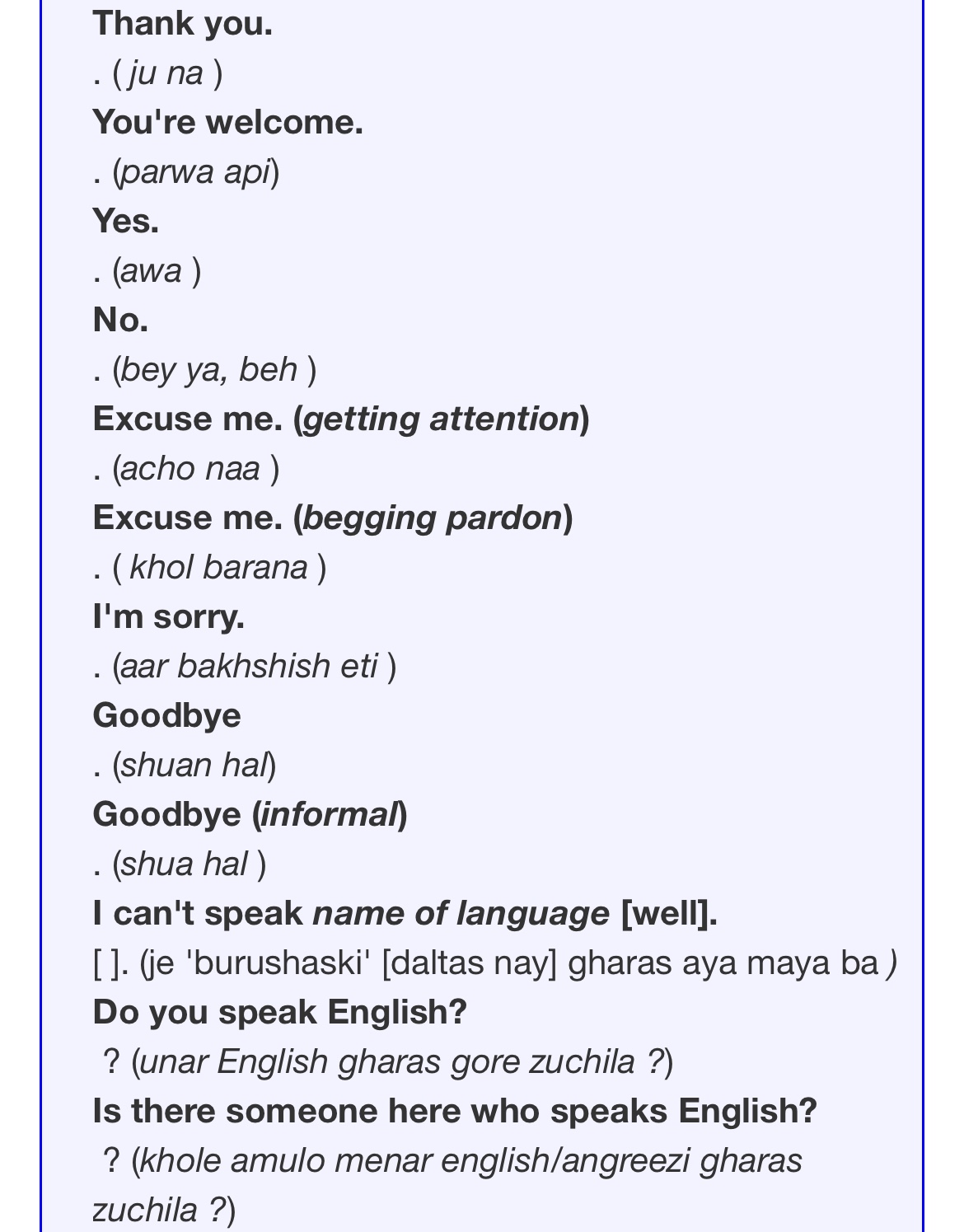
- baxṣiṣ eti Please forgive me!
- xudaa yaar Good bye! /God be with you!
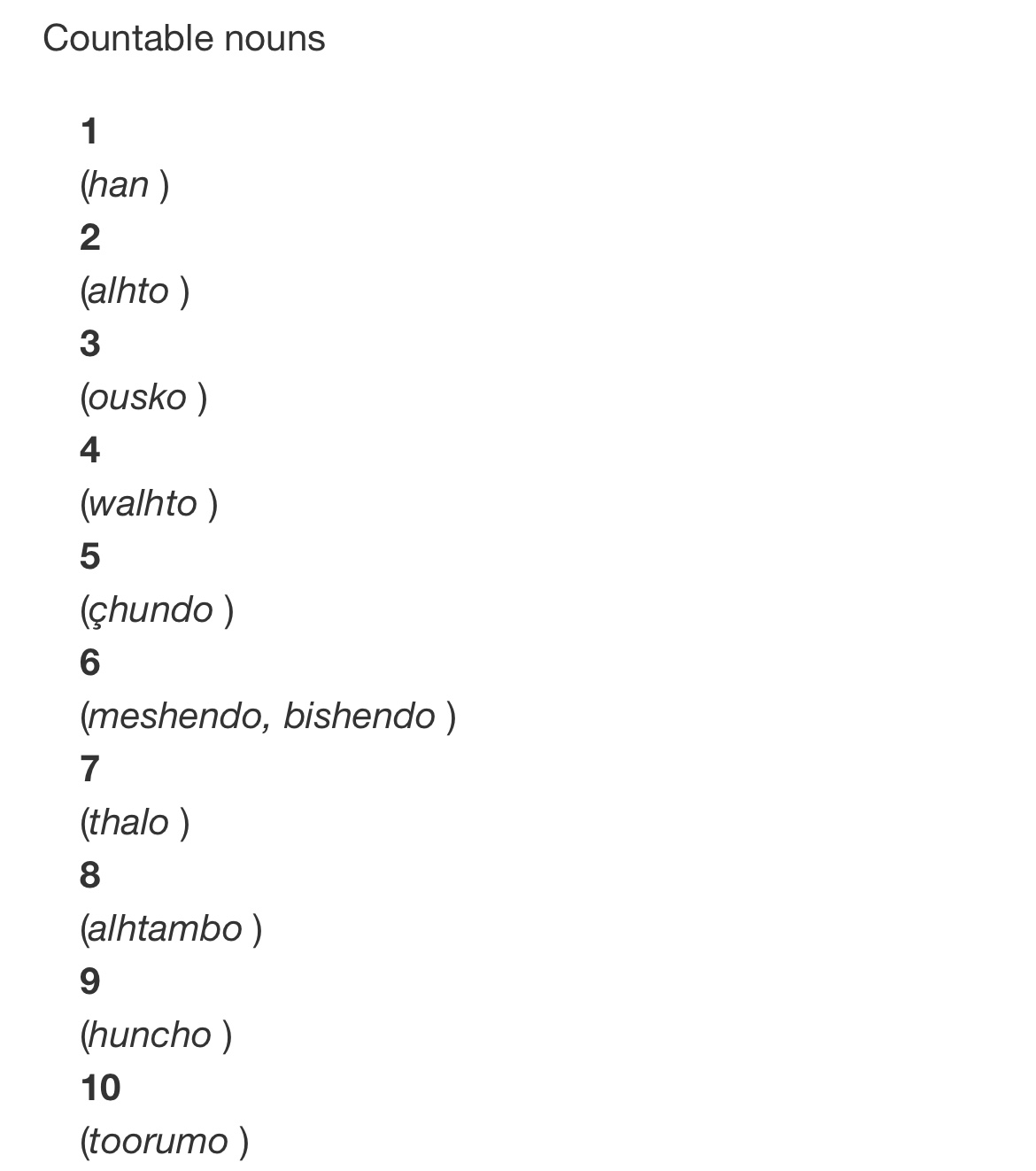
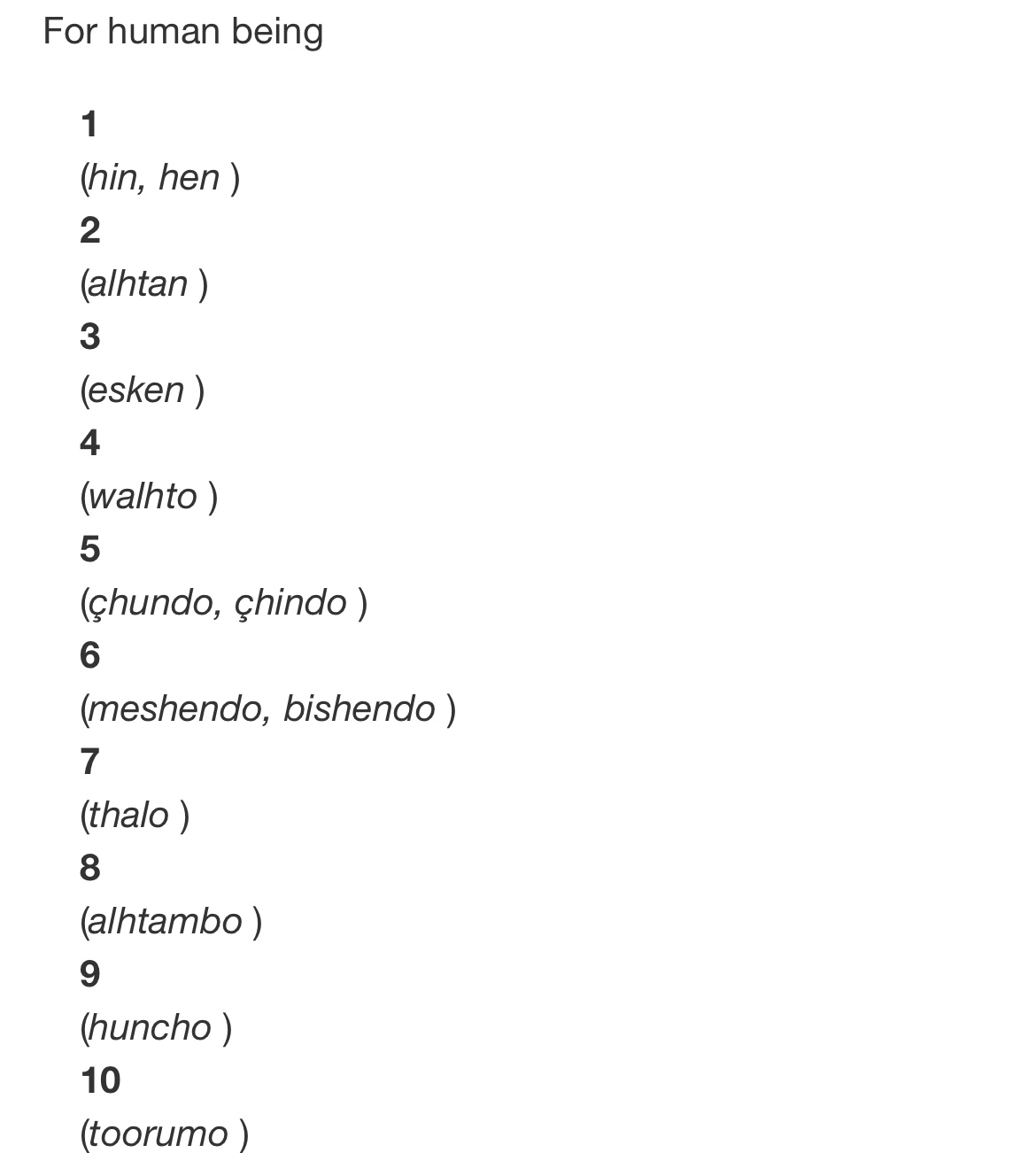
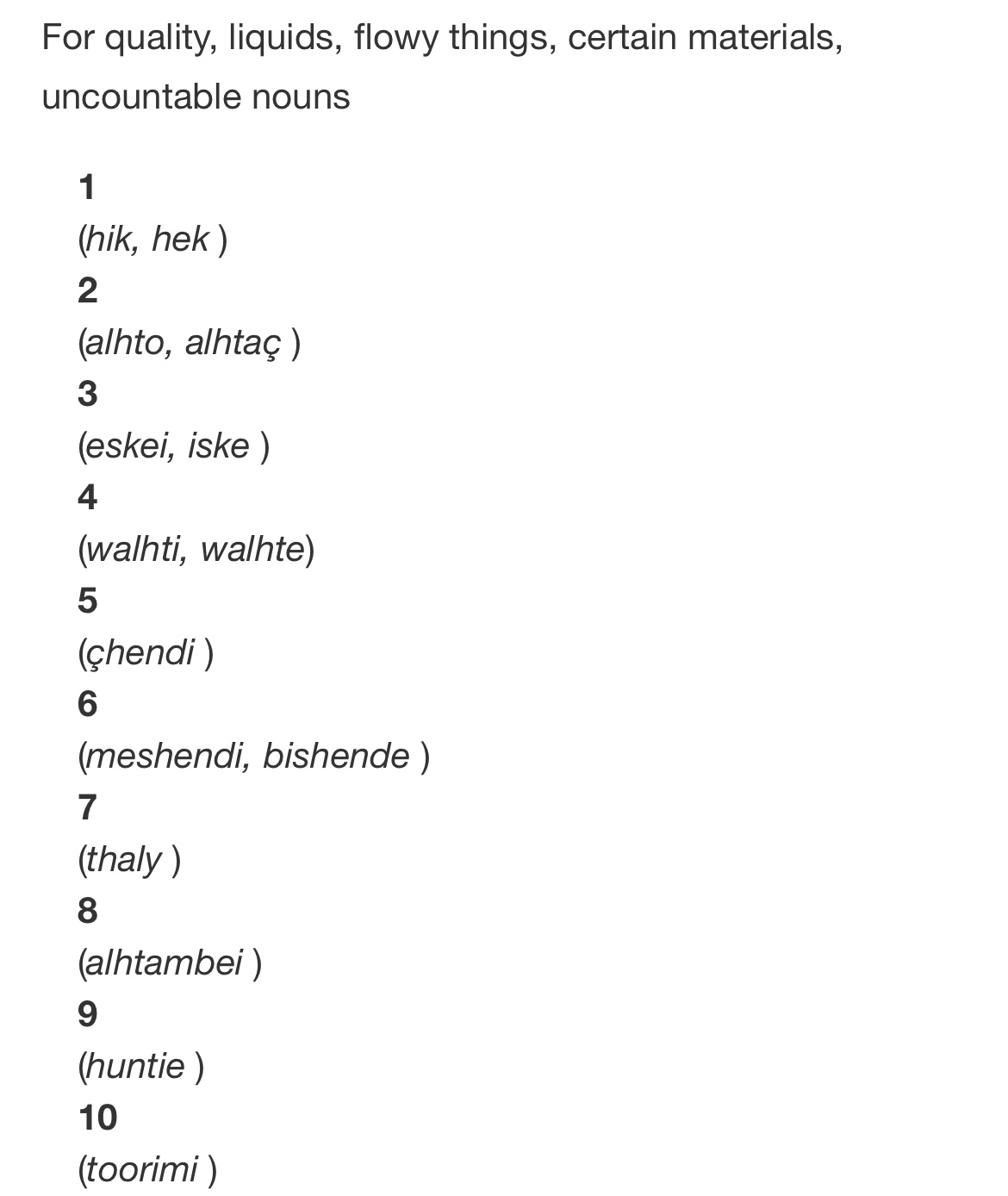
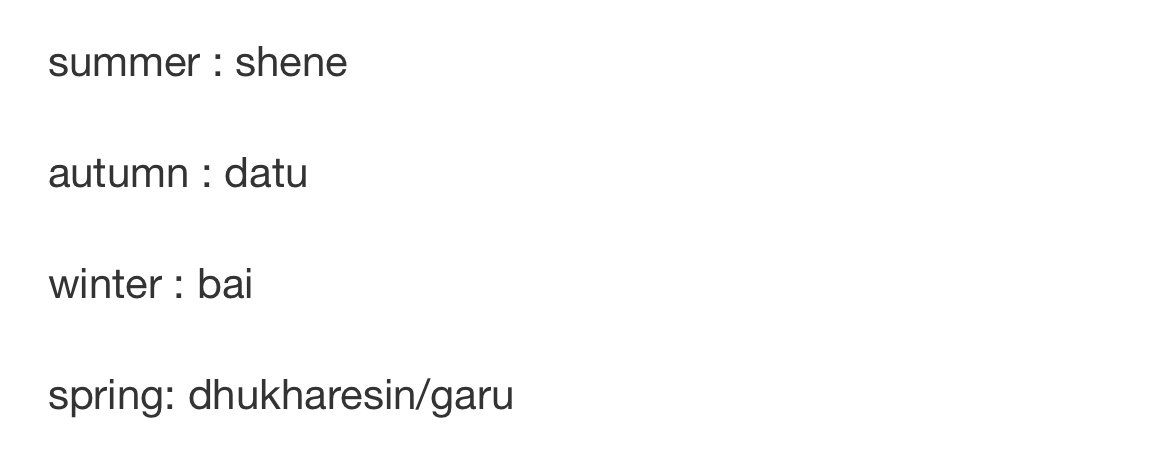
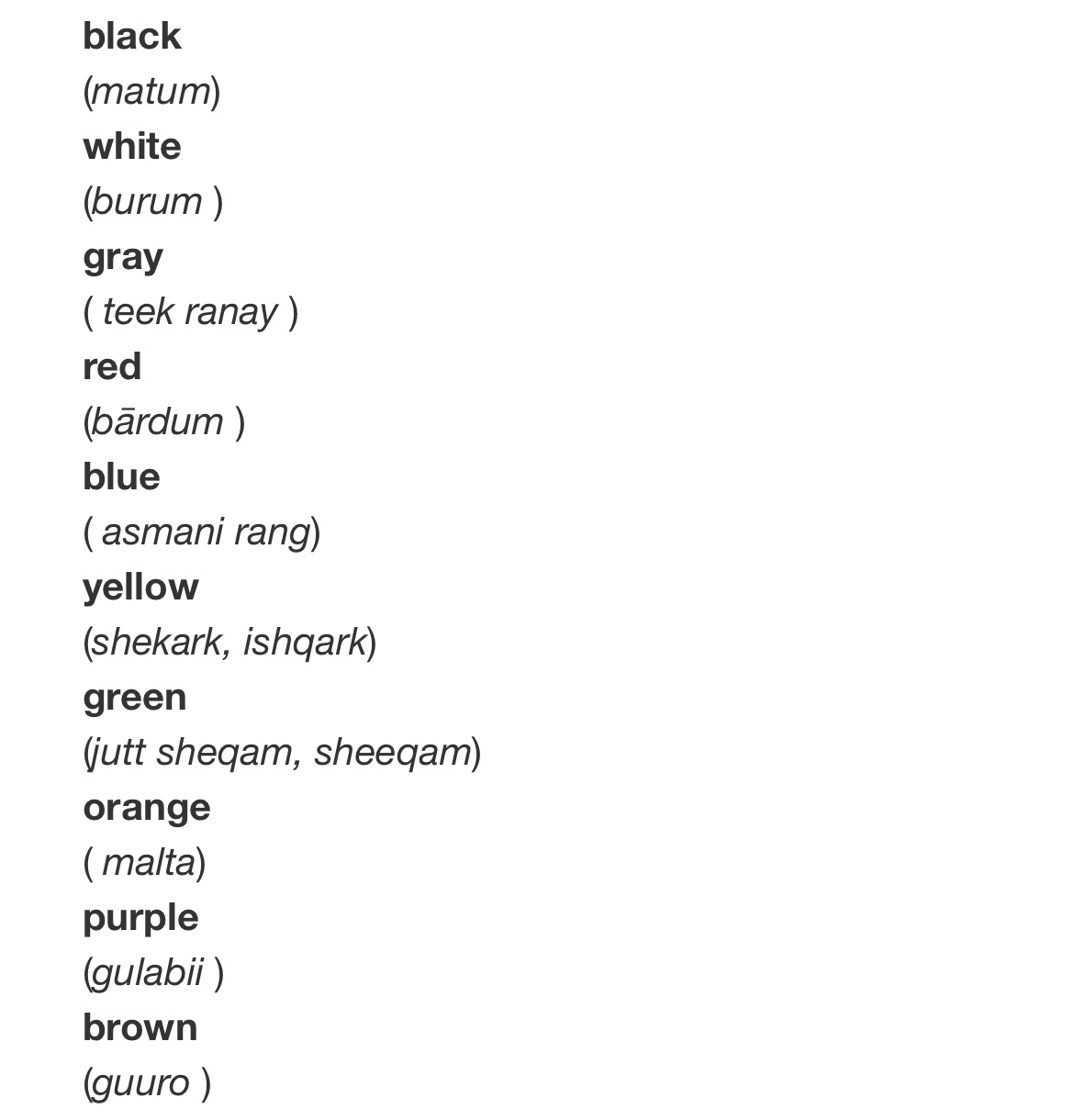
- áltar 20
- áltar torum 30 ‘twenty ten’
- altó-áltar 40 ‘two-twenty’
- altó-áltar-tórum 50
Burushaski / بروشسکی / burū́šaskī is a supposed language isolate spoken by the Burusho / Brusho / Botraj / Hunza people of northern Gilgit-Baltistan, Pakistan. Other names for the language are Biltum, Khajuna, Kunjut, Brushaski, Burucaki, Burucaski, Burushaki, Burushki, Brugaski, Brushas, Werchikwar and Miśa:ski. It is spoken by some 55,000-60,000 people in the Hunza-Nagar area and the Yasin area in Gilgit District, Northern Areas of Pakistan. Although a larger estimated puts the figure at 126,300 for 2018. Most Burushaski speakers are Shi’a Muslim. Many people, especially men, also speak Urdu as a second language. Almost all Burushos (speakers of the Burushaski language) are bilingual in Burushaski and at least one of the other regional languages, such as Urdu, Shina, Kashmiri, Khowar —Indo-Aryan languages— or the Tibeto-Burman language Balti.
Burushaski is highly agglutinative. It employs double-marking, whereby grammatical functions are doubly marked on the heads and by the modifiers – in Burushaski, “who did what to whom” is conveyed both through case and verbal marking. Burushaski exhibits a subject-object-verb (SOV) word order and uses postpositions (e.g. “school to” rather than to school). It has four genders, which can be broadly distinguished as male humans; female humans; animals (undifferentiated by sex) plus inanimate objects that are quantifiable; and abstract items and objects. Numbers up to 1,000 are based on multiples of 20 and 40.
Burushaski has no standard writing system, although a modified version of the Perso-Arabic script has been in use since the 1940s Nor do they have a written literary tradition, just a number of modest oral traditions. Its role nonetheless continues on as a means of self-identification for its speakers.
Burushaski is generally classified as a “language isolate”, sometimes referred to as the “South Asian Basque”. Several attempts have been made to relate Burushaski to fellow supposed language isolates Yeniseian Ket, Nivkh and Yukaghir, along with languages of known families, apparently. Otherwise, additional relationships have been proposed with the Yeniseian, North Caucasian, Kartvelian, and Indo-European families. In the proposed “Dené-Caucasian” macrofamily, Burushaski is included as a primary branch alongside North Caucasian and Yeniseian. The “Karasuk” hypothesis links Burushaski with Yeniseian. Eric P. Hamp and Ilija Čašule have proposed a link to an “Indo-Hittite” grouping of the Indo-European languages. Sadaf Munshi proposed that Burushaski may have developed alongside the Dravidian languages before the Indo-Aryan migration to South Asia, referencing the fact that both possess retroflex sounds.
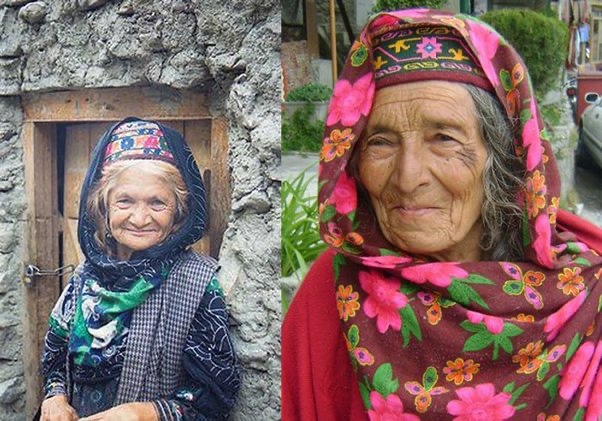
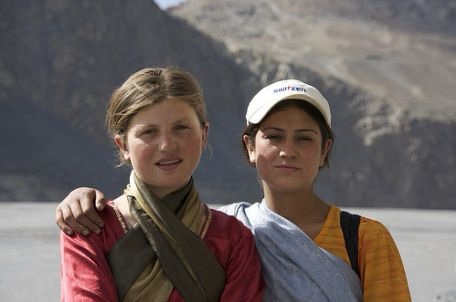
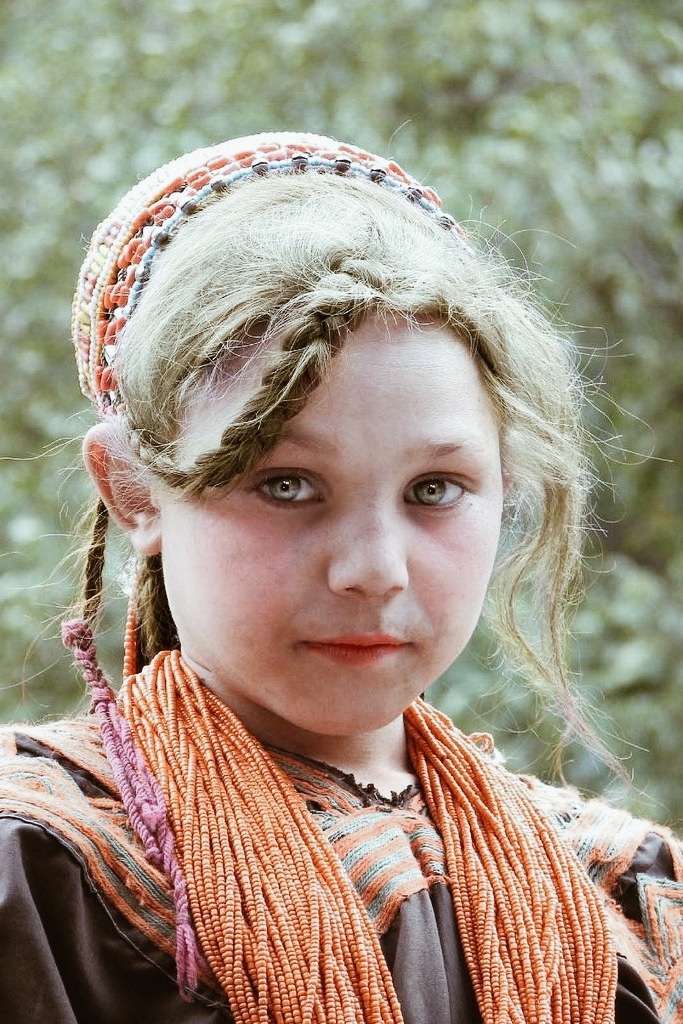
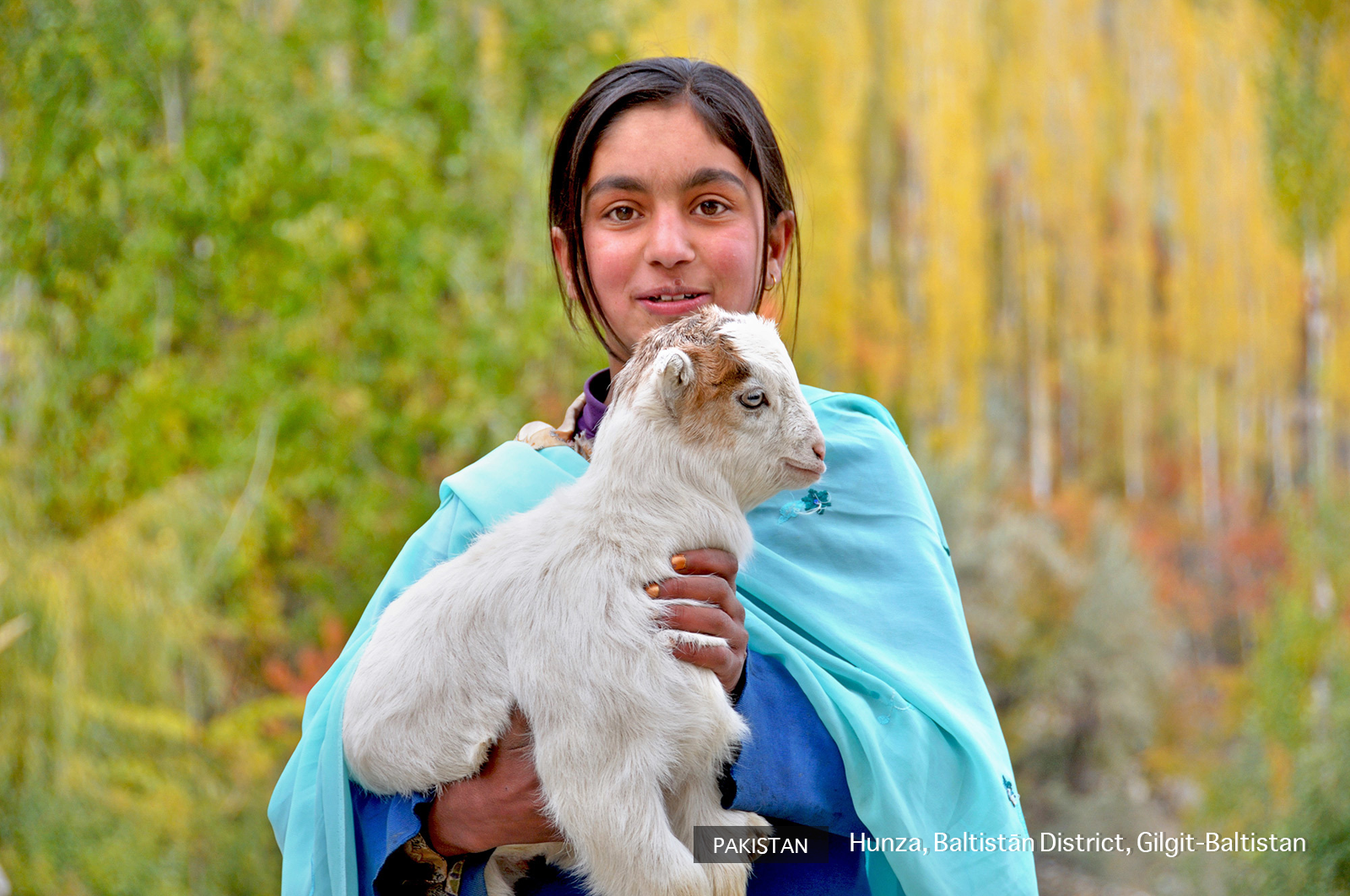
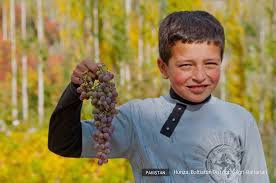
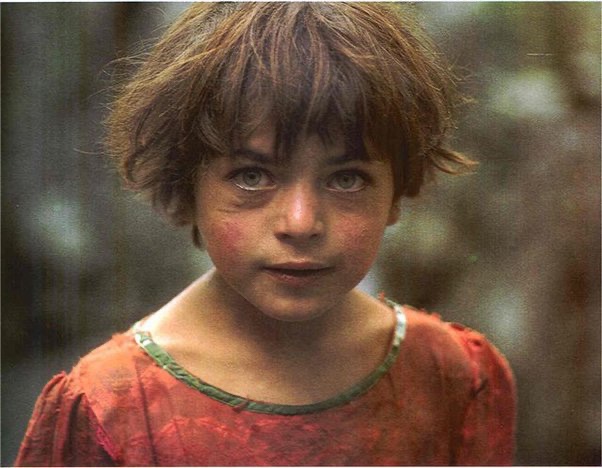
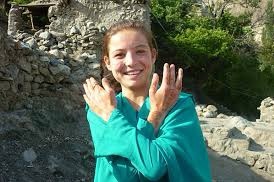
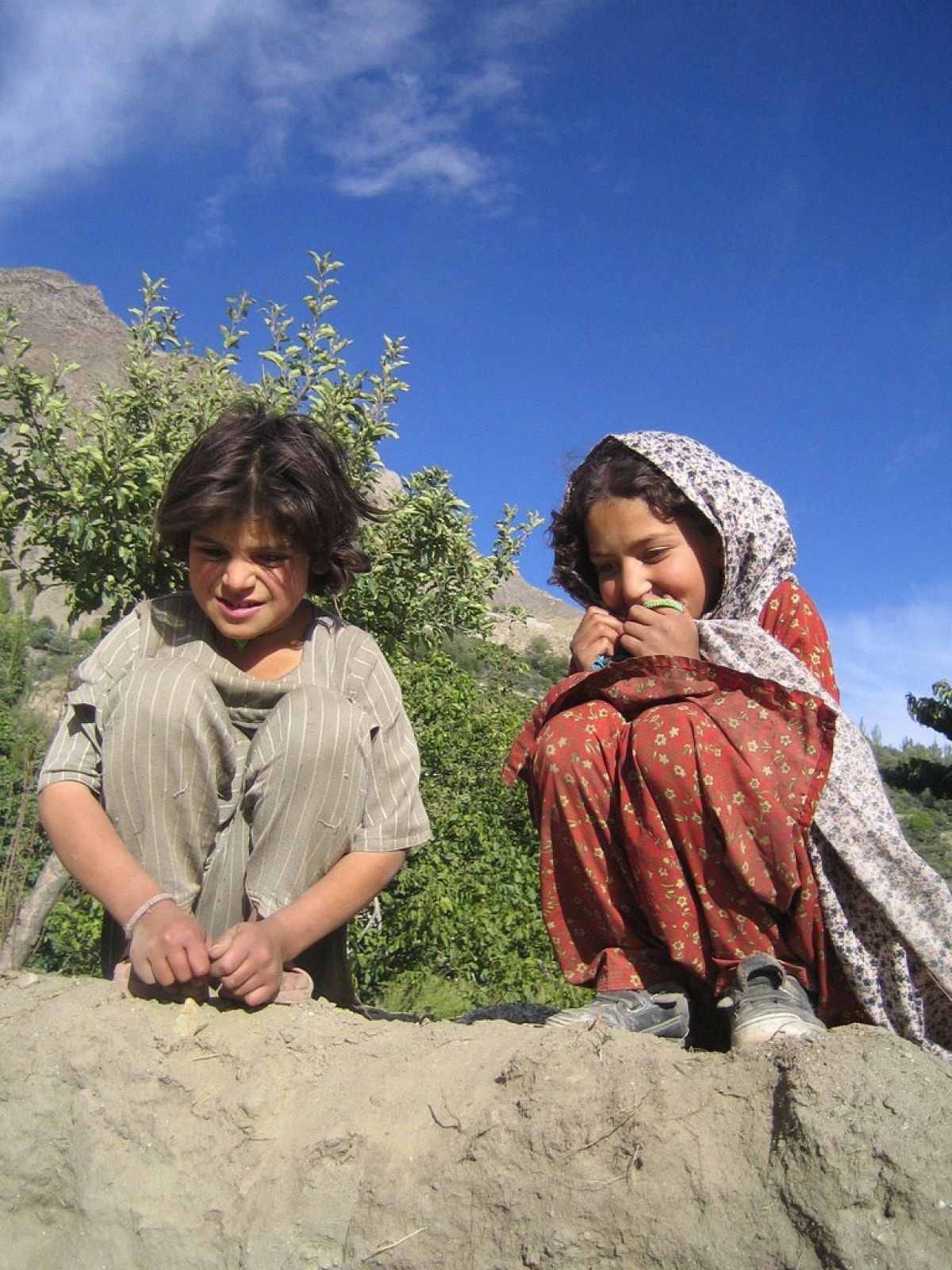
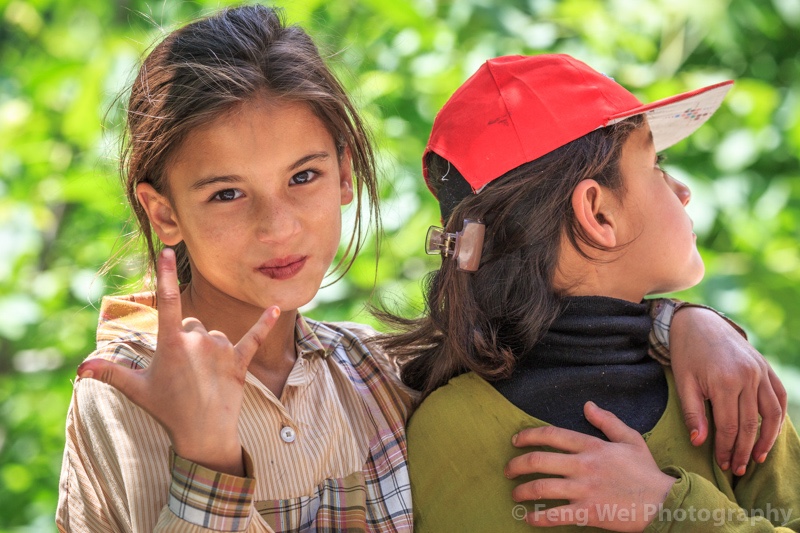
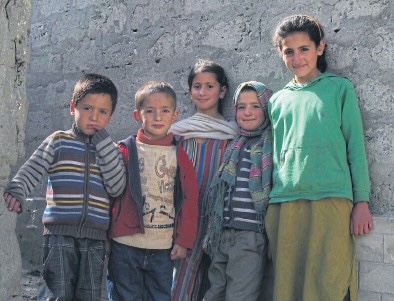
The people of northern Pakistan’s Hunza Valley are known for their life expectancy. The average life expectancy of Hunza people is said to be 100 years, while some exceed 120. Researchers have lived with the Hunza people to find out about this. Dr Robert McCarrison lived with the tribe for several years. He allegedly couldn’t find a single person who had been diagnosed with cancer, stomach ulcers, appendicitis, or any other disease. It may be because of their ‘organic and natural lifestyle’. After all, they live on the Himalayan highlands, with access to freshwater which is naturally enriched with minerals like potassium, calcium, iron, etc., that are essential for the body. The diet of Hunza people mainly consists of organic raw vegetables and fruit with low protein content. Water is also a key factor leading to longevity. As is hard work. Travellers who have stayed with the Hunza have reportedly praised their general charm, intelligence, and physical stamina.
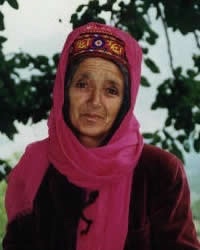
And the above is true…
Yet, moreover, Burushaski is the Language of Longevity. There is probably additionally discernibly a psychological or psycholinguistic and corresponding neurological basis for their longevity. How? The Burusho instinctively know how to comport themselves in a way that stimulates their neurology in just the right way so as to promote longevity. It is this phenomenon that their culture revolves around.
We could categorise Burushaski as yet another Nostratic tongue masquerading as an isolate, but what I have outlined above is not within the Nostratic domain. We are more focused on activity. What we do know is that Burushaski bears no visible resemblance and relation to any other living language. But as we have found here at the BCP, there in reality isn’t really such a thing as a language isolate. They all come from somewhere, from a bigger family, as a quirky spin-off, mostly.
The origins of the Burusho people themselves are of course unknown, although it is claimed that they “were indigenous to northwestern India and were pushed higher into the mountains by the movements of the Indo-Aryans, who traveled southward sometime around 1800 B.C.” Local legend indicates that the Hunza may have been associated with the lost kingdom of Shangri La, which was was mentioned in the novel by James Hilton “The Lost Horizon”. They also have some East Asian genetic contribution. Local Burusho legend maintains that the people of Hunza descend from the village of Baltit, founded by a soldier left behind from the army of Alexander the Great. This is a legend common to much of Afghanistan as well as to northern Pakistan. In 1996, an ex-patriate Macedonian linguist sought to demonstrate a link between Burushaski and the modern Macedonian language, a Slavic Indo-European tongue, and informed the Hunza about the existence of Macedonia. The proposal has not been accepted by other linguists. Furthermore, genetic evidence only supports the existence of a Balkan genetic component in the Afghan Pashtun, and not in the Burusho. No Greek genetic component has been detected in tests among the the Burusho.
Work has been realised examining potential relationships between Burushaski and another proposed language isolate Kusunda / Kusanda / Ban Raja / mihaq / gilɐngdəy məhyɐq gipən / ‘language of the kings of the forest’ of Nepal. It is spoken by less than 100 people as of 2014.
- ṭik sawaṭṭe nu pratiṣṭhā kapherā adhikār kakeje jibejī aganjī. ginā gyāo ciy kapherā māgbhayā nāṅ’ṭe aṅī.
- All human beings are born free and equal in dignity and rights. They are endowed with reason and conscience and should act towards one another in a spirit of brotherhood. (Article 1 of the Universal Declaration of Human Rights)


B. K. Rana (2002) maintains that Kusunda is a Tibeto-Burman language. In other instances it has been linked to Munda (Watters 2005); Yeniseian (Gurov 1989); Burushaski and Caucasian (Reinhard and Toba 1970), and the Nihali isolate in central India (Fleming 1996, Whitehouse 1997).


My belief is that Burushaski indeed does not fit neatly into any current proposal. However, it may technically be distantly, distantly, diiistantly related to the Turkic languages. A Pre-Turkic language, let’s say, from before the Turkic heritage materialised into the form of the contemporary Turkic language family, originally of course as “Proto-Turkic” i.e. the Language of Discretion, supposedly spoken 2,500 years ago. I have already discussed the fact that I don’t think “Proto-Turkic” was actually the real Proto-Turkic language. Technically, just. No, that would have been a language I call Pre-Turkic… more. Turkic peoples are partially descended from the Original Pinnaculars of the human population, from before we left Africa, who represented the best humanity had to offer before Europeans took over. They believe strongly in the power of… classiness, aspiration, dreaming, cohesion, and even sex. Their well-coordinated value system afforded them access to higher levels of the human experience at such premature stages, and they never forgot about it. It seems to me that Burushaski (and Hunza psychoneurolinguistic longevity) may be a spin-off from this strand of heritage…! Turkic good form started out as a psychological tool to ensure cohesion, after all, and their neurological ingenuity could easily have given rise to fascinating spin-offs like this. Let’s just call them the Turkique languages for now. The Languages of “Absolutist Neurologisation”. It has since been greatly influenced by languages such as Persian, Arabic, Urdu, Khowar, Shina, Wakhi, Balti and Kashmiri.

 The Buzz-Concept Project