
Atrox melior dulcissima veritas mendaciis.
The bitter truth is better than the sweetest lies.
Memento mori.
Remember that you must die.
Non progredi est regredi.
To not go forward is to go backward.
Semper paratus.
Always prepared.
Per aspera ad astra.
Through the thorns to the stars.
Carpe diem.
Seize the day. (Quintus Horatius Flaccus, Horace)
Errare humanum est.
To err is to be human.
Silentium est aureum.
Silence is golden.
Veni vidi vici.
I came, I saw, I conquered.
In vino veritas.
In wine there is truth. (People say what they really mean when they’re drunk) (Gaius Plinius Secundus, Pliny the Elder)
Amor vincit omnia.
Love conquers all.
Dura lex sed lex.
The law is harsh, but it is the law.
In aqua sanitas.
In water there is health.
Fortes fortuna iuvat.
Fortune favours the brave. (Virgil)
Esse quam videri.
To be, rather than to seem/appear.
Veritas nunquam perit.
The truth never perishes. (Seneca)
Vivamus, moriendom est.
Let us live, since we must die.
Non desistas non exieris.
Never give up, never surrender.
Ire fortiter quo nemo ante iit.
To boldly go where no man has gone before. (Star Trek)
Flectere si nequeo superos, Acheronta movebo.
If I cannot bend the will of Heaven, I shall move/raise hell. (Virgil)
Nunc est bibendum.
Now we must drink. (Quintus Horatius Flaccus, Horace)
Non ut edam vivo sed ut vivam edo.
I do not live to eat but I eat to live. (Marcus Fabius Quintilianus, Quintilian)
Bonum vinum laetificat cor hominis.
Good wine gladdens a person’s heart.
Sero venientibus ossa.
The bones for those who come too late.
In omnia paratus.
Ready for anything.
Age quod agis.
Do whatever you do well.
Festina lente.
Hurry slowly.
Damnant quod non intellegunt.
They condemn what they do not understand.
Memento vivere.
Remember to live.
Cedere nescio.
I know not how to yield.
Dubito ergo cogito, cogito ergo sum.
I doubt therefore I think, I think therefore I am. (René Descartes)

Above are just some random quotes in Latin I found on Google, to get us started. Try to examine the structures…

• Latin the Super-Tongue •
I talk a lot about “superior languages”. I composed a post a few days about the world’s most superior language currently, Korean. That is what the world’s most superior language is right now. But what about the most superior tongue that there has ever been? It was Latin, the prestigious language of the ancient Romans. Latin was a Super-Tongue for the enhancement of the capacity for living well, mainly. It would later on give rise to other “superpowers”, like enhancement of the capacity for refinement or civilisation, but how it started was with living well. It was also of course a boundlessly rich language of culture and intellect whose fruits continue to be reaped by classical scholars in the 21st century.
Different Super-Tongues satisfy the defining criterion in very different ways; there is only a tiny bit of overlap, mainly in the form of the promotion of social advancement. For example, Japanese is a Super-Tongue because it majorly enhances the capacity for reason among native speakers. Chinese is a Super-Tongue for the same reason but coming from a different angle. Likewise, English is a Super-Tongue because it enhances one’s capacity for success, specifically, one’s capacity to strive for and therefore attain success. Latin, meanwhile, was a Super-Tongue for its enhancement of the capacity for living well.
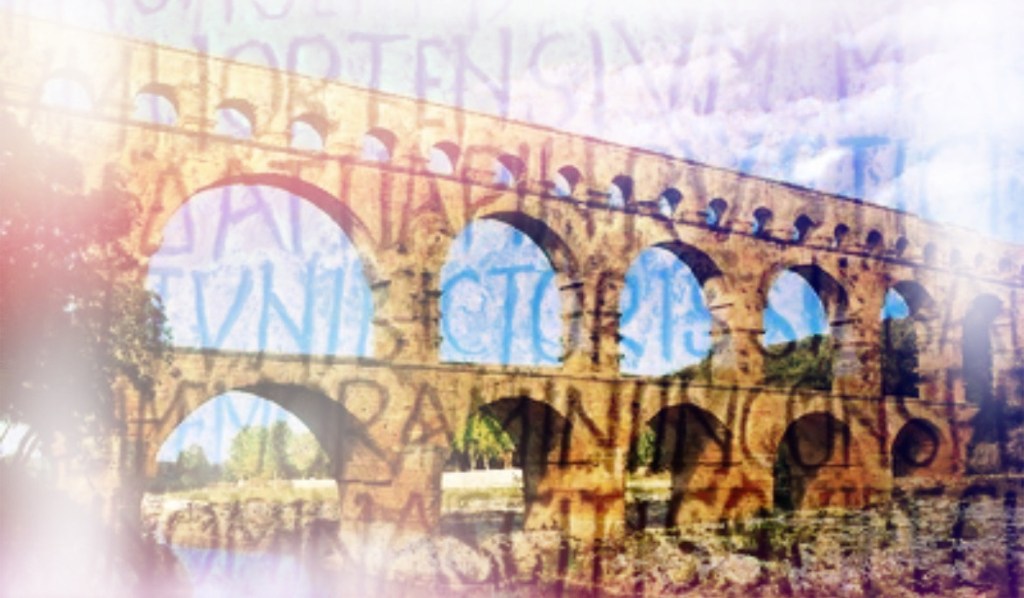
Back when the authentic “Latinophone” heart of the world was still alive and beating, hearing Latin being spoken was a magical experience. This is precisely how it enhanced the Romans’ capacity for living well. It provided endless sensorily pleasing stimulation that kept them safely snuggled up inside a heart-warming bubble of refinement, fulfilment and satisfaction. The nuances of Latin are like magical secret gardens. After all, Latin was the ancient tongue that gave birth to the whole notion of sensorily pleasing language, i.e. language that is especially, painstakingly ‘designed’ or ‘moulded’ specially to be pleasing to the visual and aural senses. The exquisiteness and preciousness of the Latin language originally served to unite its speakers in Ancient Rome. Once a child had picked up the language, they were thus duly sent on a lifelong intellectual linguistic quest to discover and learn to appreciate as many of the concealed delights and hidden treasures buried within the Latin language as their mental faculties -or lack thereof- allowed them to. The resultant richness and sophistication of Latin kept its speakers safe from -and their minds and souls untainted by- the Romans’ uncivilised, barbarous, uncouth enemies. It helped them spread their civilisation, too, by providing endless, fail-safe mental and intellectual back-up that turned the Romans into a truly indomitable people.



• The origins of Latin •
Latin was spoken far and wide in the Roman Empire, in due course developing into the modern Romance languages through varieties of spoken Latin from different parts of the empire. During the Middle Ages, and until relatively recently, Latin was the most widely used language in the West for scholarly and literary purposes. Its liturgical use was required by the Roman Catholic Church, the world’s largest church, until the latter part of the 20th century. It continues to be an official language of the microstate of the Vatican City and of the Holy See.
Latin emerged as a language that was spoken by small groups of people dwelling along the Tiber River. It would become the language of the Latium and Rome. It takes its name from the Latins / Latians / Latini, an Italic tribe who dwelled on a small triangle of fertile, volcanic soil located between the Tiber / Tiberis and the Circeian promontory / Mons Circeius, known as Old Latium / Latium vetus. When it emerged, Rome was just one of three great ancient civilisations of the Italian peninsula, the other two belonging to the Etruscans of Etruria and the Italiote Greeks of Magna Graecia / “Greater Greece”. There were numerous other peoples dwelling within the peninsula, moreover. The North was once inhabited by Celts; most of the rest of the peninsula was occupied by various Italic groups, although the non-Indo-European-speaking Etruscans occupied a large territory directly to the north of Rome. These peoples would come to be assimilated by Rome as it expanded.
Latin is an Italic language. The Italic languages are the “Refined” Tongues. The earliest known members of this family were spoken on the Italian peninsula in the 1st millennium BC. The modern Romance languages, including Italian, French, Spanish and Portuguese belong to the Italic family, as they are descended from Latin. They are the only Italic languages still spoken natively. Besides Latin, the known ancient Italic languages are:
- Faliscan
- Umbrian
- Oscan
- South Picene
Umbrian and Oscan are often considered as one, termed Osco-Umbrian. South Picene (also known Paleo-Sabellic, Mid-Adriatic or Eastern Italic) is not to be confused with North Picene, since the two languages don’t appear to be related despite sharing a name! Faliscan is the closest relative of Latin, both belonging to a Latino-Faliscan branch. Latin is the Language of Civilisation where Faliscan is the Language of Tradition. Faliscan was spoken by the Falisci people of ancient Italy, who supposedly called themselves the falesce and who joined the Etruscan League, the Etruscan civilisation having been the region’s highest before Rome – only to be subjugated and absorbed by the latter.
Words in Faliscan:
- foied vino pipafo, cra carefo • hodie vino bibam, cras carebo • ‘today I will drink wine; tomorrow I will not have any.’
- foied • hodie • today
- pretod de zenatuo sententiad • praetor de senatus sententia
- hileo • filius • son
The IV layers of Faliscan:
- cultivation, honing
- heart
- Faliscan-ness
- status
Beyond this, Latin is an Indo-European language – the Italic languages being commonly accepted as a branch of the Indo-European macrofamily. The Indo-European languages are the “Glorious” Tongues, allegedly originating in the Pontic-Caspian Steppe. This makes Latin related to other major languages of intellect and culture like Greek, and even English. It is more distantly related furthermore to languages spoken far to the east in Asia, including Farsi of Iran and Hindustani of India. I consider Latin, Greek and English to be Western Indo-European languages, a grouping which encompasses the Celtic, Germanic, Italic, Slavic, Hellenic, and Albanian branches of the Indo-European family. These are spoken by the discerning Indo-Europeans. I also think that the Indo-European languages belong to a wider (only ever so slightly wider -haha- since almost half the world’s population speaks an IE language!) “Nostratic” family, as I propose, also including the Uralic and Caucasian (Northwest, Northeast & South) languages, as well as small groups -mostly now extinct- including Tyrsenian (inc. Etruscan! – the “Extravagant” Tongues, with Etruscan buzzing about drama), Vasconic, and Hurro-Urartian. The Nostratic languages will be the “Transcendent” Tongues.
It has also been proposed -and I am inclined to corroborate this- that there is a common Italo-Celtic grouping, linking the Italic languages to the Celtic languages. Together they are the “Dignified” Tongues. The Italic languages are then of course the “Refined” Tongues and the Celtic languages are the “Intuitive” Tongues. Proto-Italo-Celtic probably originated from a sprachbund between Italic and Celtic people, and is estimated to have been spoken in the third or the second millennium BC somewhere in south-central Europe. It was the Language of Integrity.

Moreover, my proposed subgrouping of Western Indo-European aligns very closely with that of the centum languages. Indo-European languages are classified as centum or satem languages, according to how pronunciation of the dorsal consonants, which are articulated with the dorsum i.e. back of the tongue (“K”, “G”, “W” and “Y”), developed from Proto-Indo-European. An example of this division is indicated by the names of the groupings, which both mean “hundred” in Latin and Avestan, respectively. In centum languages like Latin, the words for “hundred” typically begin with a dorsal /k/ sound – Latin centum was indeed pronounced with an initial /k/, although it has been softened in the modern Romance languages. In satem languages, they often began with /s/. The living centum subfamilies are Italic, Slavic, Germanic, Celtic, and Hellenic.
The oldest existing example of Latin consists of a four-word inscription from the 7th century BC, in Greek characters, on a fibula or cloak pin. The fibula is known as the Praenestine fibula / Praeneste fibula / Fibula Praenestina / “brooch of Palestrina” and it read Manios med fhefhaked Numasioi “Manius made me for Numerius”.
• Types of Latin •
Latin can be divided into three foremost types: Ecclesiastical, Classical, and Vulgar. That is to say, Latinophonism came to be divided into three generic streams.
Ecclesiastical Latin refers to the styles employed by ecclesiastical writers and scholars starting from Late Antiquity. Also known as Church Latin, Liturgical Latin or Italianate Latin, it has never been spoken as a native language. The use of Latin in the Church started in the late fourth century, following the split of the Roman Empire in 395. Emperor Theodosius the Great (r. 379-395) was the last emperor to rule over the entire Roman Empire before it split between East and West. He also oversaw great success in a key war against the Goths, in two civil wars, as well as in playing an instrumental role in establishing the Christian orthodoxy. Before this split, Greek was the primary language of the Church as well as the language of the eastern half of the Roman Empire. This type of Latin was ininitially cultivated to discuss Christian thought and later adopted as a lingua franca by the upper class of Europe from the Medieval period through early modern.
Classical Latin was a standardised form of Latin used by educated elites from the late Roman Republic. It arose out of the standardisation of Old Latin / prīsca Latīnitās / prisca Latinitas / ‘ancient Latinity’, the earliest known form of Latin, becoming the literary standard. It was actively used from 75BC to the 3rd century AD, developing hence into Late Latin / Latinitas serior, used as the written language from the 3rd century. Good or proper Latin would come to be aligned generally with the scope of Classical Latin. Other versions were viewed as unsavoury, debased, degenerate, vulgar, corrupted.
Old Latin was originally used by the Latins of Latium, and then in due course by the Romans in the founding Roman Kingdom / Regnum Romanum (c. 753 BC–509 BC) and the Roman Republic / Rēs pūblica Rōmāna (c. 509 BC–27 BC). Old/Early/Archaic Latin is believed by some to be directly descended from a common Proto-Italic language, while others postulate the specific distinction of the Latino-Faliscan branch from its sibling Osco-Umbrian – thereby implying that there would have been a distinct Proto-Latino-Faliscan dialect or language and thus distancing Latin from Proto-Italic. Otherwise, in accordance with the former stance, it is suggested that the four sub-branches of Latino-Faliscan, Latin, Faliscan, Lanuvian, and Praenestinian, are all merely Latinate dialects – which have branched out of Latin, supposedly an immediate descendant of Proto-Italic, the Language of Cultivation. Old Latin is believed to have placed stress on the first syllable of a word until 250BC, whereas later varieties of Latin would place it on the penultimate syllables. Old Latin is understood to have conserved quite faithfully some noteworthy aspects of Proto-Indo-European, the Language of Glorification and the common ancestor of all the Indo-European languages, in particular certain cases and phonological patterns.
Late Latin, the cultivated Latin of late antiquity, was formed from a mix of Classical and Vulgar Latin. Its flourishing Vulgar dialects would develop into the modern Romance languages in the 6th to 9th centuries. This was when the development of Latinophonism, Latinity, and Romanescence would diverge into two paths. The Vulgar stream would further develop on the basis of local spoken forms, to evolve into the Romance languages. The centralised standardisation of Latin, meanwhile, would continue throughout the Middle Ages with Latin as the language of religion and scholarship.
Vulgar Latin refers to what was originally the colloquial form of the language spoken among commoners. Towards the end of the first millennium, the different varieties of Vulgar Latin spoken across the different provinces of the Roman Empire would give rise to the modern Romance languages. Modern Italian would be derived from the Florentine variety of Italo-Romance; French from Northern Gaulish Gallo-Romance, and Spanish and Portuguese from Ibero-Romance, etc. There was at first supposedly no distinction between Latin and the Romance vernacular. This, however, does not account for some things…
For example, Latin did not make use of articles, definite or indefinite. The modern Romance languages of today, however, make heavy use of them – especially definite articles. We have il/la 🇮🇹 le/la 🇫🇷 el/la 🇪🇸 o/a 🇵🇹 etc. in Western Romance languages which are used considerably more intensively than English the. The Western Romance languages (all except Romanian, pretty much) also have all lost Latin’s case system. How do they all have these things in common, if they all developed directly and separately out of the same alleged form of Latin? Wouldn’t Vulgar Latin have differed between the provinces? Was there rather a distinct separate Vulgar Latin language with concrete distinct prescribed norms that people adhered to? Curious. Anyway, the attested samples of Vulgar Latin we have access to do feature articles. The coordination was probably otherwise thanks to correspondence, since the Romans were such adept communicators, and such specific waves of differentiation were probably sent around, like trends across the empire. Cases in Vulgar Latin would be lost through vowel shifts which caused several case endings to merge. By the 5th century, the number of case contrasts had been drastically reduced… Regardless, compare…
- English: She always closes the window before she dines. / She always closes the window before dining.
- Latin: (Ea) semper antequam cenat fenestram claudit.
- Vulgar Latin: Illa/ipsa claudit semper illa fenestra antequa de cenare. / Late Latin: Illa/ipsa serrat semper illa fenestra antequa de cenare. / In Italy: Illa/ipsa claudit semper illa fenestra prima de cenare.
- Catalan: (Ella) sempre tanca la finestra abans de sopar.
- French: Elle ferme toujours la fenêtre avant de dîner/souper.
- Italian: (Ella/lei) chiude (archaic: serra) sempre la finestra prima (archaic: avanti) di cenare.
- Portuguese: (Ela) sempre fecha a janela antes de jantar.
- Romanian: Ea închide întotdeauna fereastra înainte de a cina.
- Romansh: Ella clauda/serra adina la fanestra avant ch’ella tschainia.
- Sardinian: (S) Issa serrat semp(i)ri sa bentana in antis de cenai. / (N) Issa serrat semper sa bentana in antis de chenàre.
- Spanish: (Ella) siempre cierra la ventana antes de cenar/comer.
- Venetian: Eła ła sara/sera senpre ła fenestra vanti de diznar.
- Walloon: Èle sere todi l’fignèsse divant d’soper.
Cicero (Marcus Tullius Cicero), the Roman statesman, lawyer, scholar, and writer, along with his contemporaries of the late republic referred to the Latin language as lingua latina or sermo latinus. The common vernacular was distinguished as sermo vulgaris or sermo vulgi. This was in contrast to the higher register, which garnered much enthusiasm and zeal with regard to its standardisation, known as latinitas “Latinity”. Latinitas was also called sermo familiaris(“speech of the good families”), sermo urbanus(“speech of the city”), and in rare cases sermo nobilis (“noble speech”). We also had the terms latine (adverb for “in good Latin”), or latinius (comparative adverb for “in better Latin”).
• My precious!

Being a native Latin-speaker was difficult. Using it properly was taxing and strenuous, which is why Vulgar Latin dialects became widespread alongside it, giving rise to the Romance languages that are spoken today. That said, it was used as an everyday native language by some, for some time, at least, even though it was such brutally hard work. How? It was also highly pleasurable to use, thanks to its beauty and fruitful, fulfilling, satisfying richness. Latin-speakers savoured their tongue. They concordantly took pleasure in its maintenance so devoutly that lucrative traditions of productivity, luxury, elitism, and even culinary arts would be born from the passion within the wider Romance world. So intense was their esteem of it that only the most sublime of outlets would suffice. The supremacy of the Latin language is reflected by its Buzz-Concepts:
The IV layers of Latin / LATINVM / LINGVA LATINA:
- eximietas • excellency
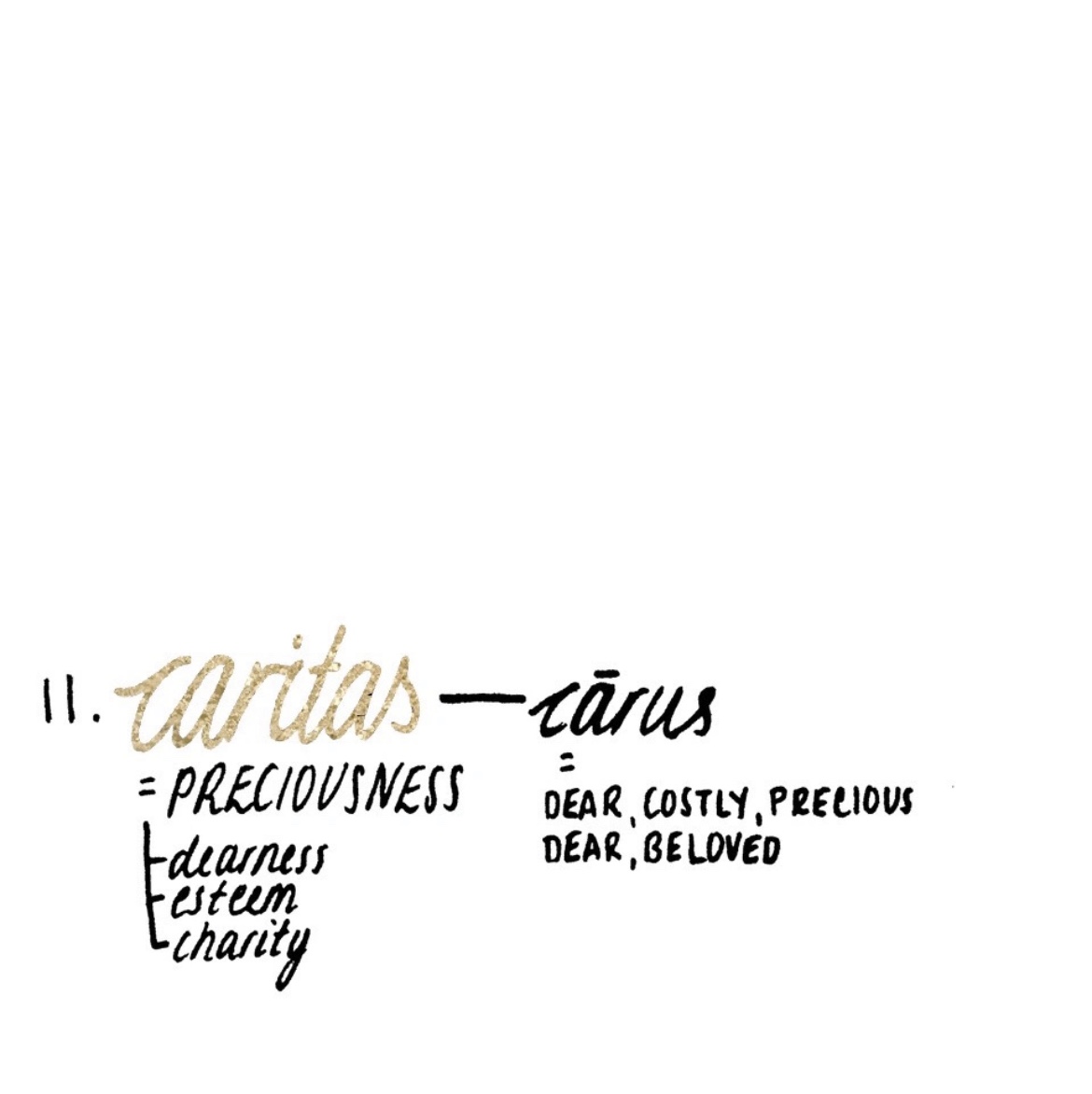
- caritas • esteem
- Romanitas
- voluptas • pleasure

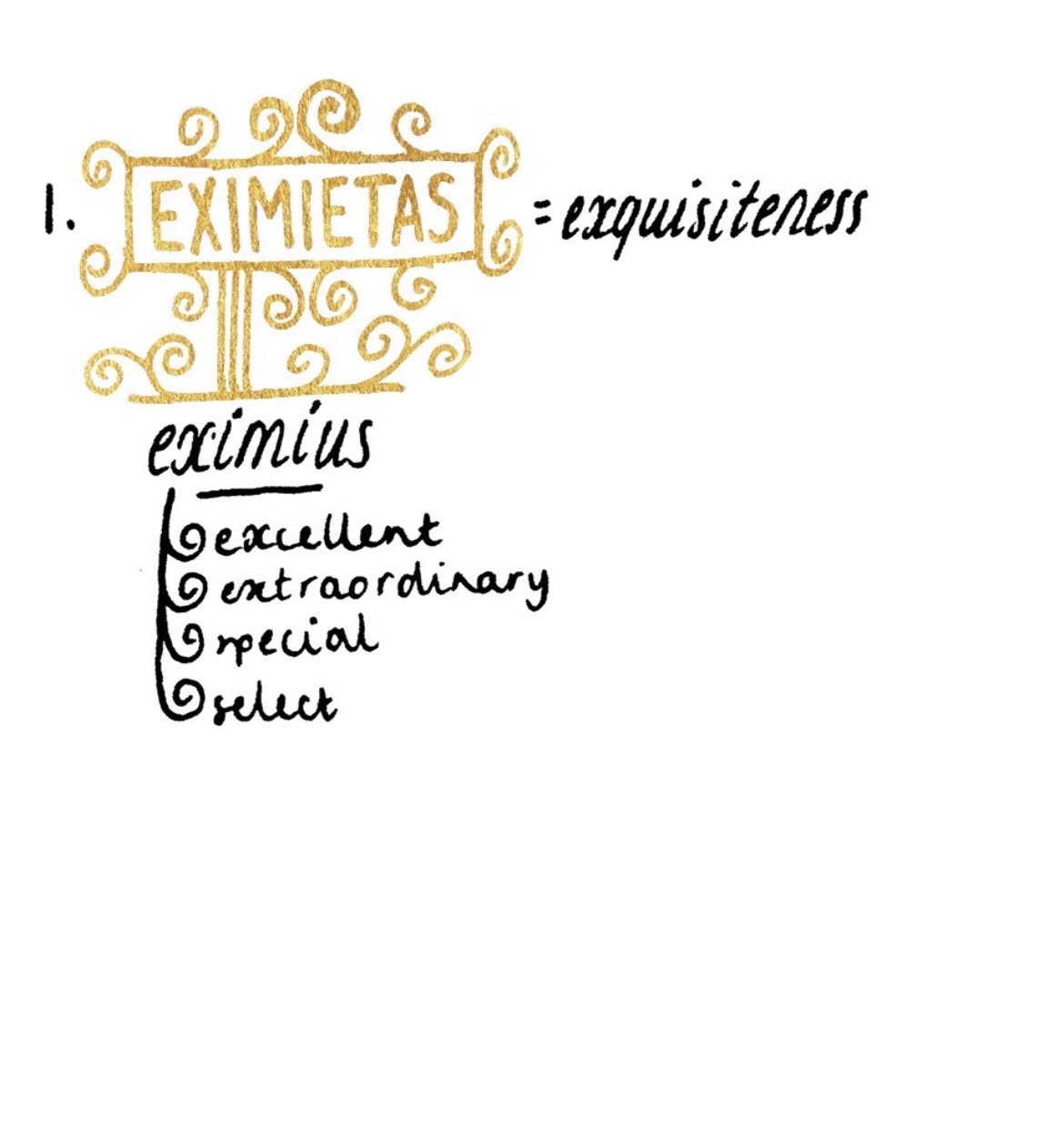


Latinophone supremacy –excellency, even- drove people insane. It was so wonderful but so difficult to maintain. Nothing was ever enough to satisfy Mercury / Mercurius, the Roman god of eloquence among other things. Of course, they had nothing less than the whole world to gain from their linguistic exploits – and the role of the Latin language was a key factor in the Romans’ ability to extend the boundaries of their empire so far and wide, from the western extremities of Europe to Asia. It endowed them with indomitable reserve, giving their armies a huge psychological advantage in battle and strategy. Their world revolved cyclically around their magnificent prestigious language; they say all roads lead to Rome, meaning that all methods of succeeding at something will achieve the same result of success in the end – all roads lead to Rome, and all of Rome revolved around Latin. When they fought wars, it was ultimately out of principle about the supremacy of Latin.
Latinophonism was big business, you might say. In a bleak ancient world, Latin was in reality the main source of beauty within Rome and elsewhere. Its beauty was so intensely felt that even the most adept of Roman poets couldn’t intellectualise it, having an effect much like how looking at the sun is unpleasant and overwhelming. It occupied the position in people’s worlds that material economic wealth now does in ours. Such was the value of the Latin lexicon, that its secondary Buzz-Concept caritas (the Second Layer of human language being that which governs emotionality, or interpersonal relations in the ultra-refined Romans’ case) gave rise to different meanings, including both “costliness”/“high price” and “charity” – radiant fulfilment instead of materialistic satisfaction.
- cāritās (f.) …
- from cārus (“dear, expensive”) + –tās
- dearness 💝
- costliness, high price 💎
- charity, the attitude of kindness and understanding towards others 🤗
- regard, esteem, affection, love 💗
- lack of something, deficiency
- The etymology of caritas may be linked to the Greek kara “head” —perhaps through a Proto-Indo-European root, or through Proto-Italic *kāros “dear”— which was one of ancient Greeks’ favorite endearments, the same way we use terms like “sweetheart”.
- …keep your head…!
People could express kindness and be charitable to others with their Latinophone reserve in ancient Rome, material wealth aside. The preciousness (and excellency) of Latin encompasses so much more than its superficial beauty. It once had worth and weight akin to economic value.
Words in Latin:
- salvē ~ hello (to one person)
- salvēte ~ hello (to more than one person)
- havē ~ greetings (1)
- havēte ~ greetings (2+)
- valē ~ goodbye (1)
- valēte ~ goodbye (2+)
- cūrā ut valeās ~ take care
- exoptātus / optātus / grātus / acceptus ~ welcome (to male)
- exoptāta / optāta / grāta / accepta ~ welcome (to female)
- Quōmodo valēs? ~ How are you?
- Ut válēs? ~ How are you?
- bene ~ good
- Bene valeō. ~ I’m fine.
- male ~ bad
- Male valeō. ~ I’m bad.
- quaesō ~ please
- amābō tē ~ please
- ita / ita est / ita vērō / sī / sīc est / etiam ~ yes
- nōn / minimē ~ no
- grātiās tibi ~ thank you
- grātiās tibi agō ~ I give thanks to you
- magnās grātiās / magnās grātiās agō ~ many thanks
- maximās grātiās / maximās grātiās agō / ingentēs grātiās agō ~ thank you very much
- accipe sīs ~ you’re welcome (1)
- accipite sītis ~ you’re welcome (2+)
- libenter ~ you’re welcome
- Quā aetāte es? ~ How old are you?
- 25 (vīgintī quīnque) annōs nātus sum ~ I am 25 years old (male)
- 25 annōs nāta sum ~ I am 25 years old (female)
- Ubi lātrīna est? ~ Where is the toilet?
- Scīs (tū) … Latinē / Graecē / Anglicē? ~ Do you speak (literally: “do you know”) … Latin / Greek / English?
- Theodiscē? / Germānicē? / Teutonicē? ~ German?
- Gallo-romanicē? ~ French?
- Russicē? / Ruthēnicē? ~ Russian?
- Hispānicē? / Castellanicē? ~ Spanish?
- Lūsītānē? ~ Portuguese?
- Dāco-rōmānice? ~ Romanian?
- Cambricē? ~ Welsh?
- amō tē / tē amō ~ I love you
- ūnus, ūna, ūnum ~ I ~ one (masculine, feminine, neuter)
- duo, duae, duo ~ II ~ two (m., f., n.)
- trēs, tria ~ III ~ three (m./f., n.)
- quattuor ~ IV ~ four
- quīnque ~ V ~ five
- sex ~ VI ~ six
- septem ~ VII ~ seven
- octō ~ VIII ~ eight
- novem ~ IX ~ nine
- decem ~ X ~ ten
- quīnquāgintā ~ L ~ fifty
- centum ~ C ~ one hundred
- quīngentī, quīngentae, quīngenta ~ D ~ five hundred (m., f., n.)
- mīlle ~ M ~ one thousand
• The Language of… •
French is the Language of Love. Well, really it’s the the Language of Adoration. Yet it’s also the Language of Study. Yep. And Latin is the Language of Civilisation. And the Language of Wonders. The term civilisation doesn’t have a direct translation in Latin, even though its etymological root is Latin, from civilis “civil” – related to civis “citizen” and civitas “city”. The concept, or institution, of civilisation was still evolving when Latin was spoken, so a specific name was yet to be assigned. Regardless, we can designate Latin as LINGVA CIVILITATIS…
- lingua means “tongue” and “language”
- cīvīlitātis is the genitive (singular) form of the feminine noun cīvīlitās
- cīvīlitās has three translations: (1) politics, the art/practice of government; (2) courteousness, politeness; (3) civility, moderation, restraint
French / français / «la Belle Langue»…
- «la langue de l’amour», «la langue de l’adoration»
- «la langue des études» = the Language of Study (on the flip-side)
- «la langue de l’encadrement» ~ l’encadrement = management, frame, framework (don’t worry – your ancestors have got u)
They knew.
Italian / italiano…
- la lingua del piacere the Language of Pleasure
- la lingua delle lettere the Language of Letters
- la lingua della cultura the Language of Culture
Latin / latīnum / lingua latīna / LINGVA CIVILITATIS…
- LINGVA MIRABILIS = the Language of Wonders (literally: “the wonderful language”
- LINGVA CIVILITATIS = the Language of Civilisation
- LINGVA OPERARUM = the Language of Opera/Oeuvre
Yes, the founding subliminal ideology behind the Latin language was that it was to be the Language of Wonders and the Language of Civilisation on the ~transcendent quintessentially Nostratic~ flip-side. Latin can additionally be understood as “the Language of Oeuvre”, in the sense not necessarily of a work of art, music or literature but really of ~marvellous technique~, which normally does get applied to the aforementioned pursuits, yes – Greek being the Language of Technique, and the Romans having borrowed a lot from the Ancient Greeks.

• On to the lectitecture •
I have mentioned before that Italians can be said to construct amazing architecture with their brand of “Latinity” as they communicate in Italian (i.e. in “Italo-Romance”). It’s a nice metaphor, no? The ancestral language of Italian, Latin, also had architectural dimensions – which were more ingenious still, would you believe it? As I indicated above, the Romans attached great esteem to their Latin tongue. Catholic discipline casts echoes of what was once Latinophone discipline, with haunting effects. The nuances of Latin were inherently magnificent: the marvellous structures of the language as well as the richly refined, poetic significations generated a colossal degree of prestige that remains attached to Latinity and “Romanescence” to this day.
The legacy of Latinophone supremacy has brought us so much beyond its time, including the Baroque era, and it is easy to get carried away with these splendid marvels. But the Romans would have been abhorred by such lavishness, devoutly committed as they were to nobler elemental pleasures like composing phrases in their beloved Latin tongue. Great care and heed were taken in composing Latin utterances, from simple phrases to literature. It was a discipline. So much so that speakers became ultra-organised thinkers. Being an eloquent Latin-speaker was an all-consuming pursuit, and Roman intellectuals had to become machines to make space for life, other activity, and pleasure. Latinophonism was life and life was complementary to Latinophonism. People lived to communicate well in Latin – well, this was certainly the case for intellectuals, not necessarily for underlings. They switched that up for themselves, and it was hard to maintain balance; the ecosystem became imbalanced and began to fail because of Germanic antagonism and that is partly how mighty Western Rome weakened and fell in the 5th century.
Latin-speakers really dynamically constructed their utterances. They were very present throughout the related processes. The importance of grammar was wholeheartedly respected and embraced. Eloquence was fiercely idealised. They believed so strongly in the power of their culture and language that they left routes of access. For those who couldn’t access its loftiest heights, Latin was alternatively romanticised for its fluidity – of expression, of meaning, of sociolinguistic function, etc. Everybody really loved that aspect of Latin. Fluency became an increasingly big deal over the ancient Romans’ exploits. Much of the effervescence would eventually settle into the form of the modern Italian language, derived from the medieval Florentine dialect of Romance, which is exalted for its flowing musical beauty.
The Romance love of fluency is reflected in the heavy use of the letter V. The letters u and v were interchangeable in Latin, represented with the same Roman letter v. The Latin v represented the phonemes [u] and [w]. For example, num was traditionally spelled NVM, and VIA was pronounced as [ˈwia]. The fluency of Latin palpably contrasts its strict architectural structure. Alternatively, the two qualities complement and equilibrate each other. The letter v evocatively acts as a hinge for both. Its heavy use in Latin fosters a tangible sense of fluency. Can you feel it? …
- LATINVM, latinum, L~A~T~I~N~V~M, [laˈtiːnʊ̃] – the nasal vowel [ʊ̃] really gives fluidity and therefore fluency. It is written with an m (as are all singular masculine nouns in the nominative case) to solidly concretise the abstract noun, concretely marking it out within all the ~fluidity!
- LINGVA LATINA, lingua latina, [ˈlɪŋɡʷa laˈtiːna]
- AQVA, aqua, water
- VBI, ubi, where
- CVM LAVDE, cum laude, with honour
- E PLVRIBVS VNVM, e pluribus unum, out of many, one
- LVX BRVMALIS, lux brumalis, the light of winter
- NVMERVS, numerus, number
- AVRORA, aurora, dawn
- CREPVSCVLVM, crepusculum, twilight
- IN PERPETVVM ET VNVM DIEM, in perpetuum et unum diem, forever and one day
- VMBRA, umbra, shadow
- EQVVS, equus, horse
- FLVVIVS, fluvius, river
A nice example to ease us in, because Latin is actually your friend!
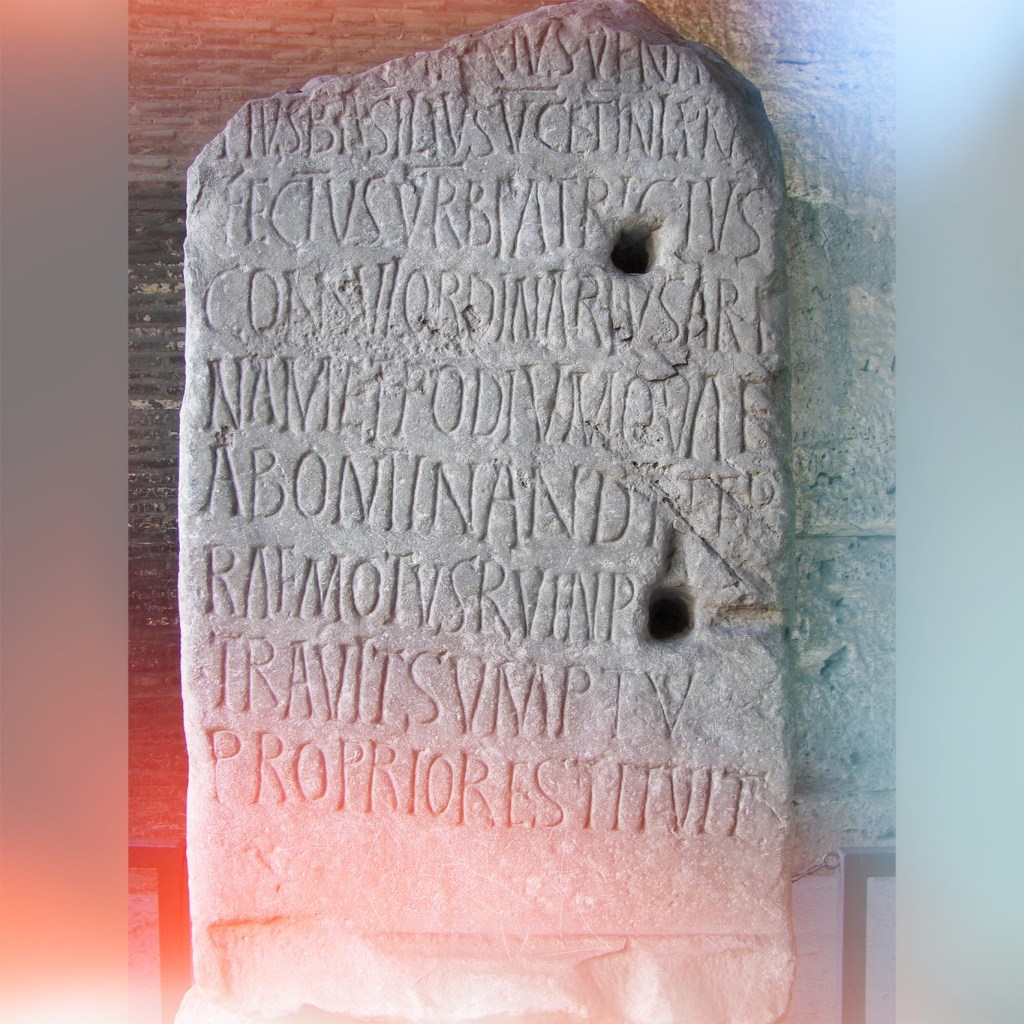
Latin is a supremely sophisticated language. It is concordantly a highly inflected language. Inflected languages are also termed fusional languages. They are a type of synthetic language, as opposed to analytic or isolating like English. In English we go by word; in synthetic language they go by construction. Another type of synthetic language is the agglutinating language, in which morphemes are consistently agglutinated. In synthetic languages, words are heavily modified to denote rich grammatical, syntactic, or semantic features. Broadly speaking, in inflectional synthetic languages a single (inflectional) morpheme is used for each word, and more (inflected) words are used as in analytic languages, whereas in agglutinating languages multiple morphemes are often used within one word to diversify meaning. Some random examples of agglutination are: evlerinizden “from your houses” (Turkish); nakakapágpabagabag “that which is upsetting/disturbing” (Tagalog); tabetakunakatta 食べたくなかった “I/he/she/they did not want to eat” (Japanese); Muvaffakiyetsizleştiricileştiriveremeyebileceklerimizdenmişsinizcesine “as if you were of those we would not be able to turn into a maker of unsuccessful ones” (Turkish – yes, one word!); ataippaṇṇamuṭiyātavarkaḷukkāka அதைப்பண்ணமுடியாதவர்களுக்காக “for the sake of those who cannot do that” (Tamil).
Latin is highly inflected yet delicately, daintily, diplomatically synthetic. It has three distinct genders, six/seven noun cases, five sets of declensions, four verb conjugation classes, six tenses, three persons, three moods, two voices, two or three aspects, and two numbers.
- 3 genders: nouns can be feminine, masculine or neuter
- 6/7 cases: Latin of the Classical period regularly made use of six cases: nominative, vocative, genitive, dative, accusative, ablative. Nouns and adjectives were declined (modified) in these cases. There were also traces of a locative case.
- 5 declensions: five sets of patterns by which a noun is declined
- 4 verb conjugations: 1st / –āre / amāre, to love; 2nd / –ēre / monēre, to advise; 3rd / –ĕre / regĕre, to rule; 4th / –īre / audīre, to hear
- 6 tenses: present, past, future I, perfect, pluperfect and anterior future (future II).
- 3 persons: first, second, third
- 3 moods: indicative, imperative, subjunctive
- 2 voices: active and passive
- 3 aspects: simple (without any explicit aspectual modification: “she sat”, “you run”, “we will stay”); perfect (presented as a completed action: “we will have finished the job”, “I have finished the job”, “you had completed the job yesterday”), and imperfect (action explicitly incomplete or “in process”: “you will be crying in your beer and cursing your fate some day”, “he is running down the street”, “she was coming into town when they stopped her.”).
- 2 numbers: singular and plural
There is definite parallel with architecture in the strategy for constructing phrases in synthetic languages. Latin is perhaps the best example of this, better than any of the scariest, most magnificent, most heavily agglutinating beasts.
Take the following quote:
Atrox melior dulcissima veritas mendaciis. = The bitter truth is better than the sweetest lies.
atrox = terrible, plain nominative masculine adjective
melior = better, a comparative adjective conveying superiority
dulcis = sweet, here as the superlative form dulcissima, meaning “sweetest”
veritas = truth, feminine noun – nominative case
mendacium = lie, neuter noun becoming mendaciis in the dative plural
Put them together in the order they read and we have “Bitter better sweetest truth to lies”… Now that does not make any sense at all in English! At all! So how does it work in Latin?
Well, in Latin the relationships between the different words (bitter—truth; sweetest—lies; truth>lies) are denoted by inflection and not necessarily by word order. A Latin speaker would know the adjective atrox to be paired with veritas, to mean “bitter truth”, from the nominative singular declension. One can see that the superlative adjective dulcissimus (sweetest; very sweet) is in its neuter dative plural form dulcissima, linking it to the neuter dative plural noun mendaciis.The placement of melior (“bitter -better- sweetest” ?!) may seem nonsensical, but Latin speakers didn’t need word order to convey meaning effectivelin constructions like this, that task being completely fulfilled by inflection instead. The dative form mendaciis features as it is the object of the comparison, instead of using a conjunction like “than”. The saying is very poetic, although much less so in English as the dramatic synthetic architectural structure of course cannot be transferred.
• In conclusion… •
Finitione, Latin is an all but dead language nowadays, but one that continues to be widely studied and appreciated for very good reason. We derive our alphabet, the Roman alphabet, from the ancient writing system used by the Romans to inscribe Latin, which the Romans in turn derived from the Etruscan alphabet, who derived theirs from the Greeks. The Greek alphabet was itself descended from the Phoenician alphabet or abjad, used to write Early Iron Age Canaanite Semitic languages including Phoenician, Hebrew and Old Aramaic. The Phoenician alphabet, for its part, was originally based loosely around Egyptian hieroglyphics. World heritage is always relevant… The English language, moreover, derives a large portion of its lexicon from Latin, further perpetuating the cycles of classical relevance. The Roman cultural legacy has been so substantial that its weight will always register. But perhaps we should be paying even more attention to the intricacies to be uncovered within it, since no degree of technological innovation can ever undermine the Romans’ ingeniousness, like Latin’s mighty “lect-itecture”!
 The Buzz-Concept Project