Biloxi is the name of a city in Mississippi, nicknamed “The Playground of the South” or Buck City”. Settled by French colonists in 1699, it took its name from a transliteration of their term for the local Native American tribe, Bilocci. It also refers to the Biloxi tribe of Louisiana and historically Mississippi. It was in 1699 that the Biloxi were first encountered by Europeans, near to what is now Biloxi, Mississippi – on the Gulf of Mexico. They would then be shifted westwards into Louisiana and the eastern extremities of Texas. The Biloxi called themselves by the autonym Tanêks, Tanêksa. Other listed variants of the name appear as Taněks / Taněks anya / Taněks anyadi / Taněks hayandi. The Biloxi language, Tanêksąyaa ade, has been extinct since the 1930s, when the last known native bilingual speaker, Emma Jackson, died. The Biloxi have been merged with the Tunica since the 19th century, as well as with other remnant groups. They call themselves the Tunica-Biloxi Indian Tribe and were federally recognised in 1981. These days they number fewer than 1,000 and share a small reservation in Avoyelles Parish, Louisiana. Some Tunica-Biloxi elders also speak French.
The Biloxi have since merged with the Tunica tribe and others. Since the early 19th century, the Biloxi have intermarried with the Tunica tribe. The Biloxi are Siouan-speaking. The Tunica language is an isolate. Since 1981 they have been federally recognised and they now call themselves the Tunica-Biloxi Indian Tribe. They also merged with other “remnant” peoples from other small tribes from the area. The Tunica language is classified as an isolate, while Biloxi is identified as a Siouan language.
The Siouan languages, also the Siouan-Catawban languages, are mostly spoken further north in the Great Plains, Ohio and Mississippi valleys. Siouan-speaking pockets could also historically be found in southeastern North America, namely the Biloxi on the Gulf of Mexico and the Catawban languages in the Carolinas.
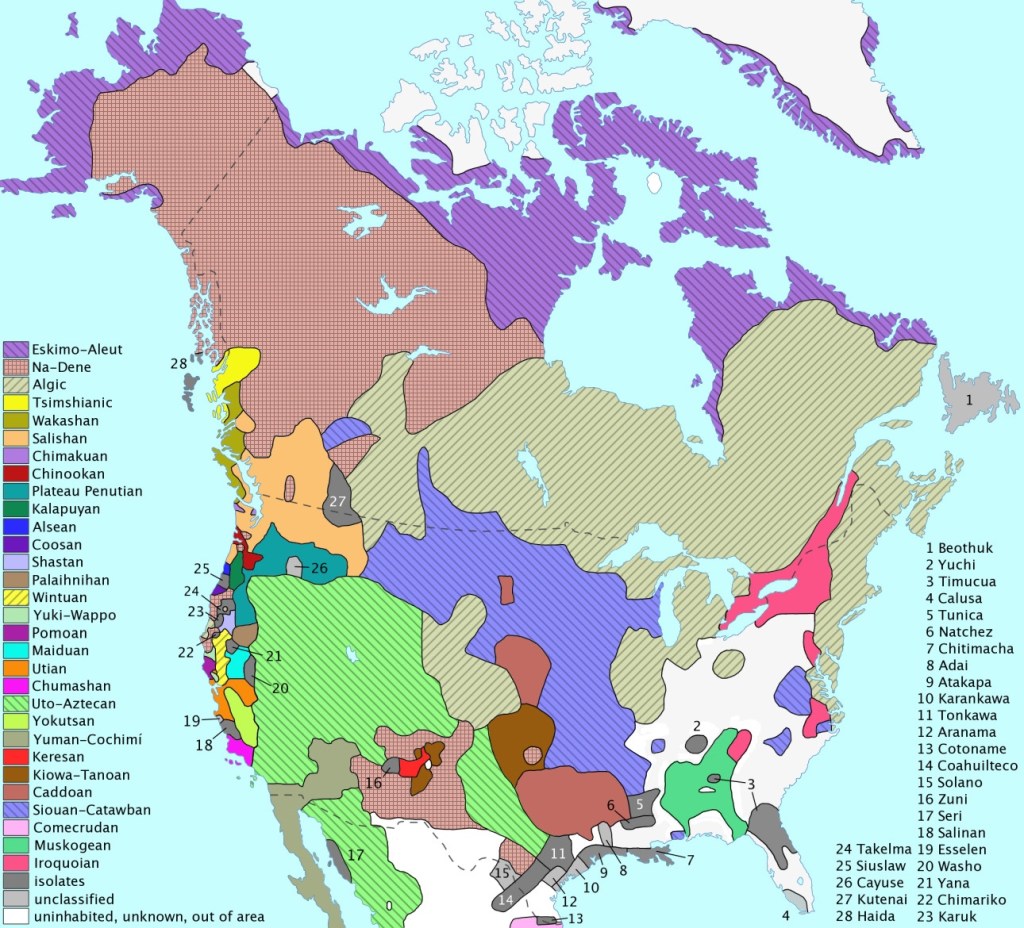


The Siouan languages are classified by me here on the Buzz-Concept Project as Amerindian languages, belonging to a wider family consisting of all the indigenous language families of the Americas. Within this, they are North Amerindian languages. Beyond it, they are “Orientalesque” languages, the Amerindian languages constituting a branch of a primary family also encompassing Chinese, Japanese, Mongolian, and others spoken in East Asia. The “Orientalesque” family is more than 30,000 years old.
The “Orientalesque” languages are the “Conceptual-Abstract” Tongues… the Amerindian languages are the “Boundless” Tongues… the Northern Amerindian languages are the “Absolute” Tongues (versus the Southern Amerindian languages which are the “Almighty” Tongues, from Uto-Aztecan & down FYI)… the Siouan-Catawban languages are the “Inferential” Tongues.
Words in Biloxi:
- apadenska butterfly
- koniška bottle
- xiye butterfly
- iñkxwi, ikxwe, ikxwi, kxwi always
- nḳa’tamĭni iñkxwi [nḳahtahminnie eekkhwee] I always work — ḳ = a medial sound between g and k
- ata’mĭni iñkxwi’ [ahtahminnie eekkhwee] he always works — kh as in loch, German ach

- hai blood
- ai yaⁿ the blood
- hiptshûⁿ’ haidi’na your nose bleeds — û = oo as in foot

- tŭpi’, tŭwi’ = bucket, pail
- tŭpi’ nitani’ = large bucket

- kŭdĕska = (a) bird — ŭ = u as in but; ĕ as in get
- kŭdĕski’ yukpĕ’ = the legs of a bird
- kŭdĕsk axe’ = the wings of a bird
- Kûdûpi’ saⁿhiⁿ’yaⁿ kŭdĕska’ o’di! Shoot at the bird on the other side of the ditch!
- natshi, natši, natci spirit
- natci’, natciyaⁿ’ a cloud; clouds
- natci’ tohi “blue cloud” the clear sky
- natci’ xwŭhi “low cloud” the horizon
- Natciyaⁿ’ ndoⁿhi’. I see (saw) the (a) cloud(s).
- anatci’ a ghost; shade; spirit
- xi chief
- aⁿ’ya xi chief
- xi supernaturally mysterious
- xi’di strange
- xiya’ bad (cunning)
- ta xi’di / taxi supernatural deer
- axi’hinya’ dande’ I will shut you up, diet you, and give you medicine in order to give you power
- xi / xidi’ a chief, governor, doctor, a lawyer
- o, odi (a) fish

- o’ ue’di to boil fish
- o’ nḳue’di I boiled (the) fish
- o’ i’ua da’nde will you boil the fish?
- o’ kueni’ not to boil fish
- o’ kūk de’di to go fishing
- poxono snail

- oⁿ = to do, make, use; past time, long ago; with, by means of; to use, wear
- ǫǫ, oⁿ = to do, to make, to use
- Tanĕ’ks haⁿyadi’ ade’ yoⁿ hiya’ñḳuka’dĕ ḳaⁿ’ psde’hi ma’ñḳdȼĕ panaⁿ’ ayindi’ta dande’ If you talk to me in the Biloxi language, all these (horizontal) knives shall be yours
- tcĭdiḳĕ’ ĕṭi’ḳayoⁿ’ Why do you do that?
- Cidike?, Tcĭdiḳĕ’, Tcĭdiḳi, Kawakehi? How?
- yohoyoⁿni to dream
- ayo’hoyoⁿni to dream about her/him/it
- ñḳ, nkindi, nḳi’ndi I, me

- yandi a heart, to think
- hiⁿya’ndihiⁿ I think of you

- ade to burn, to blaze, a blaze
- ayaⁿ’ adĕ’ wo? ayaⁿ’ adĕ? Does the wood burn?

- soⁿsa 1
- noⁿpa 2
- da’ni 3

- tacǫǫ eye
- he ha, bašu hello
Biloxi is the Language of Endeavour. It buzzes about infinity, which is the general Amerindian Buzz-Concept. All Amerindian languages buzz about infinity or a spin-off concept like omnipotence. It works by stimulating the mind endlessly and enhancing sensory and neurological function. It is the world’s most supreme Buzz-Concept, massively heightening one’s capacity to amass and make the most of human experience. It is at its most potent, in fact, when spirituality is in the mix, since the transcendent role of spirituality accounts for any gaps in logic. Modern European Americans have learnt a lot from their indigenous counterparts, and Native American culture plays a role more important that we could have imagined in the world, mostly through the power of the Buzz-Concept infinity. This degree of technological advancement, for example, is only possible thanks to insight we have gained through the Buzz-Concept infinity. It stretches the limits of the human mind to maximum potential. How can words be infinite? Is human language infinite? I do think the scope and power of language are pretty much boundless. I am not spiritual, but for spiritual people they definitely are. Language and words are totally abstract and fluid things for indigenous Americans, the whole shebang thus being of infinite scope to them. They don’t rely much on the concrete, not giving themselves much solid backing to lean on, and instead embrace abstraction and fluid experience, making the use of language traditionally a very dynamic experience -often tortuously so- that necessitates a lot of exertion. This is how the Buzz-Concept infinity works. Indeed, because of the aforementioned phenomena, every single Native American language is technically a language of intellect. Amerindians are fiercely astute and perceptive. Blocking them off from these hereditary traits is what racism against them ultimately entails. Letting it flow is how not to offend them. The Biloxi language was remarkable in that it did revolve purely around the experience of the world itself, and the Biloxi were obsessed with direction.

The Biloxi give the impression of having been quite intrepid types, no? Well, the Siouan peoples are the hyper-sturdy Amerindians, and THE communicators of the Amerindio-sphere.


Other Siouan-Catawban languages are:
- Crow | Apsáalooke “children of the raven”, Apsáalooke aliláau • of southeastern Montana
- Hidatsa | hiraaciré’ — the Hidatsa’s autonym is hiraacá, which according to tribal tradition perhaps derives from the word “willow” • of the Dakotas
- Mandan* | Nų́ų́ʔetaa íroo — autonym Nueta (Nų́ʔetaa) meaning “ourselves, our people”, previously Numakaki (Nųmą́khų́·ki) (or Rųwą́ʔka·ki) (“many men, people”) • North Dakota
- The Dakotan languages, including Assiniboine (Nakota), Stoney (Nakoda), and Dakota-Lakota (Sioux).
- Kansa* | Káⁿza — the tribe’s name (natively kką:ze) is often said to mean “people of the (south) wind” – however this probably wasn’t the term’s original meaning • Kansas, Oklahoma
- Omaha-Ponca | spoken by the Omaha (Umoⁿhoⁿ “up-stream people”) people of Nebraska and the Ponca (Paⁿka “Those Who Lead”) people of Oklahoma and Nebraska
- Osage | 𐓏𐒰𐓓𐒰𐓓𐒷 𐒻𐒷, Wažáže ie — the Osage people refer to themselves as 𐓏𐓘𐓻𐓘𐓻𐓟 (Wazhazhe), or “Mid-waters” • Oklahoma
- Quapaw (Alkansea, Arkansas, Ogahpah, Kwapa)* | O-gah-pah — the tribe’s proper autonym being Ugahxpa / Ugakhpa “down-stream people” • originally from Arkansas, now spoken in Oklahoma
- Chiwere (Iowa-Otoe-Missouria)* | Báxoje-Jíwere-Ñútˀachi, in Iowa Báxoje ich’é or Bah Kho Je; in Otoe-Missouria Jíwere ich’é. The name “Chiwere” is said to originate from a person meeting a stranger in the dark. A common folk etymology of Báxoje is “dusty noses,” although the Iowa tribe says Bah-Kho-Je means “grey snow,” since in winter their lodges are covered with snow grey from fire smoke. • Great Lakes, Midwest, Great Plains, Oklahoma, Missouri, Kansas
- Ho-Chunk (Winnebago) | Hoocąk, Hocąk, Hoocą́k hoit’éra • Ho-Chunk (or Hoocạk), variously translated as “sacred voice” or “People of the Big Voice”. Usually refer to themselves as Hoocąk-waaziija-hači meaning “sacred voice people of the Pines”. • Great Lakes, Wisconsin, Nebraska
- Ofo (Ofogoula)* • Ohio
- Tutelo (Saponi)* • Virginia
- Catawba* | Katapa • South Carolina
- Woccon* | Waccamaw • North Carolina
* extinct.

… Some 15-30,000 years ago, the first Amerindians crossed Beringia to populate Alaska, across a land bridge that had opened up due to glaciation causing sea levels to fall during the last ice age. On the first crossing, the harsh conditions caused the voyagers to enter into a peculiar state of sensory experience. They began to detach from their own humanity, and their inner worlds began buzzing. They liked it, and the ideology for the Buzz-Concept infinity was formed. This would then form the basis for the establishment of the Amerindian languages and cultures.
Life in Proto-Alaska was hard-going. The superiors set up a regime which revolved around the Buzz-Concept infinity and their Orientalesque linguistic ingenuity. Underlings were psychologically tormented and exploited. The Proto-Amerindians made the mistake of prioritising their linguistic flair, idealising it too intensely, hampering actual progress and prosperity. Eventually people detached and had ideas for new cultures and new systems of Proto-governance with refined ideologies, undermining the proto-regime. A population boom came some 10-15,000 years in, and the Americas would come to be teeming with cultural and linguistic diversity.
The Americas were fully populated in successive waves: waves of incoming migrants from East Asia, and waves of cultural innovators spreading down from there. People held on to the original ideology for leverage and reference; to be given the go-ahead to set up a new culture that adhered to the Buzz-Concept infinity, which they all sought to do, one had to come up with an idea ingenious and functional enough in order for the others to give it the green light for launch.
The Algic / Algonquian / Algonkin peoples, including Cree, Ojibwe and Mohican, branched away with an idea for the “Hyper-Logical” Tongues, coding for a more organic and diplomatic form of rationalisation. They proposed a vision for society exclusively shaped by clean, filtered, razor-sharp rationality, the premise of the new culture ultimately entailing the devout relishing of one’s position in the cycles of rationalisation. It was supposed to be the antidote to the original oppressive template, but primitive Algism nonetheless proved highly controversial itself, and gave rise to breakaways of its own. We had the Iroquoian languages including Cherokee and Mohawk, for example, the “Inventive” Tongues, set up by people who felt that more concrete output needed to be produced of their hereditary flairs. It has been proposed that the Iroquoian languages are somehow related to the Siouan languages, belonging to a supposed Macro-Siouan family also including Caddoan. This suggests that the Siouan languages were established as a further breakaway from the Proto-Macro-Siouan-Iroquoian family somewhere in the East. While the Western Siouan Dakotans are THE Siouans, it was actually the Eastern Siouans who came first. Western Siouan Ho-Chunk, furthermore, is THE Siouan language. Remember that the Siouan languages are THE Amerindian languages, so Ho-Chunk is really something special…
Words in Ho-Chunk / Winnebago / Hoocąk / Hocąk / Hoocą́k hoit’éra:
- Mįįnąkre! Sit down!
- Nąąžįne! Stand up!
- Mąąnįne! Walk!
- Hiyušare! Stop!
- Guure! Come here!
- Hinųkra wažątirehižą ruwį ‘The woman bought a car.’
- Hinųkiža hocįcįhižą wiiwagaxhižą hok’ų ‘A girl gave a boy a pencil’
- Wąąkra hąąke heepšįnį ‘The man did not sneeze.’
- Hąkaga t’eehaanį wa’ųaje ‘I never kill snakes.’
- hijâkíra one
- noñp two
- dani three
- tcop four
- satcâ five
- wañgrá man
- hinugijá woman
- wira sun
- huhawira moon
- nina water

THE Siouans specifically are the Stoney people of Western Canada, originally from the United States. Also known as the Nakoda or Îyârhe Nakoda, they are related to the Assiniboine and Dakota-Lakota of the Great Plains and the Rocky Mountains. They are now somewhat isolated from their Sioux brothers, located well above the Canadian border. They migrated at some point through the Rocky Mountains and the Great Plains to get where they are now. Inspired by their surroundings, they had the idea for a unique new culture revolving around the hereditary Siouan hardihood and resistance, and are the outward-looking and genteel Siouans. In their language, Nakoda means friend, ally. They were nicknamed Stoney by white explorers because of the technique of using fire-heated rocks to boil broth in rawhide bowls. Also known as the Mountain Stoneys, Rocky Mountain Stoney, Warriors of the Rocks, Cutthroat Indians.
Words in Stoney / Iyethka:
- Âba wathtech Good day, Hello
- Îyethka, îethka, îethka îabi Stoney language
- Îethkabi, Iyethka Stoney Nation/people
- îethkahâ in Stoney, in the Stoney language
- Îethka îwaach. I speak Stoney
- Doken yakeecha? How do you mean it?
- dokedu chiyagahâ how it should be (statement)
- tâgach, tâga-, otâga giyach to be big
- i tâga big mouth
- îdu orhnatiya tâgaa cha something big in between
- ostena tâgachach, ostena tâgacha- really big
- Dohâga tâga? How big/tall is it?
- yako tâgaa chach, yako tâgaa cha- to be too big
- thipiptaa big toe
- naoîchiborâ tâgach to make something big
- rhtîjage important
- Hakenâ ne doken yaû? How are you this morning?
- Wida Tâga Canada
X marks the spot/tribe. In Biloxi, xi means “chief” and iñkxwi, ikxwe, ikxwi, kxwi mean “always”. Sense (i.e. the nuances) of Biloxi is characteristically ingenious. In Biloxi, the Roman letter x is pronounced as a guttural kh; use of the letter x carries central notions of importance, specificity, precision. In Biloxi “chief” is xi: X marks the spot, the centre of tribal society around which life revolves. The letter x is likewise used with such ingenious evocation in iñkxwi, ikxwe, ikxwi, kxwi, evoking a sense of transcendent central importance to match the significance of “always”. Moreover, “fire” and “language” are translated pretty much the same (although there are variations) in Biloxi, as ade. Why? It has to do with their ideal of being mentally on fire. “Fish” in Biloxi is o, almost the same as ǫǫ, oⁿ “to do, to make, to use”. Why? The vowel o is round, evoking the cyclical structure of life and the world, fish a favoured source of food and activity what life revolves around.
X marks the tribe: the Amerindian languages. Here they are – and they do not disappoint.
(More.)
 The Buzz-Concept Project