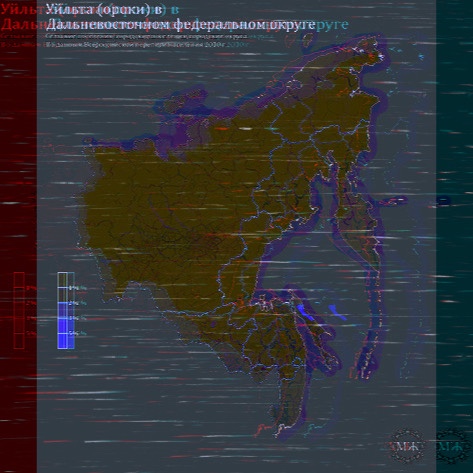
uiltadai-ri-su. ‘Let’s speak in Uilta!’
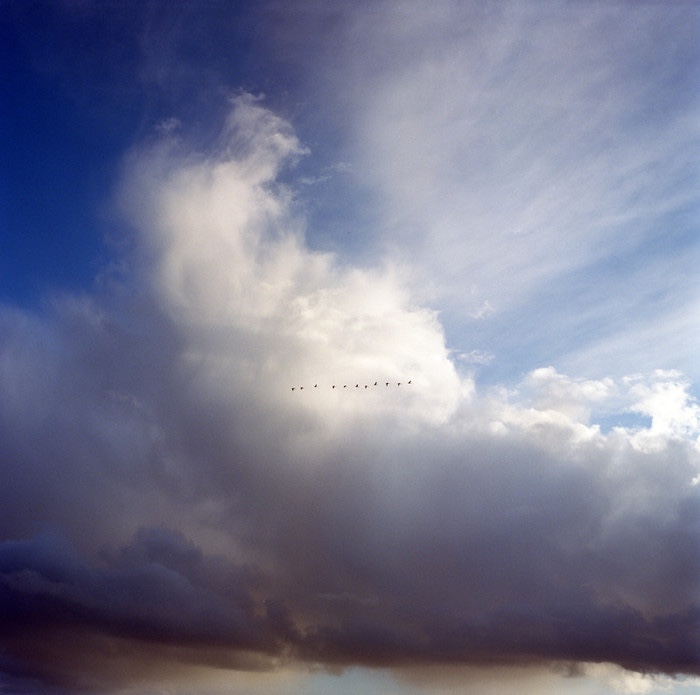
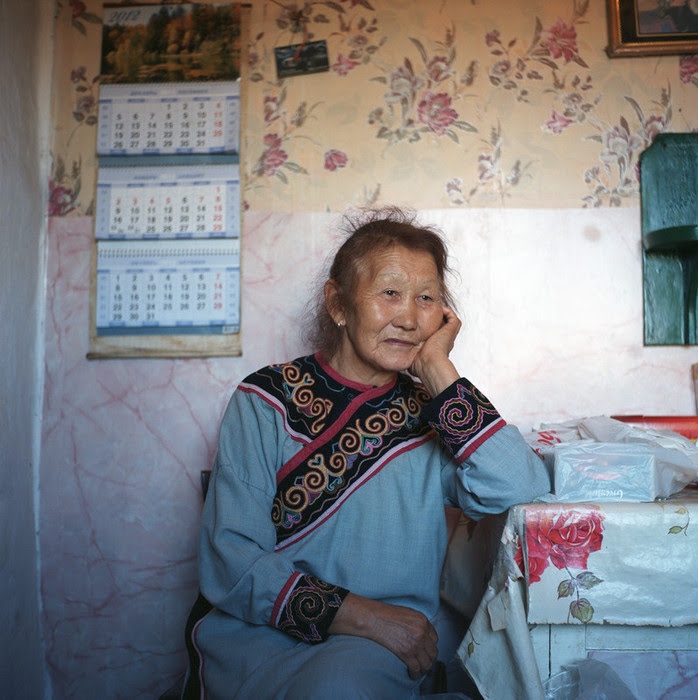
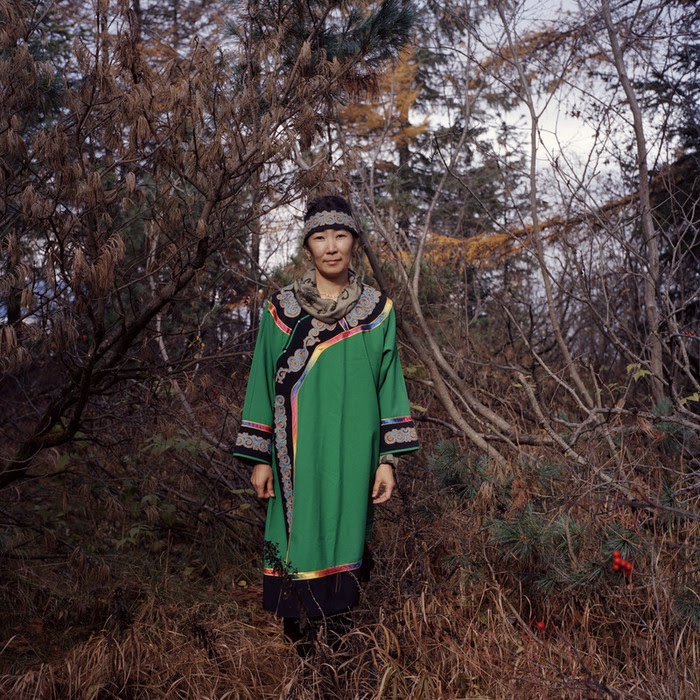

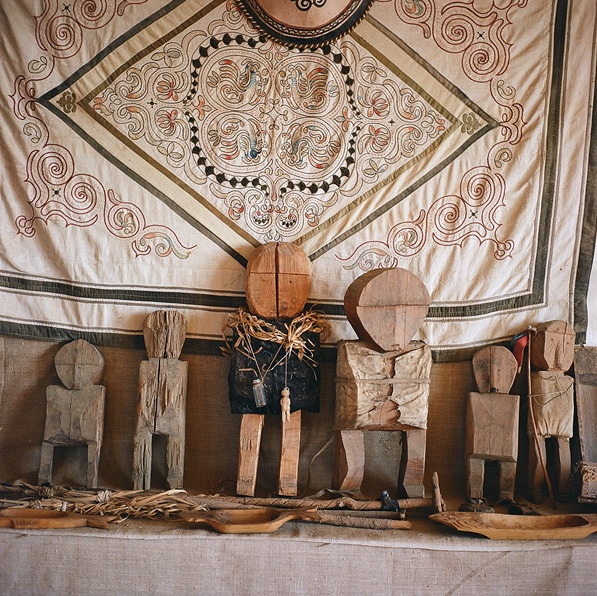
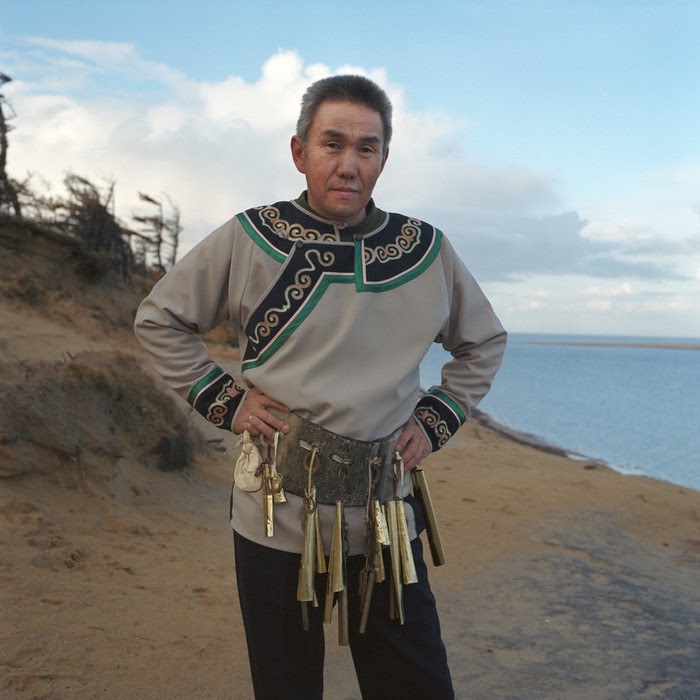
The Nivkhs and Uiltas / Oroks / Oroki / Ulta / Ulcha / Ujlta / Ul’ta / Uil’ta / Nani are two indigenous ethnicities inhabiting the north of Sakhalin Island and the Amur River estuary on Russia’s far eastern coast.
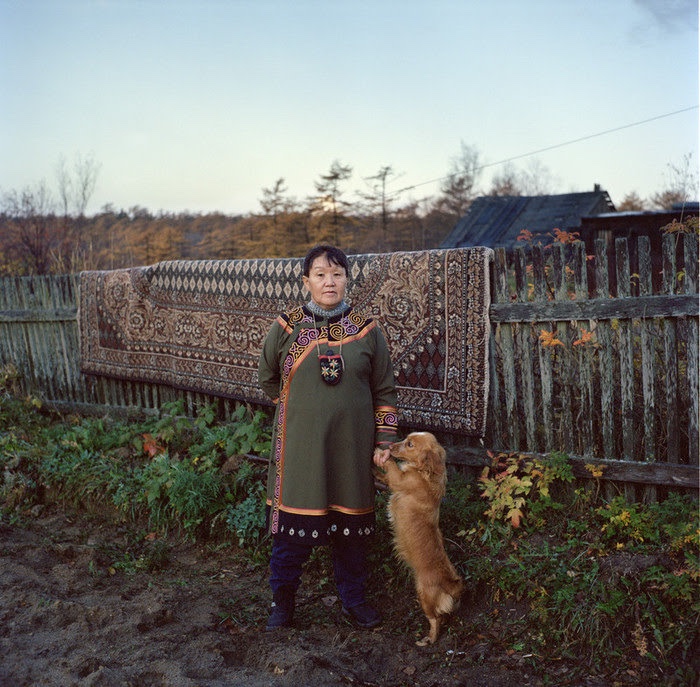
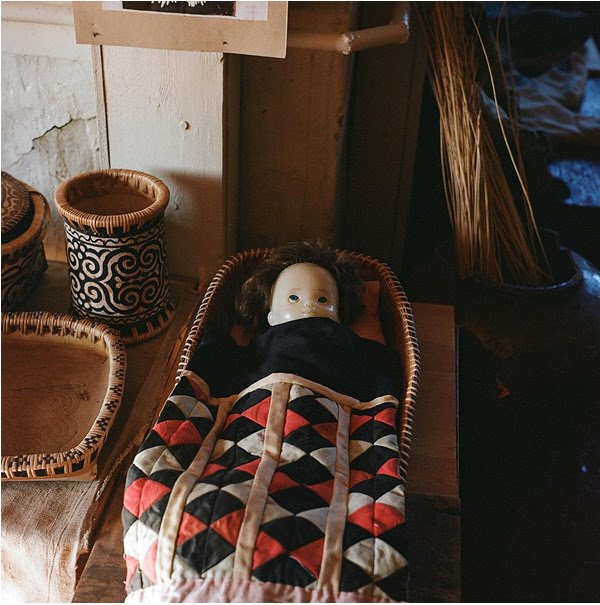
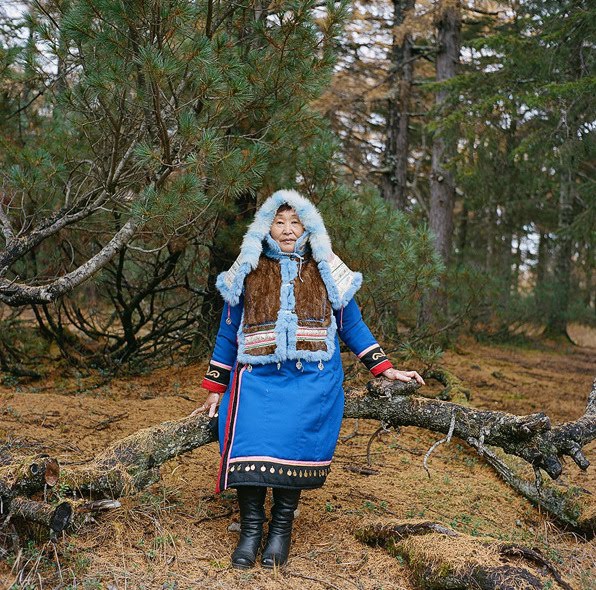
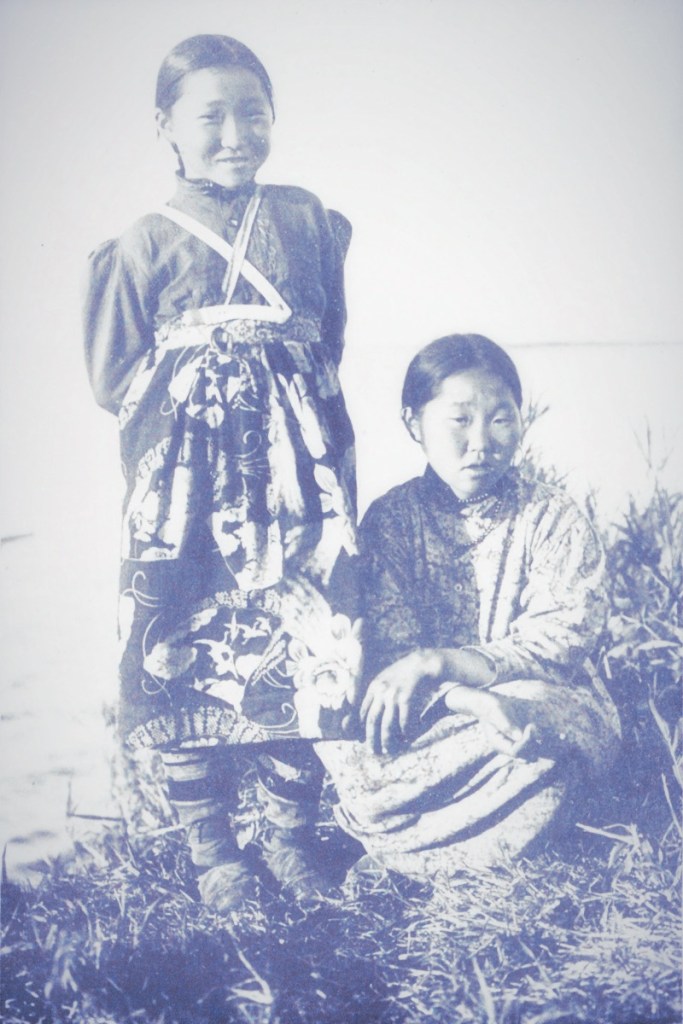
Traditionally, the Nivkhs and Uiltas practised a religion based on animist beliefs and shamanism. Their beliefs are reflected in their crafts, from wood figures, to sewing, to fish leather, to fur, to outfits with traditional embroidery.
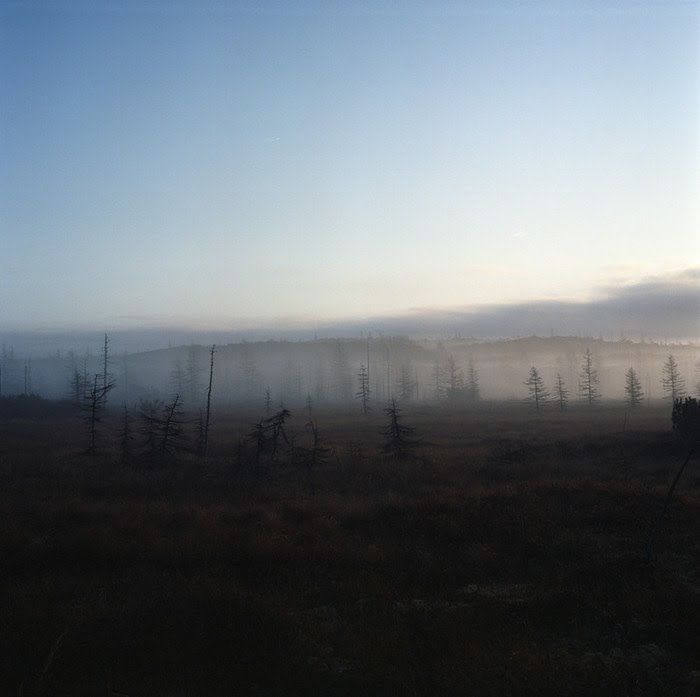
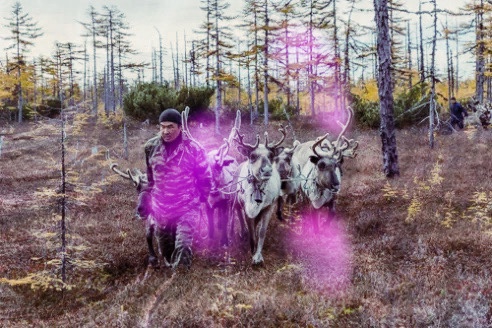
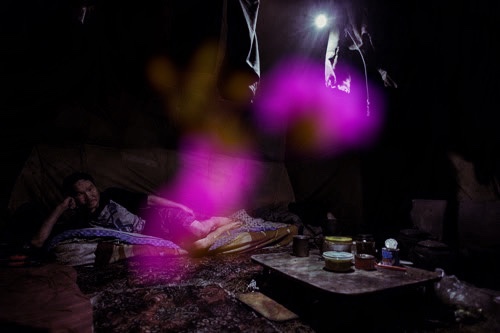
These images are a series of portraits entitled Sakhalin – Masters of Spirit by Olya Ivanova.
The Nivkh speak a supposed language isolate, while the Orok are a Tungusic people, speaking a Nanai / Nanaic / Amur / Southeastern Tungusic language most closely related to Nanai. Beyond this, it is a Southern Tungusic language alongside Jurchen, Manchu, and Xibe – as opposed to a Northern Tungusic language like Ewenki/Tungus. Other classifications recognise an intermediate Tungusic branch between Northern and Southern, and classify Orok and Nanai as Central Tungusic.
Nivkh / nivkhgu dif is the Language of Presence. Orok / ul’ta is the Language of Instance.
Words in Orok:
- ǝǝktǝ-ɲɲee ‛woman’
- geeda-ɲɲee ‛one person’
- xasu-ɲɲee ‛how many people?’
- sagǰi-ɲɲee ‛old person’
- ulisep meat
- ulise flesh
- böyö bear
- ɲinda dog
- sura flea
- cikte louse
- kupe thread
- kitaam needle
- Eri goropci nari. ‘That old man.’
- Bii xalacci-wi. ‘I will wait.’
- Sii gumasikkas nu-la. ‘You have money.‘
- Tari nari caa ninda-ji kusalji tuksɛɛ-ni. ‘That man runs faster than that dog’.
- Sundattaa dug-ji bii-ni. ‘The fish is at home.’
- əkkəsəl doommori paŋgaččukkilil biččiči xooni puli-si-wə-ččii xajwa waa-xam-ba-ččii xaali isu-li-wa-ččii ‛the women longed (for their husbands) and tried to guess, how (they) were going (xooni puli-si-wə-ččii), what (they) were catching (xajwa waa-xam-ba-ččii), and when (they) would return (xaali isu-li-wa-ččii)’
- čipaali-ɲɲee-pa-ppoo all of us
- naa-ɲɲee-ni ‛human being living on earth’ (a folkloric expression)
- ər əsi buu xaaγ-li-pu ‛Now we will reach the shore.’
- ča-ŋŋu-bi okčiči-pissa-mali čala ŋənə-li-wi ‘After healing them (my wounds), I will go there.’
- bagduxu clothes
- əčči ‛somebody or something similar or identical’
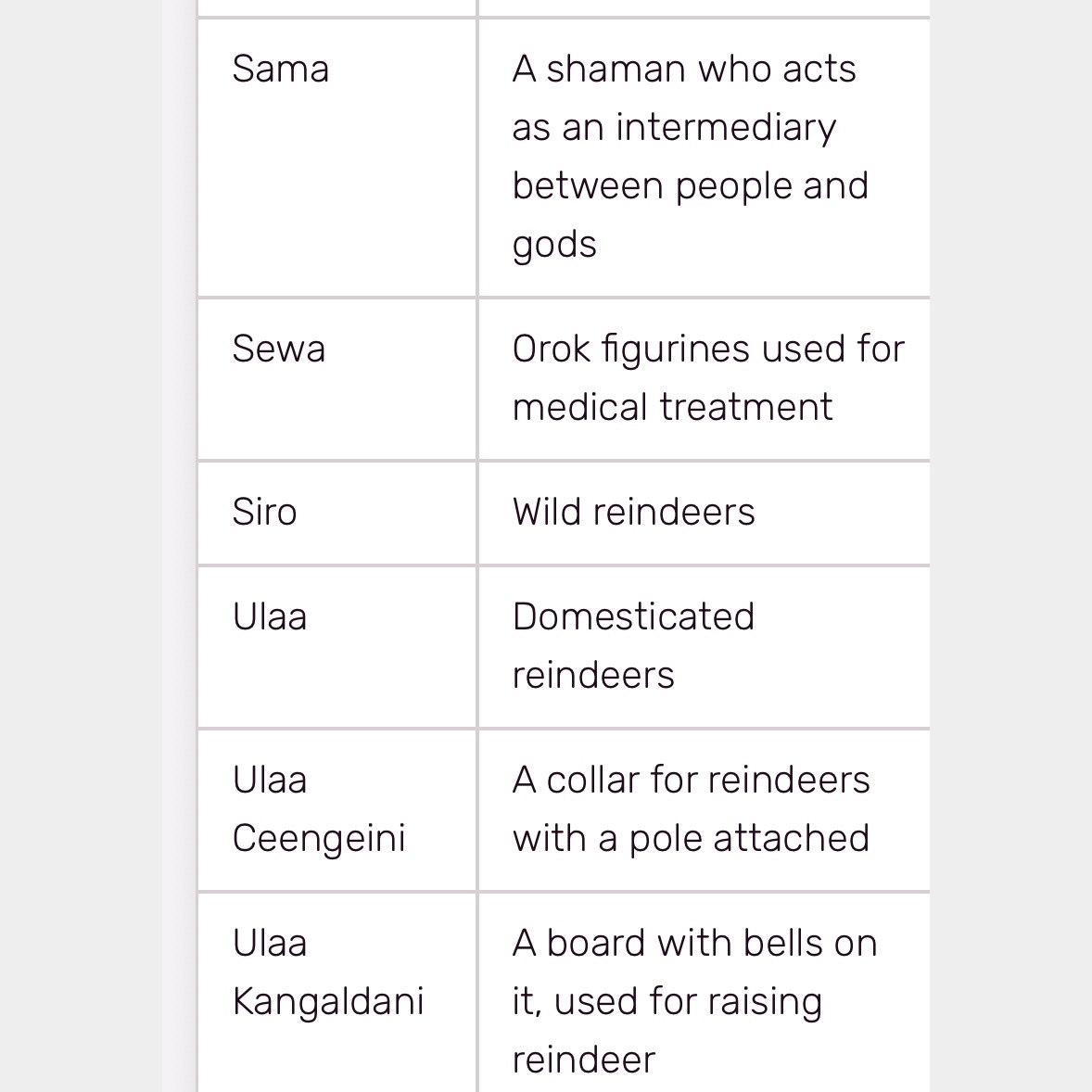
- lillu ‛a belt with which a reindeer-sledge is tied to a tree’
- xəəkə ‛a cross-breed of domestic reindeer and wild reindeer’
- askuttu octopus
- lukku small seal
- maduruku a rope made of seaweed
- ŋana lance for hunting seals
- saunaa seal flipper
- taxakka crab
- saa, saada where?
- pulakkaari for the first time
- taulu fire
- kalamuri board, plank
- ŋojokko egg
- čeennee xajmi taraŋači ə-čči-si təsu-see ‛Why didn’t you gather berries in such a way yesterday?’
- dulleekkeewwee in front of me
- kɵččɵɵli bucket
- ŋenneu Go!
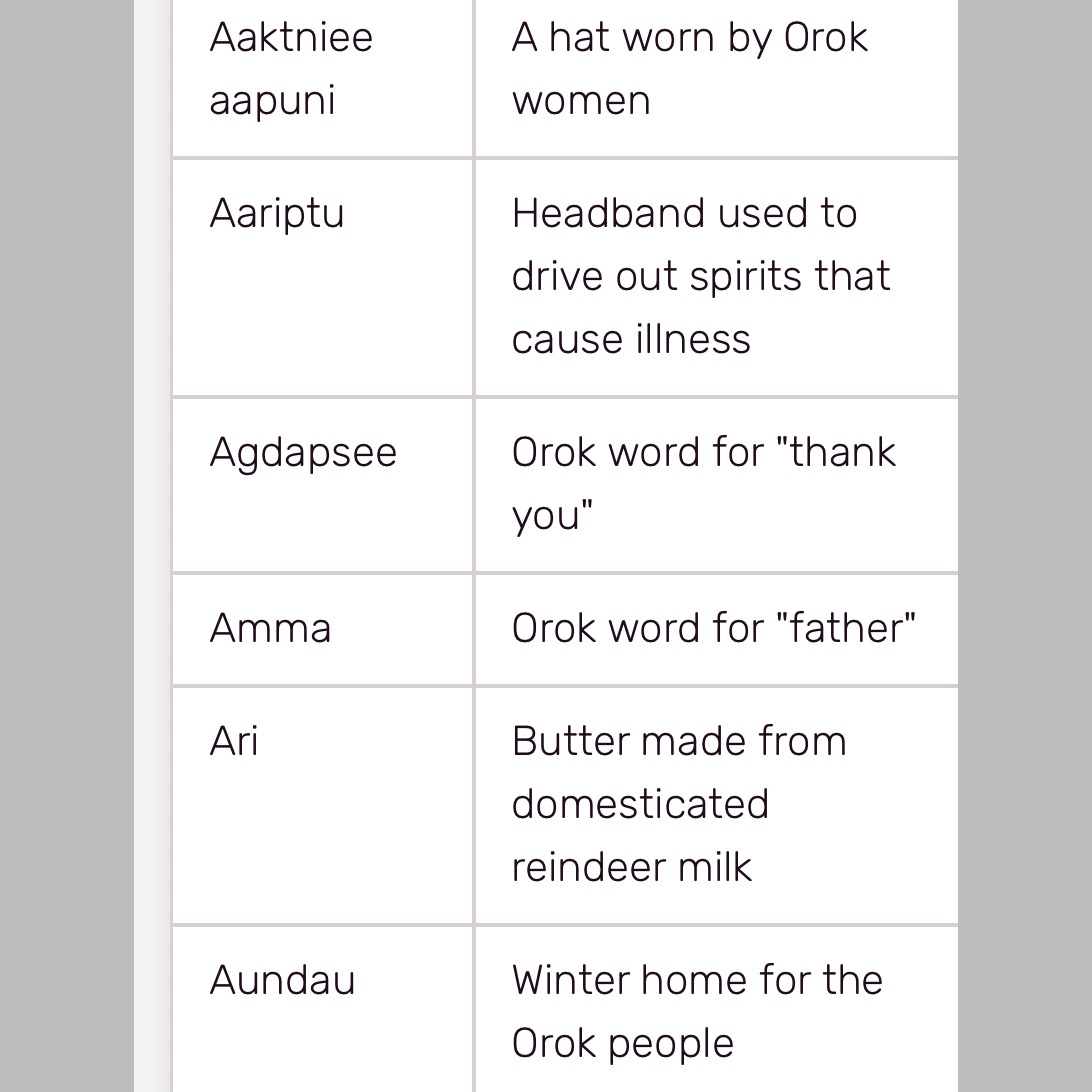
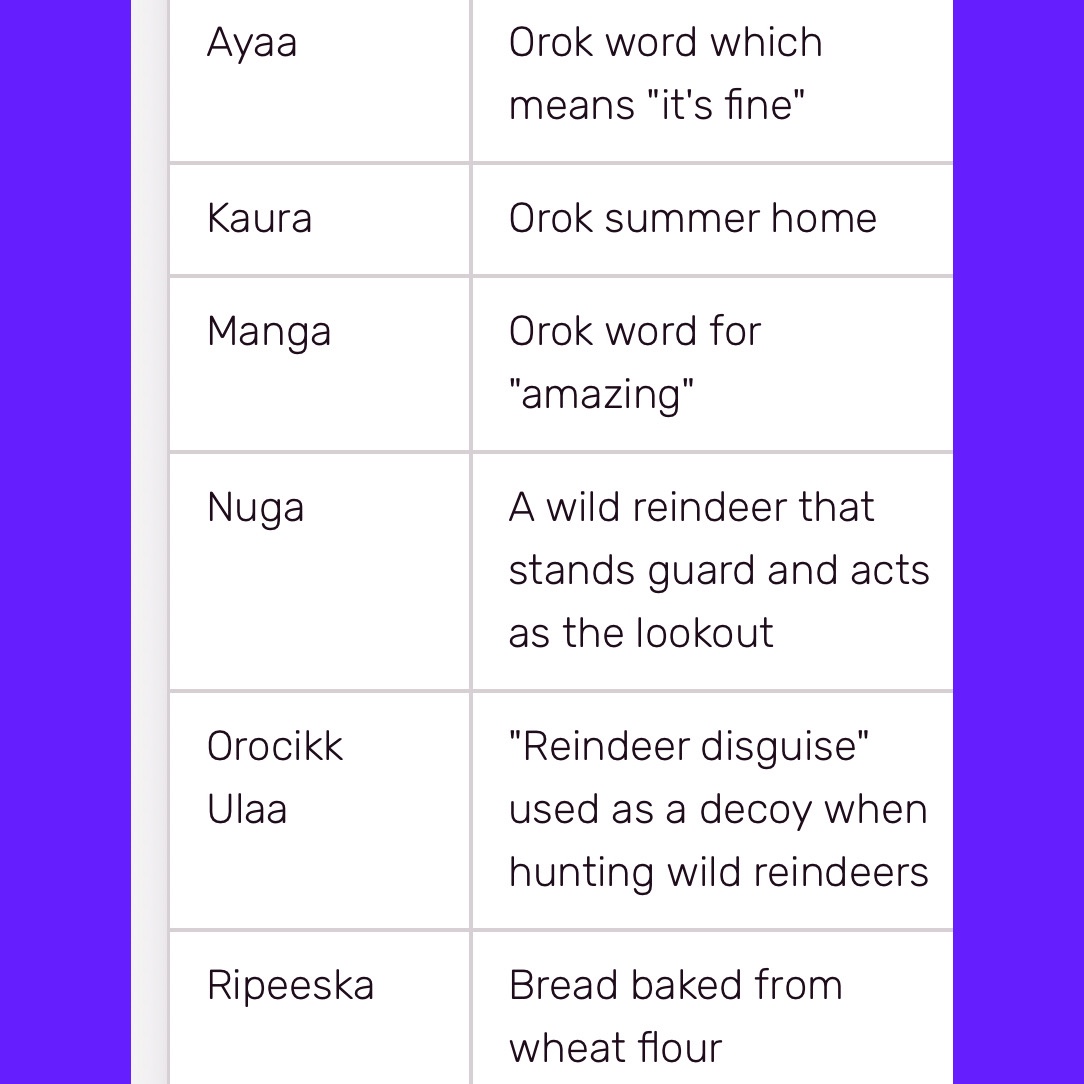
Here are some samples of Orok grammatical features…
- Simple case endings in Orok come in three types, depending on stem-final phonemic structures: -CV# (—consonant-vowel), -VV# (—verb-verb), and -(C)# (—(consonant)):

- Orok has reflexive case endings, with the meaning of “one’s own”:

- Numerals come in cardinal form…

- …iterative, representing the number of times, like “once”, “twice”, “thrice”, formed with the suffix –ra or –lta…

- …and sometimes ordinal, restricted mainly to referencing months after pregnancy or birth.
- Orok uses vowel harmony. Orok vowels can be divided into three related groups based on how they integrate: close /ə/ /ɵ/; neutral /i/ /ɛ/ /u/, and open /a/ /ɔ/. Close and open vowels cannot be found in the same word. Neutral vowels can be combined in any way, in words with close vowels, open vowels or other neutral vowels, having no restrictions.
The Orok are the only indigenous group dwelling on Sakhalin Island whose territory is confined to the island. This would suggest that the formation of the Orok grouping took place on the island itself. Their traditional economy is based on reindeer hunting, alongside fishing and hunting of other animals including marine mammals. According to the Russian census of 2010 there were but 295 Orok people (within Russia, some also living on the Japanese island of Hokkaido). The Orok language has two dialects, northern and southern. Genetically, within the Tungusic family, Orok is close to Ulcha and Nanai. It has also been influenced by the Ewenki language. The self-designation Uilta, which the Orok themselves prefer, may be derived from ulaa ‘domestic reindeer’.
The Oroks adopted Christianity in the nineteenth century, but indigenous Orok spirituality is very rich – although less so than other peoples of the Amur. Orok religious beliefs are intimately associated with the surrounding environment. There is Xaddáu, world-creator, who taught them trades, hunting, and the rules of relations. Revered also were Teomu, master of the sea – as well as his assistants, the killer whales, and Dooto, the master of the forest. They revered the bear, practising the ritual of the bear hunt, and holding a bear festival every few years. Shaman energies were impelled to assist the spirits in worthy causes.


Orok is classified generally as a Tungusic language. The Tungusic languages are often considered to belong to the proposed Altaic language family, also supposedly including the Mongolic and Turkic languages. I disagree with the proposed existence of this family, and consider it solely a sprachbund. I consider the Tungusic languages to be “Trans-Siberian-American” languages, a grouping I propose also including Nivkh, Ainu, Yeniseian, Yukaghir, Chukotko-Kamchatkan, Eskimo-Aleut, Na-Dene, and finally Muskogean. These belong to the Amerindian branch of the primary “Orientalesque”/Amurian/Mongoloid language family I propose, also including the East Asian languages Chinese, Japanese and Mongolian. The “Orientalesque” languages are the “Conceptual-Abstract” Tongues; the Amerindian languages are the “Boundless” Tongues, and the Trans-Siberian-American languages the Languages of Perceptivity. The Tungusic peoples, speakers of the Languages of Prowess, are the Trans-Siberian-American sophisticates; the Nivkh are THE Trans-Siberian-Americans.
The Buzz-Concept of Orok? Overseeing.
This Buzz-Concept is related to front-running, the general Buzz-Concept of the Tungusic languages. This Buzz-Concept is tricky as it renders use of language totally dynamic. Getting your head around the phenomenon of the Orok language is convoluted business. Proficiency in Orok entails embracing your role in the elemental cycles of the world, and your relative angles on it all. What do you make of its vigorous ins and outs, designed to get your head whirring?




 The Buzz-Concept Project