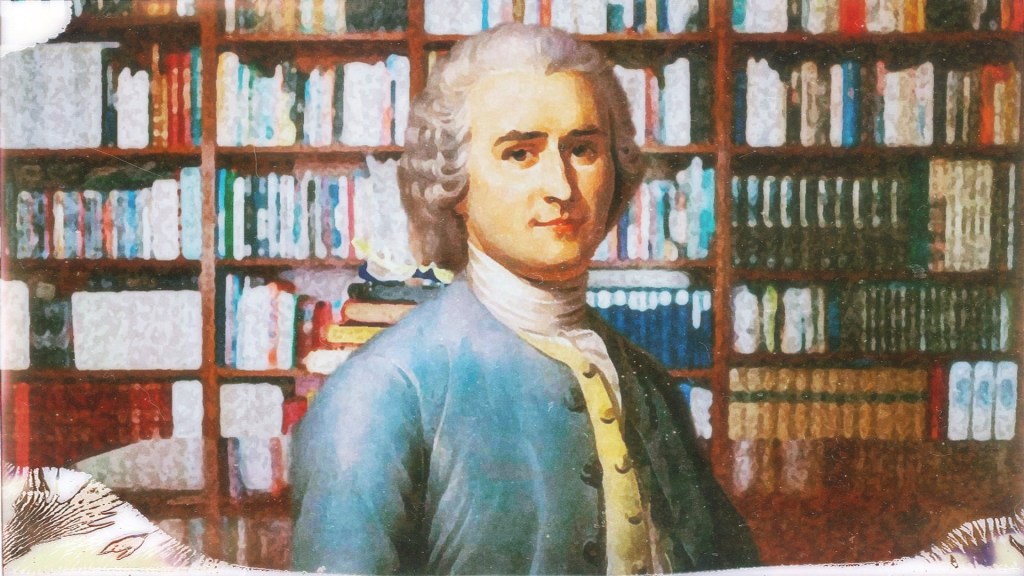



In 1762, Genevan philosopher Jean-Jacques Rousseau published his treatise entitled The Social Contract, originally On the Social Contract; or Principles of Political Right / Du contrat social; ou Principes du droit politique. Rousseau’s progressive ideas would streamline Enlightenment-era Europe for political reform and revolution, helping people move on from stifling absolutist monarchical governance which had reached its providential end-point, no longer what was best for people in the context of societal advancement. He insightfully re-assessed the understanding of the rightful, intrinsic position of the individual within human society.
Rousseau famously stated that “man is born free, but he is everywhere in chains.” He thereby showed people how contemporary states were repressing the physical freedom that is rather supposedly our inherent birthright, and weren’t respecting our desire for civilised liberty for which one -a civil citizen- subscribes to the organisation of civil society. He decisively undermined the inherent authority of absolutist monarchies by emphasising the idea that only a social contract agreed upon by all citizens for mutual benefit can ultimately produce legitimate political authority. Originally, he was concerned in composing this work by the challenges of upholding civilised politics in the context of increasingly commercial i.e. mercenary -in due course capitalist- society. He was vehemently inspired by the capacity of mankind to make progress, and fiercely moved by his desire to disseminate this vital illumination of human potential, whereby the world might accept his invitation to develop.
While Rousseau underlined the fundamental importance of civil freedom of the individual, he also painstakingly elaborated the intrinsic role of the official state in facilitating its attainment. The concept of legitimate government is presented as a symbiosis of the general will of the people and the legislative power of the state. Anything else -especially authoritarianism- is therefore perverse and counterproductive. We can also conclude that for the law to have meaningful substance, the people must have their say in its configuration.
The idealised democratic vision for civilised human society irradiated by Rousseau and others is most certainly not gloriously transcendent to basic human instinct in its legitimacy, but rather profoundly correlative and supplementary to it. He is guiding people to rise above nothing but deficiency itself. In this aspect, Rousseau’s ideas massively changed the position of Buzz-Concepts within the human experience, of which they have constituted a major dimension -whether or not people are aware- since the very first Buzz-Concept of survival came into existence to promote productivity, cooperation, civility and social harmony however far back during prehistory.
Languages revolve around their Buzz-Concepts, which moreover guide people in making use of the components of language (i.e. words, lexemes, lexicology, significances, etc.). So in English, which buzzes about success, we strive to be successful in doing so. In Russian and the Slavic languages, whose Buzz-Concept is perfection, they are perfectionists. In the Romance languages, including Spanish, French, Italian and Portuguese, speakers are ardently passionate about making use of linguistic components. In Arabic and Hebrew, both Semitic and thus Afroasiatic languages, people’s psycholinguistic outlook is inherently unionistic thanks to the Buzz-Concept unity (while it is merely the secondary Buzz-Concept of Arabic, which subsequently adopted the superimposed artificial Buzz-Concept of exquisiteness along with the two other major languages of the Islamic world, Farsi and Turkish). In Africa, the generic representative continental Buzz-Concept of preciousness leads people to objectify the components of language, peculiarly ascribing concrete quality to most things. In Japanese, use of language and the activity it inspires are fiercely efficient. These inclinations also of course influence immensely our activity in general; societies -economies, even- which adhere to the Buzz-Concept success are all successful, funnily enough.
In elevating our capacity to make progress within modern democratic civilised society, Rousseau -unwittingly, conversely- made it possible for us to become detached from the vital scope of the Buzz-Concept. The official state should never override its primary Buzz-Concept, this truth being an essential logical concomitant of his design around which he treads carefully, incisively and brilliantly – but since Rousseau, everyone has been so excited about the modern world’s amazing new possibilities that we have acquired the habit of overstepping the scope of our Buzz-Concepts, with degenerate consequences. We must reconcile this disjunction in order to access modernity’s best results.
 The Buzz-Concept Project