Why are Japanese people so amazingly productive, and in just the right, ingenious, heart-warming way? In the West we’re so boring and pragmatic…
Previous related posts:
Jin Kitamura / 北村人


Yayoi Kusama x Louis Vuitton (2012)


Sulang | Learn Japanese Slang on Instagram

Japanese words:
- buranchi = brunch (a late morning meal or early lunch)
- gariben = nerd-out (to study for a long time)
- riajuu = living the life (an expression for someone who has a perfect life)
- shindoi = drained (physically and mentally feeling dull)
- gaishutsu suru = go for a spin (to go for a drive or go outside)
- gekikara = burning (the effect of something spicy)
- gerogero = ribbit (the sound that a frog makes)
- kimoi = nasty (a synonym for disgusting)
- kira kira = sparkly (shining brightly)

Subete no ningen wa, umarenagara ni shite jiyū de ari, katsu, songen to kenri to ni tsuite byōdō de aru. Ningen wa, risei to ryōshin to o sazukerarete ori, tagai ni dōhō no seishin o motte kōdō shinakereba naranai.
All human beings are born free and equal in dignity and rights. They are endowed with reason and conscience and should act towards one another in a spirit of brotherhood.
(Article 1 of the Universal Declaration of Human Rights)
Some Japanese words are onomatopoeic, mimetic or based on sound symbolism:
- ニャーニャー, にゃん (nyan) / にゃーにゃー (nyā-nyā) = miaow (cat sounds) 🐈; cat, kitty
- ワンワン / わんわん (wan-wan) = woof (dog sounds) 🐕
- コンコン / こんこん (kon-kon) = bark, yelp, cry (fox sounds) 🦊; tap-tap, knock-knock, bang-bang
- ヒヒーン / ひひいん (hi-hīn) = neigh, whinny (horse sounds) 🐎
- メーメー / めーめー (mē-mē) = baa (sheep sounds) 🐑
- ペチャクチャ / ぺちゃくちゃ (pechakkucha) = chattering, chit-chat, prattle
- ペラペラ / ぺらぺら (pera-pera) = fluently (speaking a foreign language), incessently (speaking), glibly, garrulously, volubly; thin, flimsy, weak
- クスクス / くすくす (kusu-kusu) = chuckle, giggle
- ポタポタ / ぽたぽた (pota-pota) = dripping (water), trickling 🌧
- パタパタ / ぱたぱた (pata-pata) = flapping, fluttering, whack-whack, pitter-patter
- ゴロゴロ / ごろごろ (goro-goro) = thundering, purring, grumbling
- キラキラ / きらきら (kira-kira) = glittering, sparkling, glistening, twinkling ✨
- フラフラ / ふらふら (fura-fura) = unsteadily, shakily, tottering, dizzily 😵
- ベトベト / べとべと (beto-beto) = being sticky
- ワクワク / わくわく (waku-waku) = trembling, excited, thrilled
- ドキドキ / どきどき (doki-doki) = thump-thump, pitter-patter, with a throbbing heart ❣️
- ウキウキ / うきうき / 浮き浮き (uki-uki) = cheerfully, buoyantly, happily, in high spirits
Let us indulge our curiosity! Just like they do!
Japanese / 日本語 / Nihongo is generally classified as a Japonic or Japanese-Ryukyuan language. It is spoken mainly in Japan. As of 2018, there were around 125 million speakers of Japanese within Japan. Well over a million more Japanese-speakers reside abroad in countries like the USA, Brazil and Hong Kong. Standard Japanese / 標準語 / hyōjungo is the language of the media, education and official publications. It is based on the variety of Japanese that was spoken in the higher-class areas of Tokyo after the Meiji Restoration of 1868. It is the robust, intensely refined efficacy of hyōjungo as a system of communication enables Japanese society to operate as developed alongside the West. Unsurprisingly in light of the weight carried by Japanese as a “Super-Tongue” (top 5 in the world!), Japanese socioeconomic development has a linguistic foundation! Hyōjungo intensively streamlines speakers’ neurology to stomach collective progression.
Historical linguists believe Proto-Japonic, the language from which modern Japanese and Ryukyuan varieties descend, to have been brought to the Japanese archipelago from Korea during the 4th century BC by the Yayoi people / 弥生人 / Yayoi jin (Yayoi period: 300BCE-300CE). The Yayoi warred, interacted and intermarried with the established Jōmon people / 縄文人 / Jōmon jin (Jōmon period: c. 14,000 to 300 BCE), consisting of multiple groups already dwelling in the Japanese archipelago, to form the modern Japanese people. Modern Japanese people have about 90% Yayoi ancestry on average, with the remaining proportion derived from the Jōmon. Proto-Japonic is understood to have replaced existing languages spoken in Japan at the time, including ancestors of Ainu and possibly Tungusic and Austronesian languages.
Japanese was first written in the 8th century AD, in a form known as Old Japanese. Previously the Japanese has used Classical Chinese to compose writings, but over time the Chinese characters were adapted, using some to represent equivalent words and sounds (i.e. kanji) and others purely phonetically (i.e. kana). Japanese would subsequently pass through phases of adopting more loans from Chinese, as well as borrowing words from Portuguese, Dutch and other European languages brought to Japan by missionaries and merchants. Such terms include パン (pan – bread), from the Portuguese pão (bread), フラスコ (furasuko – flask), from the Portuguese frasco (bottle, jar), カラン (karan – tap, faucet), from the Dutch kraan (crane, tap, faucet), and ズック (zukku – canvas cloth/shoe), from the Dutch doek (cloth, linen, fabric). From 1600, the onset of the Edo period -when the centre of government moved from Kamigata/Kansai/Kyoto/Osaka/Kobe to Edo/Tokyo- saw Japan shut off its borders in isolation, allowing the Edo dialect, the ancestor of the modern Tokyo dialect, to become the most influential, replacing Kamigata/Kansai. After the Meiji Restoration, Japan was once again opened up to the world and more words from languages like German, French and English could again enter the language. Anglicisation has accelerated especially since 1945.
Japanese is often dismissed as a “language isolate”, with no accepted relatives. That said, it is nonetheless currently classified as Japonic or Japanese-Ryūkyūan, related to the Ryūkyūan languages, such as Okinawan, which are spoken in the Ryūkyūan and Amani islands.
Certain similarities displayed to Korean, Mongolic, Tungusic and Turkic languages have led scholars to conclude that they all form a so-called “Altaic” group of languages. While popular, Altaic is not universally accepted by linguists – and certainly not by me. I believe the Altaic grouping and the grammatical similarities concerned to be the result of what is merely a sprachbund (read my verdict here).
My view is that Japanese, Korean, Mongolic and Tungusic (but not Turkic) are indeed related to each other within the same primary language family, but not as Altaic but what *I* have termed “Orientalesque”/Amurian/Mongoloid, also including Sino-Tibetan (Chinese, Tibetan, Burmese), Paleosiberian (Chukotko-Kamchatkan, Nivkh, Yukaghir, Yeniseian, Eskimo-Aleut, Ainuic), and the Amerindian/Native American languages (yes, all of them. The “Orientalesque” languages are -philosophically speaking- the “Conceptual-Abstract” Tongues within the colourful patchwork of world heritage.

Read my first cohesive outline of the Orientalesque languages here.
These languages are strictly characterised by abstract lexicology, sharp phonology, innovative morphology and efficacious ideologies. They are all technically languages of intellect.
Another notion regarding the origins of Japanese has been proposed that it is a creole that emerged from the 2nd century BC, based on languages from northern Asia, which supposedly arrived in Japan via Korea, mixed with ancestors of the Ainu language of Hokkaido (previously in other parts of Japan, too), and possibly with Austronesian languages as well.
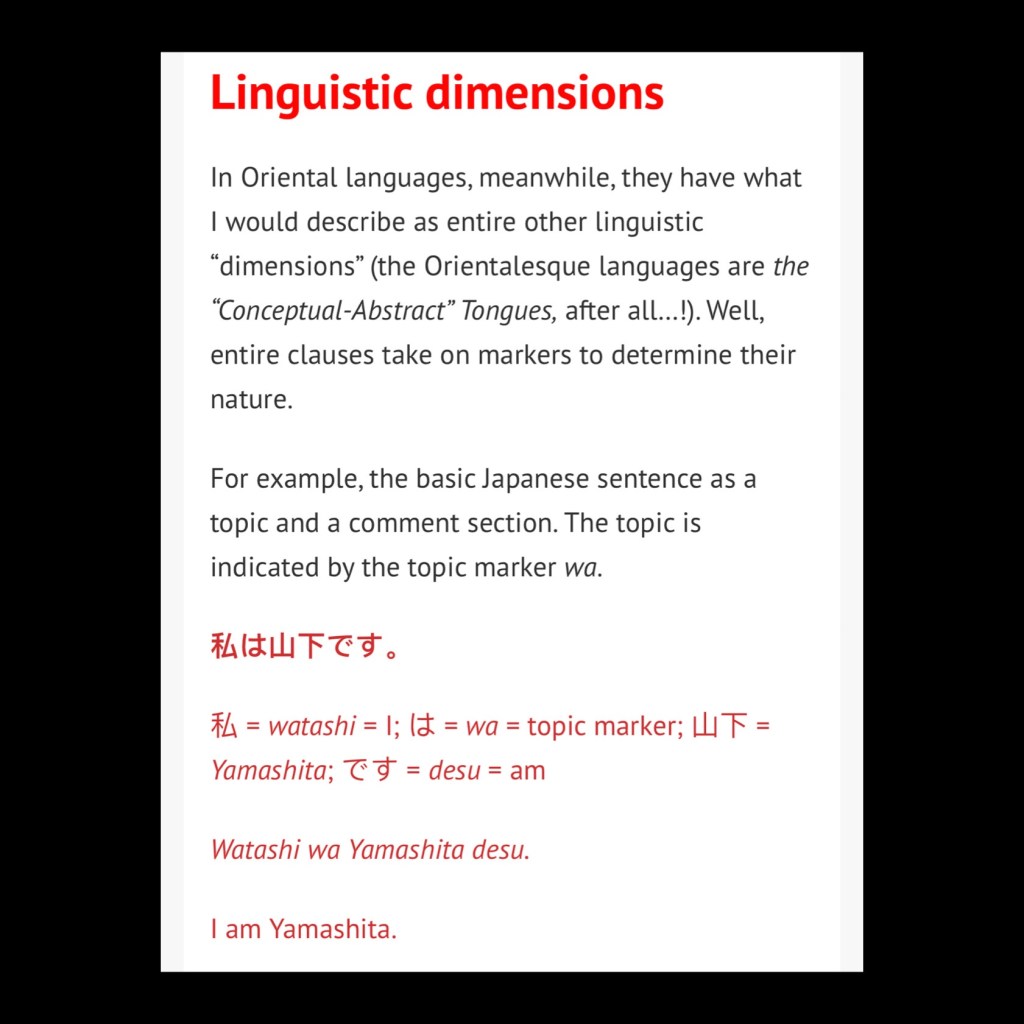


The structural feature above is one thing that leaves me convinced that Japanese and Korean occupy together their own branch of “Orientalesque”/Amurian/Mongoloid (OAM). The ancestors of the Japanese and Koreans were the cultivated OAMs. Today, Korean is the Language of Logicality/Rationality, and Japanese is the Language of Knowledgeability…


It is the efficiency of Japanophone communication combined with their OAM neurological flexibility, and their acutely heightened sensoriality (inherited from primitive prehistoric Pre-Mongoloid people from tens of thousands of years ago still living adhered to the Proto-Global panhumanist collective) that ultimately permit this level of productivity. Their sensory awareness keeps them intimately in touch with their own wants and needs – especially useful for design, customisation, ergonomics, branding, marketing. The efficiency with which they communicate and thereby think and act helps them build strategy and technique. Their neurological flexibility characteristic of OAM peoples gives them the perfect attitude and psyche. The Japanese can also visualise products and ideas like nobody else. They additionally owe their insatiable curiosity and openness – traits which infinitely expand their potential for innovativity- to habits acquired among the Proto-Orientalesques dwelling in the Amurian heartland (around the sacred Amur River, forming the boundary between what is today China and Russia, meeting the sea by Sakhalin Island), eager as they were to find outputs to match their characteristically enhanced inner experiences and cognitive strengths. There the OAM culture of productivity first emerged.


It also of course comes down to Buzz-Concepts, the layers of Japanese being (1) 効 KŌ “effect, efficiency, success, result, efficacy, benefit” (2) 楽 RAKU “ease, comfort” (3) 和 WA = old name for Japan, also a cultural concept translating as “harmony” – the ancestors of the Japanese once having been the harmonious, gentle, discreet, ruminating Oriental people, now the sophisticates… and (4) 奏 SŌ “playing, rising, play music, speak to a ruler, complete, perform, finesse, superficiality, frivolity, lightheartedness (soulfulness of a positive variety)”

The explosive tradition of Japanese productivity can be traced back materially to the Yayoi period.
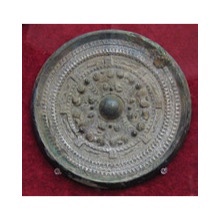
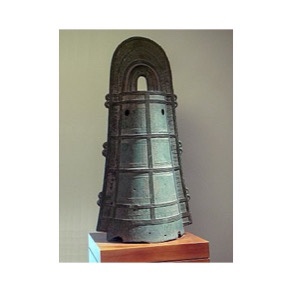
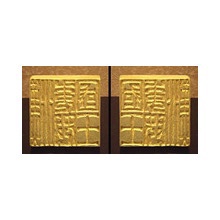
Social development and a nascent primitive love of productivity allowed clans and distinct social classes to emerge in prehistoric Japan. The Japanese productive tradition would simply increase in sophistication and robustness over ensuing millennia. This is what facilitated the establishment of such excellent relations with European powers from the 16th century. Alessandro Valignano noted in 1584 that the Japanese “excel not only all the other Oriental peoples, they surpass the Europeans as well”. Early European visitors were astounded by the quality of Japanese craftsmanship. The Tokugawa shogunate would open the country up to Western commerce after 1854. When the Tokugawa shogunate was overthrown in 1868 and the Meiji government was founded, the Japanese became entranced by Western approaches towards mass productivity and the Japanese economy’s Westernisation commenced. Full industrialisation unfurled, and by the 1890s, Japanese textiles dominated the home markets and even competed successfully with British products in the markets of China and India. When the Meiji period brought the end of feudalism, Japanese productivity was able to explode in that Japanese people were able to advance through the ranks of society more easily than before by inventing and selling their own wares, as well as attain superior education levels.

The economic history of Japan is known for the incredible growth that took place after the Meiji Restoration. This would see Japan become the world’s first non-Western superpower. But World War II cancelled out many of the gains Japan had made since 1868. Around 40% of the nation’s industrial plants and infrastructure were destroyed. People were shocked and intense modernisation began, explaining why Japanese people famously exhibit such open, eager, effervescent approaches to the process today – as well as to technological advancement.
 The Buzz-Concept Project