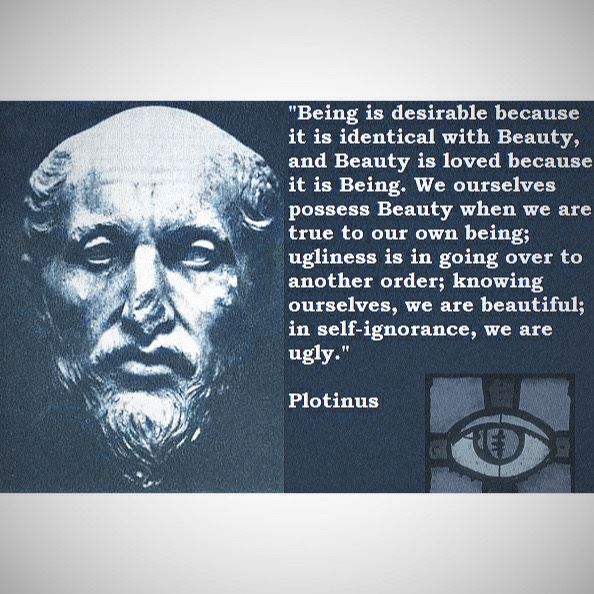
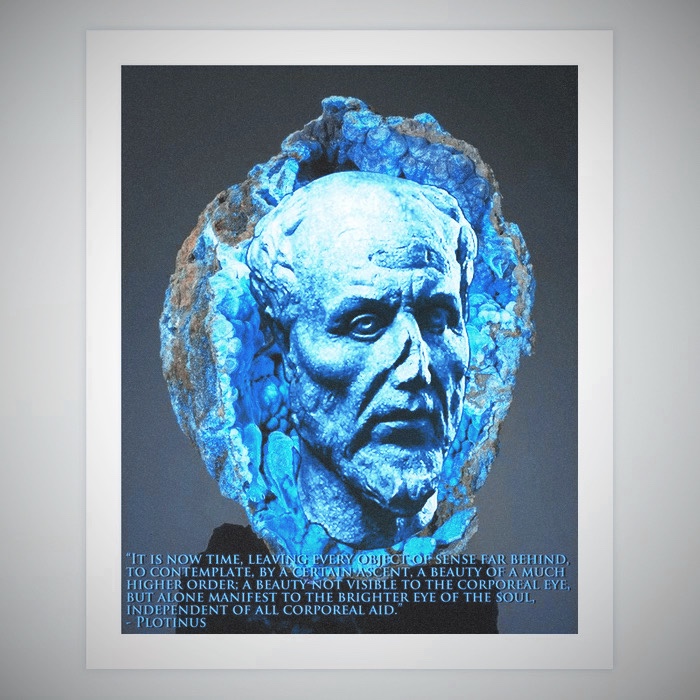
The philosopher Plotinus / Πλωτῖνος / Plōtînos is known as the founder of Neoplatonism, which was ultimately about working to expand the interpretations of Plato to their fullest possible extent – which wasn’t always strictly necessary or appropriate, giving the field a critical downfall in the form of zaniness. Plotinus was born in 204/205 CE and died in 270, likely in Lycopolis (now Asyut), Roman Egypt to what will be a Greek, Roman or Hellenised Egyptian family. He was one of the most influential philosophers in antiquity after Plato and Aristotle.
What is known about Plotinus comes from biographical writing composed by his disciple Porphyry, included as an introduction to Plotinus’ work called the Enneads. We know that Plotinus was moved to study foreign Persian and Indian philosophy, attaching himself to the military expedition of Emperor Gordian III to Persia in 243, after ten or eleven years of instruction by the self-taught visionary Ammonius Saccas in Alexandria. Disheartened by the lack of organisation displayed by Persian and Indian intellectuals, he fixed his discerning determination firmly on his own well-managed culture after the expedition was aborted upon Gordian’s assassination by his own troops. Porphyry reveals Plotinus to have been “a man at once otherworldly and deeply practical” (Stanford Encyclopaedia of Philosophy). So cherished was Plotinus’ wisdom that a number of Plotinus’ acquaintances supposedly appointed him as guardian to their children when they died.
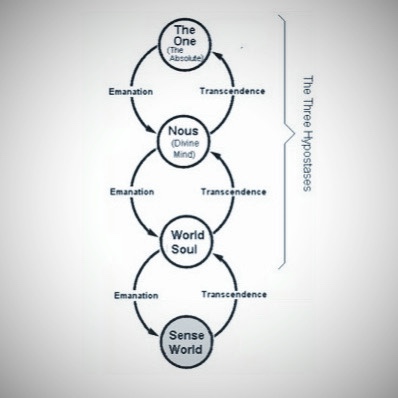
Plotinus’ view was meticulously metaphysical. Famed are his Six Enneads, in which he first examines human virtues and the physical world, and then describes his three immaterial grades of reality, or his three basic principles of metaphysics, so named by him ‘the One’ (or ‘the Good’), Intellect, and Soul. They are known technically as hypostases or metaphysical orders: Soul (3), Intellect (2), and The One (1). Plotinus’ Enneads also contain a unified synthesis of almost eight centuries of Greek philosophy, and he explicitly cites the philosophers Pherecydes, Pythagoras and the Pythagoreans, Heraclitus, Anaxagoras, Empedocles, Socrates, Plato, Aristotle, and Epicurus.
The Enneads passed on the Platonic tradition through to centuries of Christian, Jewish, and Islamic philosophy, theology and religion. Part of Plotinus’ fundamental intellectual morale was indeed about translating Platonic theory for corresponding pragmatic interests. It is through him that the Abrahamic religions, especially Christianity, were able to draw from Plato’s philosophy in order to flourish. The tentative trajectory of early-modern philosophy was also fed by Plotinus, and his stalwart influence on art, poetry (particularly modernist or forward-looking creative works), and the nonacademic esoteric tradition has been just as enormous. It is the lattermost –Plotinus’ influence on the so-called nonacademic esoteric tradition– that strikes me the most since I can see how my own perspective has been hinged thus.
Plotinus’ Enneads are built solidly on an intense form of introspective contemplation. But really, Plotinus is about discernment – as a foremost Nostratic thinker, after all, the very first “Palaeo-Nostratics” having had discernment as the name of their game! He discerned carefully around the limitations of what he deemed the inseparableness of contemplation, thought and life.
But how are you to see into a virtuous Soul and know its loveliness? Withdraw into yourself and look. And if you do not find yourself beautiful yet, act as does the creator of a statue that is to be made beautiful: he cuts away here, he smoothes there, he makes this line lighter, this other purer, until a lovely face has grown upon his work. So do you also: cut away all that is excessive, straighten all that is crooked, bring light to all that is overcast, labour to make all one glow of beauty and never cease chiselling your statue, until there shall shine out on you from it the godlike splendour of virtue, until you shall see the perfect goodness surely established in the stainless shrine. – ‘The Enneads’ I.6.9
His written style comes across as somewhat awkward to the layman, but he is simply being meticulously considerate about his reasoning and duly seeking to maintain the absolute purity of the light in which he presents himself. His voice is definitely awkward but unmistakeably authoritative, of course. And we Western folk truly owe so much to this quirk, quite possibly a trapping of linguistic flair – heightened by his link to Egypt, Ancient Egyptian having been the Language of Philosophising/Mystique! Gratitude we must show for his extravagance. Was he a visionary for the trajectory of Western politics?



 The Buzz-Concept Project