Mongolian is not a fun language. Well, it could be, or it can be, as can any language, but the Mongolian people are honestly just of such a dark disposition, and they have an imperial history that is unfortunately soaked in the blood of the tens of millions of Eurasians they slaughtered in conquest (Okay so you’ve heard of Mongolia…). The Mongolian language (Монгол / ᠮᠣᠩᠭᠣᠯ ᠬᠡᠯᠡ / Mongol / монгол хэл mongol khel [ˈmɔ̙̃ɴɢɞ̜̆ɮ çe̝ɮ] ) is also notoriously difficult and inaccessible. It is a dark labyrinthine beast to tackle, often considered a language isolate within a small Mongolic family – including Mongolian proper (5.2 million speakers), Buryat (330,000), Oirat (360,000), Dagur (96,000), Moghol (200) of Afghanistan, and more. Mongolian is a typical agglutinative language, relying on suffix chains, with a complex syllabic structure that does not open up easily to outsiders.
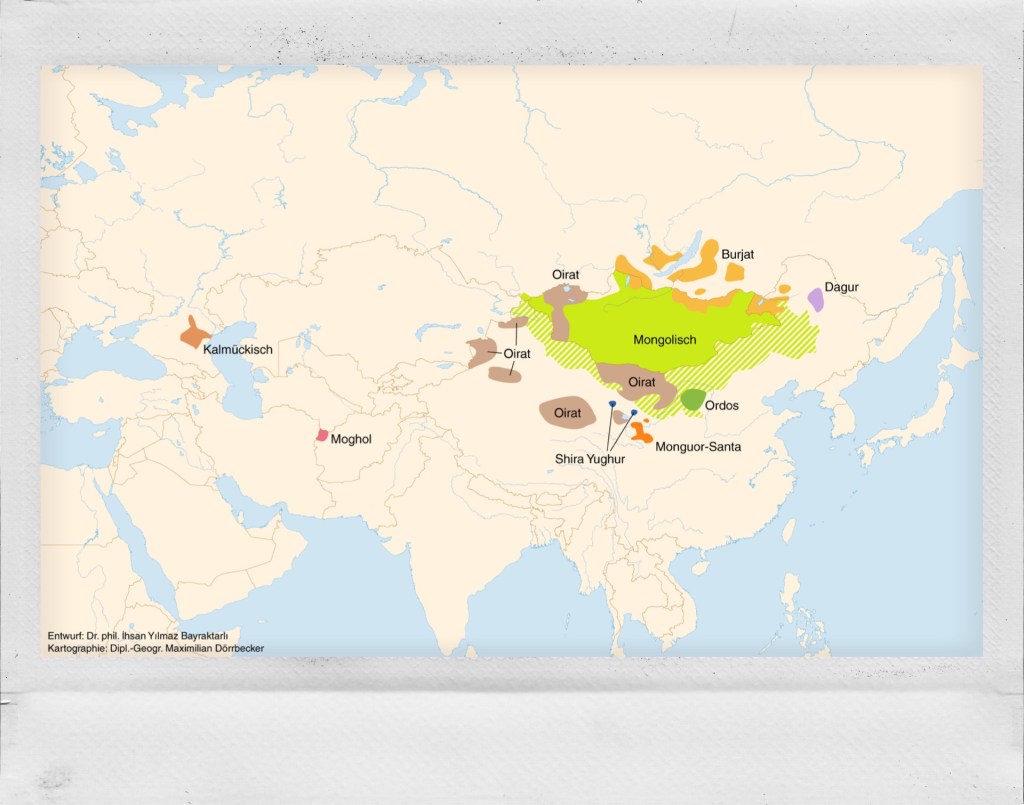
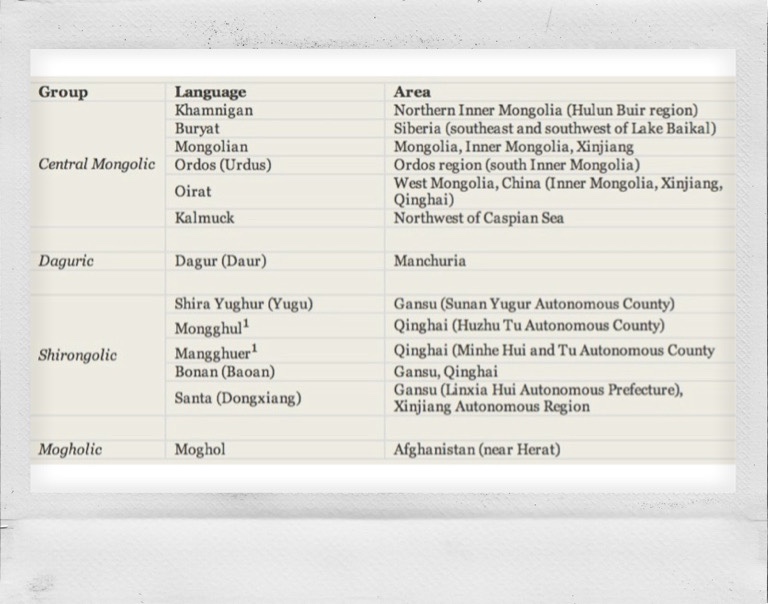
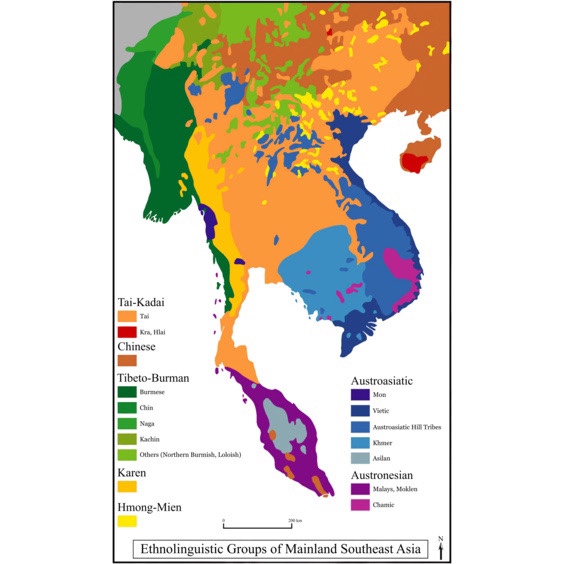
Mongolian is often considered to belong to a proposed Altaic language family –which is often placed in contrast to the Mainland Southeast Asia linguistic area, a sprachbund (the conventional, intensely stereotyped 👯 Sinitic/Oriental sprachbund by my ascertainment, referred to by James Matisoff as the “Sinosphere”) including languages of the Sino-Tibetan, Hmong–Mien (or Miao–Yao), Kra–Dai, Austronesian and Austroasiatic families spoken in an area stretching from Thailand to China. The Altaic grouping conventionally consists of Mongolic (the “Generative” or even “Fireball” Tongues), Tungusic (the Languages of Prowess) and Turkic (the “Gracious” Tongues: read Turkicity & the Buzz-Concept 🩰grace ♥️), but it is controversial and I certainly disagree with its existence as a language family. Korean and Japonic have also been added on in a minority of proposals. Disregarding a common genetic origin, Clauson, Doerfer, and Shcherbak proposed that Turkic, Mongolic and Tungusic languages form a simple language Sprachbund (area of mutual influence rather than common origin). I share the view that Altaic is merely a sprachbund (Why the Altaic languages are just a sprachbund).
I myself have managed to pull together a level of authority(ship) in the field of philology, or comparative linguistics, or historical linguistics. My work with the languages of East Asia and the Americas has led me to conclude that there is one enormous primary language family uniting the two/three continents, which I call the “Orientalesque”/ Amurian/ Mongoloid (OAM) languages – “Orientalesque” being the light-hearted playful term I tentatively attached at the initial stage of discovery, “Amurian” after the Amur River which I believe to be the location of the Proto-OAM heartland, and “Mongoloid” which was an archaic technical term for the corresponding race now often seen as offensive (I seek to reclaim it, perhaps). OAM contains two initial streams or dimensions: “Oriental” (proper, inc, Chinese, Japanese, Mongolian) i.e. the “Efficient” Tongues of East Asia (loosely linked), and “Amerindian” i.e. the “Boundless” Tongues governed by the Buzz-Concept infinity of the Americas (and pockets of Siberia). Beyond this, OAM entails the Amerindian-Siberian, Sino-Tibetan, Mongolic, and Korean-Japanese families. Read my first write-up on the “Orientalesque” languages here. The OAM languages are defined by abstract lexicology, sharp phonology, innovative morphology and efficacious ideologies – and are all technically languages of intellect thanks to neurological flexibility.
Unfortunately, due to the intensified neurological sensitivity of Orientalesque peoples, the rigid misclassification of Altaic is on some levels a geopolitical issue that has had serious, harmful psychical and perhaps neurological consequences for humanity.
From Nomyn Ger School of Mongolian (mongolianlanguage.mn):

- dalayn gahkay 🐬
- dalayn yast melkhiy 🐢
- naymaalzh 🐙
- dalayn khav 🦭
- dalayn od = starfish
- makhchin zagas 🦈
- shur 🪸
- khavch 🦀
- khyasaa 🐚
- sam khorkhoy 🦐
- emgen khums 🐌
- dun = shellfish
- dalayn mor’ = seahorse
- khavch = 🦞
- khalim 🐳
- zagas = 🐠 fish 🐟
- erdenes = treasure
- dalayn deeremchin = 🏴☠️ pirate
- dalay = 🌊 sea
- dalayn = marine/sea (adjective)
- далайн амьтны биологи, dalayn am’tny biologi = marine biology

- Erkh chölööniy khöshöö the Statue of Liberty 🗽
- ❕⛄️🗿🗽✔️ хөшөө khöshöö [xцʃц:] statue
- Tazh makhal the Taj Mahal
- 🇲🇳🐎👾 Tsonzhin boldog location of the Genghis Khan Equestrian Statue
- Tsagaan ordon the White House
- Efyeliyn tsamkhag the Eiffel Tower
- Big ben Big Ben
- Kreml’ Kremlin
- Khyatadyn tsagaan kherem Great Wall of China
- хэрэм kherem [xirim] wall
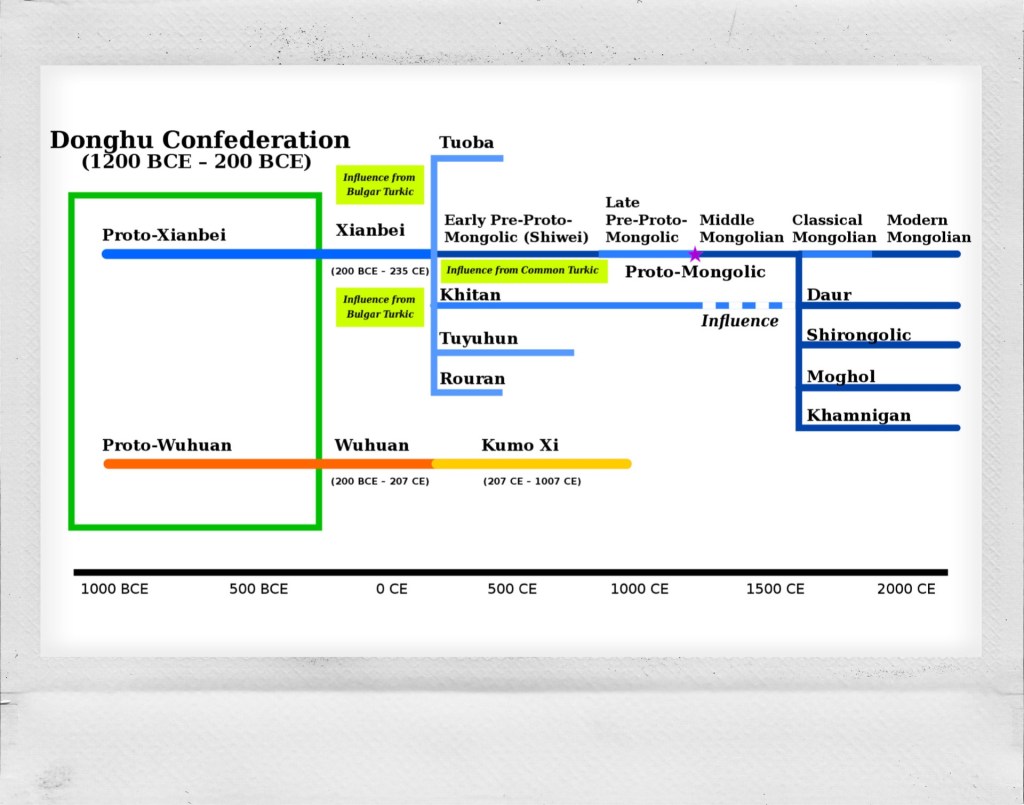
- Хятад Khyatad [⚡️xjuhtuhd] China; Cathay – Cathay is a historical name for China that was used in Europe with poetic connotations. The name Cathay originates from the word Khitan, a Para-Mongolic (Khitan, Tuyuhun, Tuoba, Ruanruan – proposed extinct sister branch of Mongolic, within Serbi-Mongolic/Mongolic-Khitan/Xianbei-Mongolic) nomadic people who ruled the Liao dynasty in northern China from 916-1125. Carries the connotation of ~interminably cunning fellow Orientalesque ppl who we should really always maintain as ally or most likely god may only help us~
- цагаан tsagaan white, picotee, snow-white, travelled, blanch, ivory-coloured, fair, simple-minded, ingenuous, grittle, boyish, simple minded, white pearly, grittled, whitey, blue-eyed devil, marble
- Piramid Great Pyramids of Giza

- багана bagana shaft
- морин хүүр morin khuur [mɔrin xʊːr] horsehead fiddle, a traditional Mongolian bowed stringed instrument, one of the most important musical instruments of the Mongol people, considered a symbol of the nation of Mongolia, one of the Masterpieces of the Oral and Intangible Heritage of Humanity identified by UNESCO.
- тооно smoke hole
- унь un’ caber
- бүрээс burees [bourēhss] covering
- хана khana [han] wall/lattice
- хаалга khaalga door
- босго bosgo [bosog] doorstep, entrance way, threshold
- тогоо togoo cauldron, pan, pot
- тулга tulga [tułuk] hearth
- ташуур tashuur whip
- эмээл emeel saddle
- ор or bed
- авдар avdar chest, box, trunk
- хивс khivs carpet, rug, mat, tapis
(Pronunciation guides my own approximations and not necessarily corresponding to official IPA.)
With its intense nuances, rich history, flexible functionality, cultural value, and its curious lexicology, the Mongolian language makes for fascinating study. But for reasons mentioned above, these strengths remain stubbornly inaccessible to outsiders, and it’s certainly not the issue that the Mongols aren’t interested the outsider. Beyond the awkwardness, the Mongols are totally indifferent to our input, and when the job is done well, actually remarkably open. There is a shortcut to making Mongolian fun for all -for intimidated outsiders and perplexed insiders- and that shortcut involves us embracing the stereotypes about Mongols as “random”, subversively working with and building on top of them in a fulfilling cycle of commitment -Mongolian literally being the Language of Commitment, a Super-Tongue, which buzzes about accomplishment (бүтэмж butemzh: “efficiency, success, effect, accomplishment”) and cultural enlightenment! The only remaining obstacle, then, is the lack of technical resources and attention from within the global community of linguists.


 The Buzz-Concept Project