


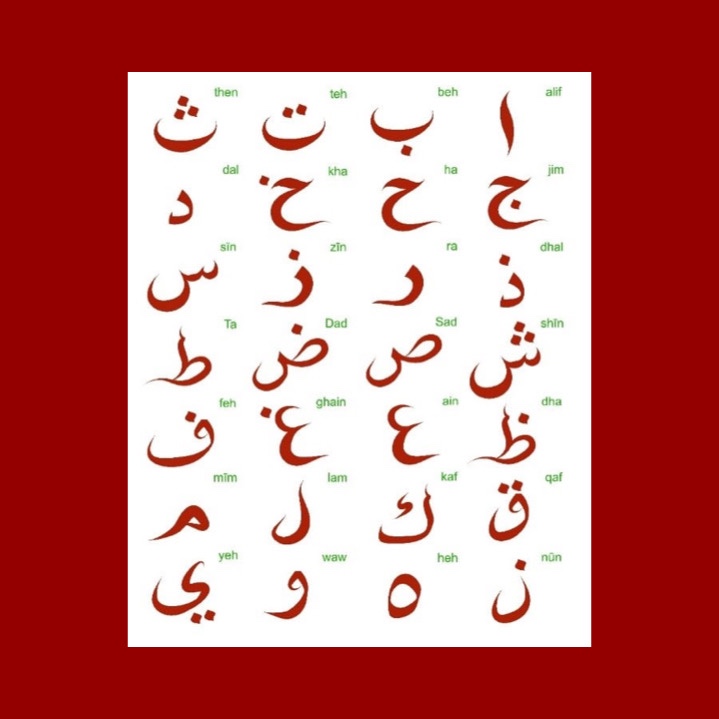
Sample (non-vocalised):

Sample (vocalised):

Yūladu jamī’u n-nāsi aḥrāran mutasāwīna fī l-karāmati wa-l-ḥuqūq. Wa-qad wuhibū ‘aqlan wa-ḍamīran wa-‘alayhim an yu’āmila ba’ḍuhum ba’ḍan bi-rūḥi l-ikhā’.
All human beings are born free and equal in dignity and rights. They are endowed with reason and conscience and should act towards one another in a spirit of brotherhood.
(Article 1 of the Universal Declaration of Human Rights)
You see, in Arabic quite literally everything is deeply meaningful in a way…
The four layers of Arabic / العربية / al-Arabiyyah:
- 1) exquisiteness
- 2) unity
- 3) Arabiyyah
- 4) profundity
The Arabic tongue cuts through life. You don’t build meaning with it: you scythe with it. The Arabic script was indeed designed to symbolise cuts, cutting, wounds, blood splatter or flow. In Arabic, and of course throughout the Muslim world in general, meaning is inherently visceral.
The Arabic script is not necessarily an alphabet, but rather an abjad. The name “abjad” derives from the first four letters of the Arabic “alphabet” A, B, J, D. The difference with abjads is that they traditionally don’t contain vowels. This doesn’t mean that the Arabic language has no vowels, but simply that the script does not traditionally demarcate them and speakers have to rely on their own memories to fill gaps.
That said, the scholarly standard has become to use a special modified version of the Arabic script in which vowels are indeed demarcated by additional marks above and below the traditional script.

The Hebrew script is also an abjad. It was designed to resemble bones or fossils! Jews are also very profound, like all other Semitic-speaking peoples.

The Arabic script is used throughout the Islamic world. It is the predominant writing system of many other tongues, from Persian/Farsi of Iran, to Pashto/Afghani of Afghanistan, Urdu of Pakistan, and Malay-Indonesian. It was also used to write Turkish until the language reform in 1928. It is the second most widely used writing system in the world, after Latin. It is also called the Perso-Arabic script, since Persia sits upon a substantial Muslim heritage of its own. Arabic script goes from right to left.
Its inception dates back to ancient times. The earliest recorded document in this script, an inscription in Arabic, Syriac and Aramaic, dates from 512AD, although it has been in use since the 4th century AD. The Perso-Arabic writing system was originally developed for writing the Arabic language, probably directly descended from the Nabataean alphabet. It was subsequently carried across much of the Eastern Hemisphere by the spread of Islam, having been adapted at different points to a diverse array of languages as Persian, Turkish, Spanish, and Swahili.
The Arabic script contains 28 letters, all consonants. The shape of each letter depends on its position in a word – whether it is initial, medial, or final, or written alone. The letters ālif (glottal stop), wāw (w) and yā (y) are used to represent the long vowels a, u, and i, while a set of diacritical marks developed in the 8th century CE are often used to mark short vowels and certain grammatical endings that would otherwise not be represented.


 The Buzz-Concept Project