
The stony Russian arts of snagging have been vexing NATO and the West since World War II. Russian / Russkij jazyk / Russkiy yazyk / Русский язык is the Language of Precision and buzzes about sovershenstvo / совершенство / perfection / consummation. It makes Russia the trickiest of enemies, with the infuriating capacity to precisely, meticulously, balletically scoot through and away from strife. In Russia, their understanding of the concept of perfection is different, centred on the purely objective. They do not drop this quality casually: they have other broader words like идеальный / ideal’nyy, прекрасный / prekrasnyy and отличный / otlichnyy that one would resort to first to drop such a compliment. Qualifying something with the notion of совершенство / sovershenstvo is done when it objectively truly is perfect, i.e. consummate – completely, absolutely. With the Slavic languages buzzing about perfection, Slavic peoples are of course perfectionists. But beyond that, the Russians are thus a highly discerning people when it comes to perfectionism, in and of itself, so to speak. In their lifelong quest for совершенство / sovershenstvo, votaries become boundlessly artful, intimately discovering how to tweak serendipity in their favour at very young ages.

This is also of course why Russians are famously so good at ballet! Cовершенно!

The Russian Empire oversaw the flourishing of “Great Russian” culture, one of the three nationalities that arose from the disintegration of medieval Ruthenia, alongside the “Little Russians” i.e. Ukrainians and the “White Russians” i.e. Belarusians. The Russians are the enchanting Slavs, the Ukrainians the creative Slavs, and the Belarusians the docile Slavs. Their languages make up the East Slavic languages, being descended from Old East Slavic. The Great Russian strand went on to give rise to one of the world’s greatest, richest, most prestigious cultures. The Russian devotion to совершенство makes this culture singular even within Europe.

Russian supremacy was built up painstakingly step by step – often en pointe :-). Their repertoire was cultivated painstakingly point by point, step by step, moment by moment, feat by feat, lifetime by lifetime. Political traction came thence. In the quest for совершенство, such details were never compromised, and the Tsardom of Russia / Tsardom of Rus’ / Tsardom of Muscovy / Русское царство / Russkoye tsarstvo / Российское царство / Rossiyskoye tsarstvo accumulated great power, culminating in the foundation of the Russian Empire in 1721 by Peter the Great.

The Russian Empire / Российская Империя / Rossiyskaya Imperiya lasted from 1721 until it was overthrown by revolutionaries in 1917. It extended across much of Eurasia, becoming the third-largest empire in history after those of the British and the Mongols. Élitism being a pillar of Russian imperialism, one of the world’s most splendid cultures flourished within its bounds.

Russian society, led by the reigning House of Romanov / Романовы / Romanovy, became highly distinguished, even giving birth to a leading literary sphere. Anna Karenina, the famous 1878 work of Leo Nikolayevich Tolstoy / Лев Николаевич Толстой explores the theme of exacting Russian imperial society. Tolstoy was born unto an aristocratic Russian family in 1828, and devoted his œuvre to paying homage to the intricacies of Russian detail-oriented ascendancy. His fictional realism, complementary to the cultural prestige that gave rise to it, earned him the status as one of the greatest authors of all time.

However, the exacting disposition of Russian élite circles made conditions rather harsh for the Empire’s predominantly rural, uneducated population within a feudalist setting. Peasants were repressed and became resistant, culminating in the bloody Russian Revolution of 1917-23. Abhorred by the capitalism that had dominated a government controlled by Russian noblemen and aristocrats until then, the working class rose up to successfully install a new socialist order.

The Bolsheviks overthrew the intermediary Russian Provisional Government / Vremennoye pravitel’stvo Rossii in 1917, leading to the establishment of a socialist state, the Russian Soviet Republic, which became the largest and most populous of the Soviet socialist republics of the Soviet Union (USSR), which existed from 1922 to 1991. The resolute Bolsheviks were led by Vladimir Lenin / Владимир Ленин, and went on to establish the world’s first constitutionally guaranteed socialist state. The bloodthirsty arrogance of the Bolsheviks, having audaciously overthrown definitively the traditional order, upset many prudent traditionalists and led promptly to the Russian Civil War of 1917-23. The Bolsheviks positioned themselves as leaders of the revolutionary Russian proletariat, and upon emerging victorious from the Civil War and the overall revolution having overseen the execution of the ruling imperial Romanovs in 1918, a radical new order came to define Russian society.

The new order poignantly chimed in infamous discordance with the splendid legacy of imperial Russian cultural supremacy. The latter was arguably steamrolled by the Soviet agenda.

Socialism gave way to communism, and the Soviet Union was established in 1922, lasting until 1991. The Soviet Union was one of the world’s great powers, fighting in World War II partly in collaboration with Western Allied powers including the United States of America and the United Kingdom to defeat Nazi Germany. The Soviets even tried to form an anti-fascist alliance with the West. The war was won on the 9th of May 1945 when Soviet forces captured Berlin and ensured the categorical surrender of the Nazis. Soviet efforts in countering the far-right around the world resound to this day.

Competing ideologically and geopolitically for global influence, the Soviet Union and the United States swiftly entered into the Cold War. This was a period of passive-aggressive tension between the two superpowers that lasted many decades hence until the disintegration of the Soviet Union in 1991. Tension also duly arose between the Soviets’ allies, known as the Eastern Bloc, and the USA’s allies, known as the Western Bloc. Previously allies -temporarily- in securing the victory of WW2 against Nazi Germany, the two superpowers’ clashing created a culture shock for the entire world. And it was really this shock/shift across the world that the enduring discourse of the Cold War represents. Beyond that, the Soviets were eager to expand their influence further as well as spread a beloved leftist sensibility. The capitalist belief system of the United States, meanwhile, fostered a great deal of aversion towards communism and therefore Soviet influence. The hard-hitting Bolshevist Soviet strategy for advancement offended Americans, and the Soviet Union became their principal adversary for a long time. When the perceived threat of communist starkness waned with the fall of the Union was when the Cold War period ended.

I think that it is best to use the term Soviet when referring to this period of Russian history and its legacy, since Soviet values are in many ways antithetical to those underpinning traditional Russian culture.
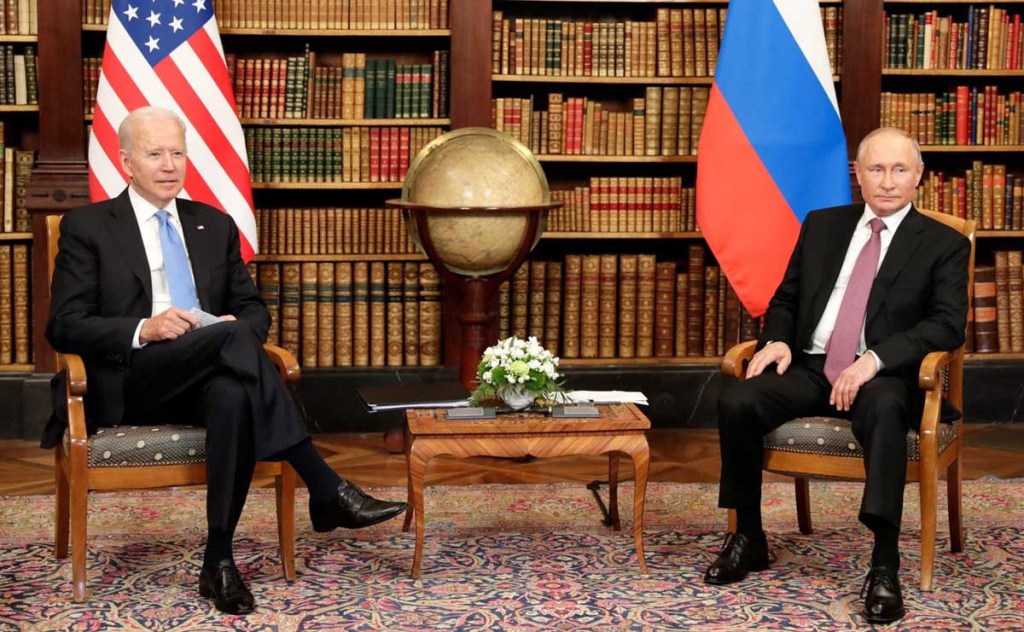
The USA grew paranoid about foreign input over the Cold War. Nationalists in “the Land of the Free” could instinctively feel that there was an unwelcome incongruous alien ideology encroaching from abroad, tainting what Americans saw as their world, shrouding their panoramic view. They immediately pointed their fingers at the Soviets because of their starkness. But actually the evil ideology that was really at fault was that of far-right fascism, which had already been largely quashed with the defeat of the Axis (Germany, Italy and Japan) in WW2. Anyway, communism really irked and offended US liberal capitalists, eager to launch their own polar intricate economic model, and they really wanted to quash it – never managing to as direct violence was not an option. The Cold War is labelled a “war” of sorts because there was plenty of potential conflict bubbling continually beneath the surface; “Cold” because full-on war never actually broke out. The US spent half a century being wound up by Soviet snagging, and vice versa. The gloomy backdrop of the nuclear arms race buttressed this all.

Regardless, collective sloppiness in countering the rise of fascism means that traces endure. Unlike radically inclined leftists, fascists are/were strongly pro-culture. Fascists were traditionally sophisticated and erudite. Ironically, people were sort of enchanted by far-right ideologies. The Soviets did their part to counter this but the rest of us didn’t, and certain fires were not put out satisfactorily. Fascist regimes continued to govern Spain and Portugal, most notably, even after the war. Former fascist states still possess the characteristic fascist venom in their disposal, sadly.

The rise of the Soviet identity saw the Russian perspective spliced in half.

The Soviets were extreme leftists: anti-capitalist and therefore anti-materialistic. They nonetheless sat contradictorily on top of a vast empire whose scope had been previously painstakingly accumulated according to an opposing value system, that of élitist, feudalist Imperial Russia. This surely made them hypocrites. But more than that, the Soviets had usurped the very standing of the Russian ethnic identity that had splendidly flourished thanks to imperialism, arguably undermining it.

The aforementioned Russian perspective was thus divided between the “traditionalist-élitist-culturalists“ and the “leftist-Soviet-Bolshevists”. Efforts to reconcile the two halves are ongoing and very strenuous indeed.

They found themselves divided truly on the deepest of levels. Their very angle on hereditary Slavicity was torn.

Russian is a Slavic language, along with Ukrainian, Belarusian, Polish, Czech, and Bulgarian. The Slavic languages, the “Fabulous” Tongues (ever wondered why Russian women are so… fabulous?), belong to the Balto-Slavic branch of the Indo-European language family. The Indo-European languages, being the “Glorious” Tongues, endow their speakers with hereditary splendid flair… and enterprising instincts, among other things. It all gets coded for within us by the very languages we speak.
The “traditionalist-élitist-culturalists” align(ed) most closely with that aforementioned dimension of the Russian identity and heritage. The Russian people collectively made the call back in the Tsardom days to establish this alignment, for the opportunities it opened up to them to cultivate their culture. This choice ended up opening up the world to them in due course. Or a world: the Second World…!
The “leftist-Soviet-Bolshevists”, meanwhile, were compelled more deeply by an even more radical dimension of their national heritage. The Slavic languages are a branch of the Indo-European language family, but the foundations for the Slavic ethnicity were laid long before the Proto-Indo-Europeans ever even existed. I ascertain the Indo-European languages, commonly accepted to be the world’s largest primary language family, to belong to the older Nostratic primary language family: the “Transcendent” Tongues. The Nostratic family also includes the Uralic languages (including Hungarian, Estonian, and Finnish), the Caucasian/Kartvelian languages (inc. Georgian), the Tyrsenic languages (inc. ancient Etruscan – all now extinct), the Vasconic languages (inc. Basque), and perhaps more. Many thousands of years before the Pre-Nostratics ever even left Africa for Europe, the “Pre-Slavs” had already begun to drift away psychologically, staying separate from the others to a significant extent. They refrained from branching away independently for a long, long time, but nonetheless preserved all the independent developments they made separately within their particular dialect of the collective Pre-Nostratic language. The Slavs went on to become THE Nostratics, speaking THE Indo-European languages. The foundation of the Slavic (slovenĭskyi) ethnicity was indeed communicative/linguistic – slovo means “word” in Russian even today. The Soviets were more compelled by this part of their heritage, the one that dates back to the Pre-Nostratic era, but which also permits access to an intoxicating, radical, liberated, refined, autonomous variant of Slavicity that gets spirits fizzing, you might say. Soviet leaders would accordingly coast on this spirit and their hereditary communication skills, never giving enough heed to contextual factors for the regime to work properly. They coasted moreover on the traction previously painstakingly worked up by imperialists, which then ran out.
The Soviet era faded out to grey when people had finally had enough of its starkness, becoming detached from the fourth layer of the Russian language, утешение / utesheniye, in fact. When the USSR legally ceased to exist on December 31, 1991, the Russian Federation set off on the road to democracy instead.


Serendipity. No, the Soviet Union did not come to its demise thanks to serendipity taking its course. People in some post-Soviet states report feeling worse off without it, so they were certainly not liberated by any serendipity. Instead, dissent arose when Soviet citizens had come to feel totally overwhelmed by all the unlikely serendipity that came their way thanks to hereditary Russian exacting enterprise, concentrated under Soviet control. It felt like they were floating and it began to alarm people. The consensus was established to pursue separatist agendas, with people being pushed to be wary about another rise of Western antagonism. The Union collapsed but only technically, mainly because of frustration about central Russian arrogance blocking people off from the outside world. The post-Soviet states that were (re-)established are Russia, Ukraine, Kazakhstan, Georgia, Azerbaijan, Armenia, Uzbekistan, Belarus, Latvia, Estonia, Moldova, Tajikistan, Lithuania, Turkmenistan, and Kyrgyzstan.
“The collapse of the Soviet Union is a tragedy… If the Soviet Union had survived to this day, we could have avoided all sorts of conflicts in the world… While the USSR existed, the world was multipolar and one pole balanced the other… Now the reason for what’s happening in the world is unipolarity – the monopolisation of our planet by the United States of America,” bemoaned Alexander Lukashenko, leader/dictator of Belarus, in a recent interview with Japanese television.
Russian perfectionism is a potent force, even up against Western antagonism.

Vladimir Putin’s Russian Federation / Российская Федерация / Rossiyskaya Federatsiya launched a full-scale invasion of Ukraine / Україна / Ukraïna on 24 February. I have previously asserted that we are dealing with a -straightforward- case of thirst for blood, and I stand by this. Thirst for blood is a very unique state, a sensation which works like no other. I can tell that this is what the problem is because of Putin’s most peculiar behaviour, accusing Ukraine and its allies of being aggressive, stating that he is trying to “denazify” Ukraine when its president Zelenskiy is Jewish himself, for example. Thirst for blood is indeed a most peculiar phenomenon.

Vladimir Putin is allegedly even suspected of planning to assassinate Volodymyr Zelensky. Russia has apparently gone so far as to compile a list of Ukrainian officials to be assassinated. It is believed that the only reason Zelensky has not been assassinated is the fact that he has become such a huge figure in the world. The Kremlin / Кремль / Kreml’ obviously must know its position is precarious as it is, and that they are in no position to be assassinating anyone right now. Let alone a beloved figure like Zelenskiy. But the point is that this is a very important conflict, and there would most likely be a horrific genocide happening right now if it weren’t for global security measures, with Putin having questioned the validity of Ukraine’s existence.

The Ukrainians and the Russians are both East Slavic peoples who descend from the Rus’ people. But the Ukrainians are free-spirited, as the creative Slavs. Russia is just that bit more historically prudent, and Ukraine has somehow irritated Russian stern sensitivities as of late. A mere dip in the Slavicity frequency caused Putin to pounce – a shadow of doubt having recently been cast over the West’s loyalty to supposed plaything Ukraine and its democratic aspirations following the aftershocks of Donald Trump’s impeachment a couple of years ago.


Meanwhile, the open-hearted disposition of the Ukrainian people has regardless aroused a lot of solidarity in the rest of the world, particularly in the West. People are vehemently speaking out against Putin’s wiles already. The Buzz-Concepts of Ukrainian are (1) завершеність / zavershenist’ / perfection / completeness / maturity / finality / finish and (2) впевненість / vpevnenist’ / assurance / confidence. The Buzz-Concept of Russian is of course совершенство / sovershenstvo, which principally means perfection and consummation, making Russians intrinsically precise communicators and thinkers. Завершеність also of course translates as perfection, but overlaps with different concepts from maturity to finish. Fact: Ukrainians are obsessed with fruit and the concept of growth. The Buzz-Concept of Ukrainian is somewhat different overall in that it first stretches strategically to cover the ideal of serendipity rather than that of exactitude. Putin is in fact directly looking to reverse Ukraine’s Buzz-Concept-related serendipity. But, within the conflict, Ukraine has definitely had the luck of being able to obtain so much support from the West thanks to their charm and the Buzz-Concept впевненість / vpevnenist’. The poignancy of these traits that arise out of Ukrainian’s Buzz-Concepts is really why its position is so heartbreaking.

Sadly, despite the ferocious efforts to put an end to this conflict, Russia is not backing down. And the furore really has been ferocious.

So people are looking to sanction the life out of Russia.

Attention has even turned to Russia’s notorious oligarchs. But can punishing the super-rich set do much to stop Putin? Yes. Symbolically it cuts him off at the source of his arrogance. Reversing his serendipity.

Russian perfectionism makes them indomitable. People have already been exerting themselves to take Russia down, but afloat it stays. To the extent that it’s very easy to ignore how resented they are in the West. This is how they do it. The strengths of the Buzz-Concept perfection mean that they don’t miss a beat when it comes to defending themselves.
Speaking yet again of serendipity: the Slavs are THE Nostratics, as I have mentioned above. They are thus the heirs to the rawest iteration of Nostratic culture etc. Note that the Original language of the “Origino-Nostraticos” was the Language of Serendipity! The very first language of intellect. This seriously all goes waaay back, beyond 100,000 years ago, perhaps. The foundations for Slavic supremacy were unwittingly laid all that time ago: Origino-Nostratico / the Language of Serendipity was the very first language of intellect, and the Slavs founded their ethnicity aeons later on a linguistic premise as THE Nostratics, and nowserendippidydippidydooblablabla
You see, this conflict really could not be more important, for reasons too abstract to be defined.
In defence of Ukraine, international measures are being implemented with the aim of crippling Russia’s finances and wealthiest citizens. Sanctions include the banning of the sale of luxury goods to Russia, including vehicles, high-end fashion and art, by the UK and the EU. All Russian flights have also been banned from US, UK, EU and Canadian airspace. Hundreds of individual oligarchs with ties to the Kremlin are also being targeted, with assets being frozen. The US is banning all Russian oil and gas imports, which Joe Biden intends to target “the main artery of Russia’s economy”. Europe will be independent from Russian energy “well before 2030” according to the EU. International companies including McDonald’s, Coca-Cola and Starbucks have suspended trading in Russia. Much more still is being done, with everyone quick to acknowledge the gravity of this conflict and of Russia’s behaviour.
But it still doesn’t seem like these sanctions are working against Russian perfectionism. Released from Soviet austerity three decades ago, the circle of Russia’s super-rich has been thriving since then. They can’t however forget what life was like under Soviet austerity, and it is with these smarts that Russia is evading punishment for its atrocities. The dichotomy of the modern Russian identity resists definition, like their power resists containment.
What else can be done? Can they be pinned down? Russia has already flipped the narrative and deflected a chunk of attention by accusing the West of pursuing the great Slavic superpower’s downfall. So no, it seems like they can’t be broken.
Why? They’re used to this dissonance, as votaries of the Buzz-Concept perfection. The strengths of this Buzz-Concept of course include enhanced capacity for precision, while the weaknesses include the sense of being lost that arises out of the reality that perfection can’t be attained most of the time. Imagine how much strength is being worked up all the time in the Slavic Buzz-Concept chronicles. War in Europe is so very complicated!
 The Buzz-Concept Project