In his pivotal treatise on the development of Latin into Italian De vulgari eloquentia “on vernacular eloquence”, composed circa 1302-05, medieval Italian poet and key figure in the history of the language Dante Alighieri divided the emerging Romance languages -which all descended from Vulgar Latin- according to their words for “yes”: Nam alii oc, alii si, alii vero dicunt oil, “For some say oc, others say si, others say oïl” – oc of southern France, of Occitan (lenga d’òc), from Latin hoc “that”; from Italy and Iberia si (sì / sí), from Latin sic “thus”; finally, oïl of northern France, of the langues d’oïl including French / français, from Latin hoc ille “that is it” and which has become oui in modern French.

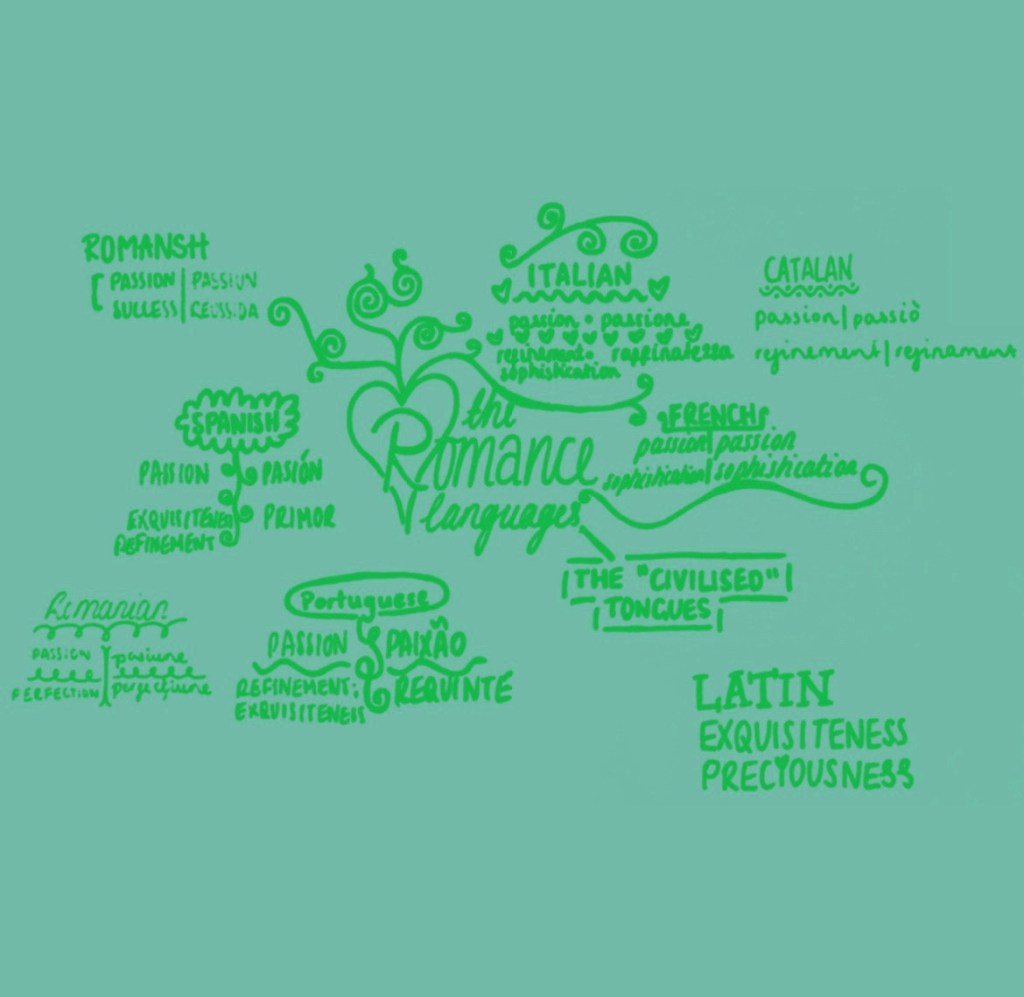
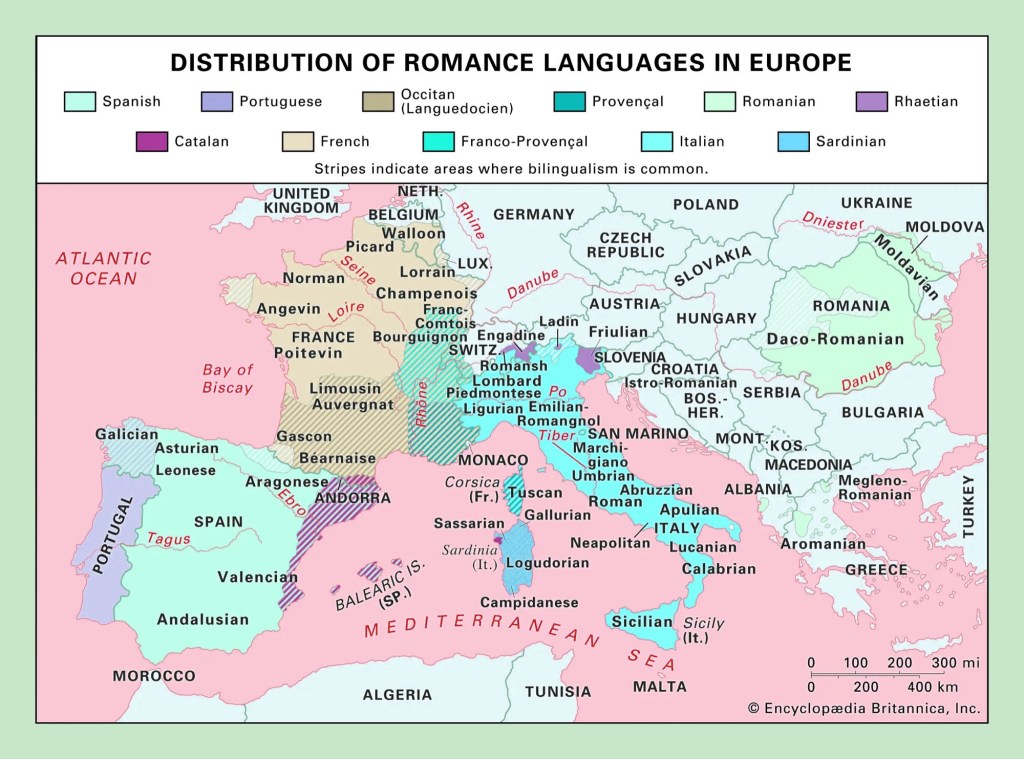
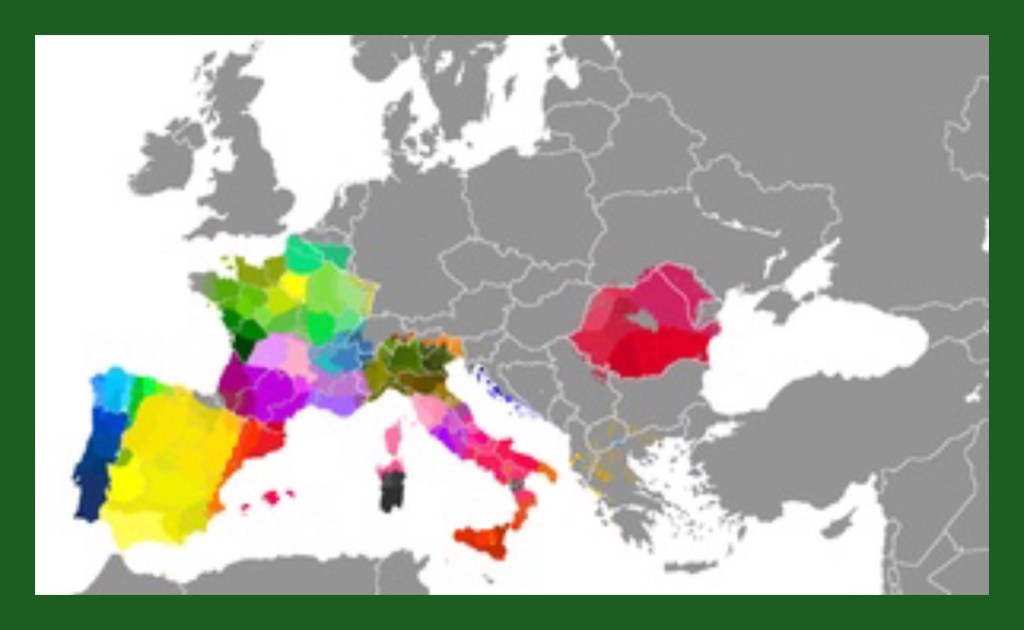
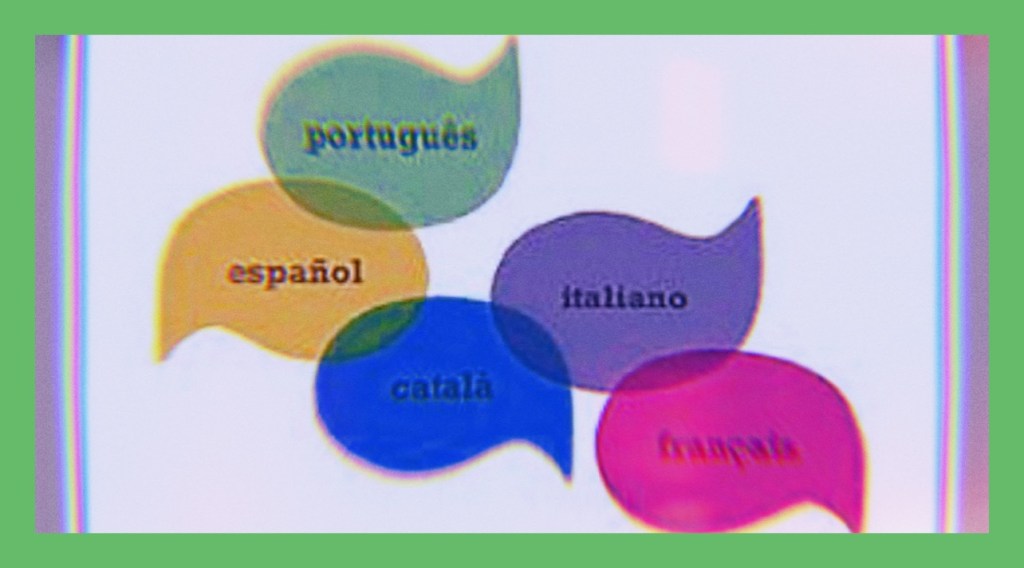
The Romance languages, the “Civilised” Tongues with Latin having been the Language of Civilisation / lingua cīvīlitātis, are the only surviving contemporary branch of the Italic language family (the “Refined” Tongues), and Indo-European languages beyond that. They emerged from vernacular dialects of Vulgar Latin spoken throughout the Roman Empire over the transition of Europe from antiquity to the Middle Ages. The Italic Romance of the Apennine Peninsula became Italian / italiano (descended specifically from the Florentine dialect); the Gallic Romance of Gaul became French; the Iberian Romance of Iberia would give rise to Spanish / español and Portuguese / português; the Balkan Romance of Romania became Romanian / limba română, etc. The development from Latin to Romance mostly took place between the 3rd and 8th centuries. Today, the Romance languages, also termed the Latin or Neo-Latin languages, have more than 900 million speakers worldwide, from Europe, to the Americas and parts of Africa. The six most widely spoken Romance languages according to number of native speakers are Spanish (489 million), Portuguese (283 million), French (77 million), Italian (67 million), Romanian (24 million), and Catalan (4.5 million). For much of the previous millennium, Latin had been the most widely used language in the West for scholarly and literary purposes; the main Romance languages, in particular Italian, French and Spanish, came to establish corresponding grand traditions of their own as prestigious languages of intellect while the power of Latin waned.


🇪🇸 Todos los seres humanos nacen libres e iguales en dignidad y derechos y, dotados como están de razón y conciencia, deben comportarse fraternalmente los unos con los otros.
🇵🇹 Todos os seres humanos nascem livres e iguais em dignidade e em direitos. Dotados de razão e de consciência, devem agir uns para com os outros em espírito de fraternidade.
🇫🇷 Tous les êtres humains naissent libres et égaux en dignité et en droits. Ils sont doués de raison et de conscience et doivent agir les uns envers les autres dans un esprit de fraternité.
🇮🇹 Tutti gli esseri umani nascono liberi ed eguali in dignità e diritti. Essi sono dotati di ragione e di coscienza e devono agire gli uni verso gli altri in spirito di fratellanza.
🇷🇴 Toate ființele umane se nasc libere și egale în demnitate și în drepturi. Ele sunt înzestrate cu rațiune și conștiință și trebuie să se comporte unele față de altele în spiritul fraternității.
Català: Tots els éssers humans neixen lliures i iguals en dignitat i en drets. Són dotats de raó i de consciència, i han de comportar-se fraternalment els uns amb els altres.
Sardu: Totu sos èsseres umanos naschint lìberos e eguales in dinnidade e in deretos. Issos tenent sa resone e sa cussèntzia e depent operare s’unu cun s’àteru cun ispìritu de fraternidade.
Walon: Tos lès-omes vinèt-st-å monde lîbes, èt so-l’minme pîd po çou qu’ènn’èst d’leu dignité èt d’leus dreûts. I n’sont nin foû rêzon èt-z-ont-i leû consyince po zèls, çou qu’èlzès deût miner a s’kidûre onk’ po l’ôte tot come dès frés.
🏛 Omnes homines dignitate et iure liberi et pares nascuntur, rationis et conscientiae participes sunt, quibus inter se concordiae studio est agendum.
🇬🇧 All human beings are born free and equal in dignity and rights. They are endowed with reason and conscience and should act towards one another in a spirit of brotherhood.
- Latin: (Ea) semper antequam cenat fenestram claudit.
- Vulgar Latin: Illa/ipsa claudit (or in Late Latin, serrat) semper illa fenestra antequa (or later, only in Italy, prima) de cenare
- Apulian: (Jèdde) akjude sèmbe la fenèstre prime de mangè.
- Aragonese: (Ella) zarra siempre a finestra antes de cenar.
- Aromanian: (Ea/Nâsa) ãncljidi/nkidi totna firida/fireastra ninti di tsinã.
- Asturian: (Ella) pieslla siempres la ventana enantes de cenar.
- Cantabrian: (Ella) tranca siempri la ventana enantis de cenar.
- Catalan: (Ella) sempre tanca la finestra abans de sopar.
- Northern Corsican: Ella chjode/chjude sempre lu/u purtellu avanti/nanzu di cenà.
- Southern Corsican: Edda/Idda sarra/serra sempri u purteddu nanzu/prima di cinà.
- Emilian (Reggiano): (Lē) la sèra sèmpar sù la fnèstra prima ad snàr.
- Emilian (Bolognese): (Lî) la sèra sänper la fnèstra prémma ed dṡnèr.
- Emilian (Piacenza): Ad sira lé la sèra seimpar la finéstra prima da seina.
- Extremaduran: (Ella) afecha siempri la ventana antis de cenal.
- Franco-Provençal: (Le) sarre toltin/tojor la fenétra avan de goutâ/dinar/sopar.
- French: Elle ferme toujours la fenêtre avant de dîner/souper.
- Friulian: (Jê) e siere simpri il barcon prin di cenâ.
- Galician: (Ela) pecha/fecha sempre a fiestra/xanela antes de cear.
- Gallurese: Idda chjude sempri lu balconi primma di cinà.
- Italian: (Ella/lei) chiude (archaic: serra) sempre la finestra prima (archaic: avanti) di cenare.
- Judaeo-Spanish: Ella cerra siempre la ventana antes de cenar אֵילייה סֵירּה סײֵמפּרֵי לה בֵֿינטאנה אנטֵיס דֵי סֵינאר
- Ladin (Badiot): Ëra stlüj dagnora la finestra impröma de cenè.
- Ladin (Centro Cadore): La sera sempre la fenestra gnante de disna.
- Ladin (Auronzo di Cadore): La sera sempro la fenestra davoi de disnà.
- Ladin (Gherdëina): Ëila stluj for l viere dan maië da cëina.
- Leonese: (Eilla) pecha siempre la ventana primeiru de cenare.
- Ligurian: (Le) a saera sempre u barcun primma de cenà.
- Lombard (east): (Lé) la sèra sèmper sö la finèstra prima de senà.
- Lombard (west): (Lee) la sara sù semper la finestra primma de disnà/scenà.
- Magoua: (Elle) à fàrm toujour là fnèt àvan k’à manj.
- Mirandese: (Eilha) cerra siempre la bentana/jinela atrás de jantar.
- Neapolitan: Essa ‘nzerra sempe ‘a fenesta primma d’a cena / ‘e magnà.
- Norman: Lli barre tréjous la crouésie devaunt de daîner.
- Occitan: (Ela) barra/tanca sempre/totjorn la fenèstra abans de sopar.
- Picard: Ale frunme tojours l’ creusèe édvint éd souper.
- Piedmontese: Chila a sara sèmper la fnestra dnans ëd fé sin-a/dnans ëd siné.
- Portuguese: (Ela) fecha sempre a janela antes de jantar.
- Romagnol: (Lia) la ciud sëmpra la fnèstra prëma ad magnè.
- Romanian: Ea închide întotdeauna fereastra înainte de a cina.
- Romansh: Ella clauda/serra adina la fanestra avant ch’ella tschainia.
- South Sardinian: Issa serrat semp(i)ri sa bentana in antis de cenai
- North Sardinian: Issa serrat semper sa bentana in antis de chenàre.
- Sassarese: Edda sarra sempri lu balchoni primma di zinà.
- Sicilian: Iḍḍa ncasa sempri a finesṭṛa prima ’i manciari â sira.
- Spanish: (Ella) siempre cierra la ventana antes de cenar/comer.
- Tuscan: Lei chiude sempre la finestra prima di cenà.
- Umbrian: Lia chiude sempre la finestra prima de cenà.
- Venetian: Eła ła sara/sera senpre ła fenestra vanti de diznar.
- Walloon: Èle sere todi l’fignèsse divant d’soper.
Old French / franceis / françois / romanz: Pro Deo amur et pro Christian poblo et nostro commun salvament, d’ist di en avant, in quant Deus savir et podir me dunat, si salvarai eo cist meon fradre Karlo, et in aiudha et in cadhuna cosa … (For the love of God and for the Christian people, and our common salvation, from this day forward, as God will give me the knowledge and the power, I will defend my brother Karlo with my help in everything …) – Oaths of Strasbourg (842)



Another pertinent non-genetic scheme for dividing the Romance languages is “conservative” vs. “innovatory”. French is believed to be the most “innovatory”, the most technically divergent from Latin, having been heavily influenced by Germanic languages. Meanwhile, Spanish, Italian, Sardinian and Romanian are considered “conservative” and thereby remarkably faithful to core Latinate standards.
This is an interesting way to consider the Romance family, yet not a particularly reliable one. Why? For starters, French is only seemingly “innovatory” and the most divergent from Latin as it has been so heavily influenced by Germanic languages, and its brand of “Latinity” or “Romanescence” is otherwise very faithful to classically-refined standards, giving it a closer relationship to Italian that meets the eye.
Genealogically speaking, meanwhile, there are some quite fundamental blurred lines in Romance philology that are in dire need of clarification. Compare my preliminary (this is not all I have, but simply my recommended view, not definitive or final, as some features of the family are too abstract and tenuous to permit a clumsy genealogical or typological view) groupings below with others:
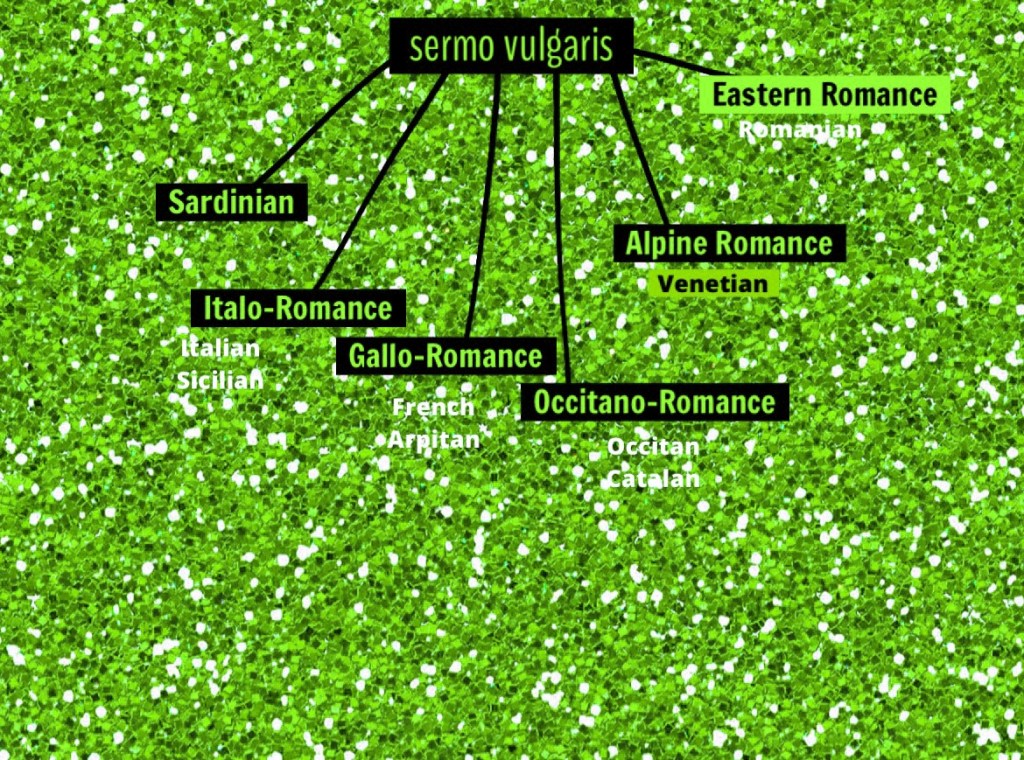
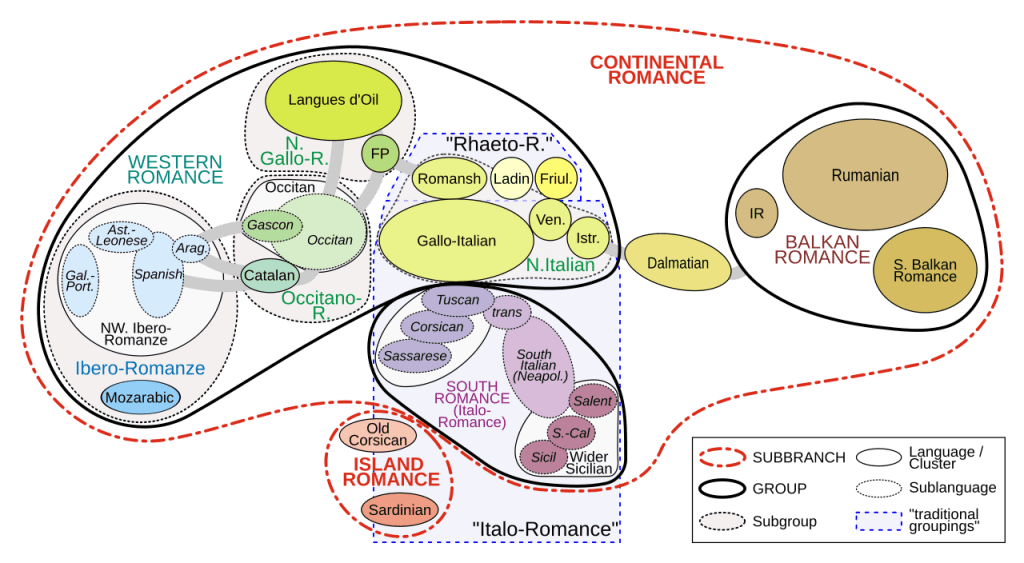


There are inconsistencies. For example, Sardinian / sardu / sadru / limba sarda / lìngua sarda is widely considered to occupy its own separate branch, believed to have been the first Romance tongue to diverge from Latin around the 1st century AD, supposedly separate from so-called Continental Romance. I would rather disregard the Continental Romance grouping, and instead group the languages primarily into a Western and a small Eastern category, solely encompassing Balkan Romance (including Romanian). I deem Sardinian to feature among the Western Romance languages. Meanwhile, the common Western grouping endorsed by others encompasses Ibero-Romance (Spanish, Portuguese), Occitano-Romance (Occitan, Catalan), Gallo-Romance (French, Franco-Provençal), Rhaeto-Romance of the Alps (inc. Romansh, the fourth language of Switzerland after German, French and Italian), and Gallo-Italian of northern Italy – all together. I accept a potential close relationship between Gallo-Romance and Occitano-Romance, but reject the alignment with Ibero-Romance, Rhaeto-Romance and Gallo-Italian. Rhaeto-Romance and Gallo-Italian are in fact linked, alongside Venetian and Istriot, within what I have tentatively called “Alpine Romance”.
I have developed the peculiar view that there is a link between my so-called “Alpine Romance” grouping and the Ibero-Romance languages. These will be the real “innovative” Romance languages, or better “progressive” Romance. This refers specifically to the lexicological essences of their brands of “Latinity” or “Romanescence”, derived from earlier (yes, earlier rather than later), confidently progressive, military-sensitised, dynamic Latin as spoken by the highly militaristic Romans who conquered northern Italy / Cisalpine Gaul and the Iberian peninsula in the 2nd century BC. French actually -contrary to the previously discussed consensus- is a classically-spirited Romance language, aligned here more intimately with Italian. It has, however, been externally influenced by Germanic languages as well as the genuine “progressive” Romance languages, to the extent that its original Gallo-Romance character has been drastically subverted and distorted. Gaul/Gallia was not conquered by the Romans, led by Julius Caesar, until 58-51BC. By then, Roman strategies of administration and education had been honed and, propelled by Caesar’s vision, himself one of the best Roman writers, “innovative” Romance was paradoxically overwritten by more refined, effervescent, classically-oriented streams within Italy and Gaul, which would give rise directly to Italo-Romance, and also Occitano-Romance and Gallo-Romance. This particular relationship is probably too tenuous to pursue, so I have classified the Romance languages otherwise for pragmatic ends as above.


Venetian: Tuti i eseri umani xe nati liberi e conpagni par dignità e diriti. I xe dotai de raxon e de cosiensa e i deve conportarse i uni co st’altri c spirito de fradelana.
Romansh: Tuots umans naschan libers ed eguals in dignità e drets. Els sun dotats cun intellet e conscienza e dessan agir tanter per in uin spiert da fraternità.
Romansh (Grischun): Tut ils umans naschan libers ed eguals en dignitad ed en dretgs. Els èn dotads cun raschun e conscienza e duain agir in vers l’auter en spiert da fraternitad.
Romansh (Puter): Tuot ils umauns naschan libers ed eguels in dignited ed in drets. Els sun dotos cun radschun e conscienza e dessan agir ün invers l’oter in spiert da fraternited.
Romansh (Surmiran): Tot igls carstgangs neschan libers ed eguals an dignitad ed an dretgs. Els èn dotos cun raschung e schientscha e duessan ager l’egn vers l’oter an spiert da fraternitad.
Romansh (Sursilvan): Tut ils humans neschan libers ed eguals en dignitad ed en dretgs. Els ein dotai cun raschun e cunscienzia e duein agir in viers l’auter en spért da fraternitad.
Romansh (Vallader): Tuot ils umans naschan libers ed eguals in dignità ed in drets. Els sun dotats cun radschun e conscienza e dessan agir ün invers l’oter in ün spiert da fraternità.
Gardena Ladin: Duta la jënt ie nasciuda liedia y à la medema denità y i medemi dërc. I à na mënt y na cuscienza y dëssa cunviver coche fredesc.
Val Badia Ladin: Dötes les porsones nasc lëdies y cun la medema dignité y i medemi dërć. Ares à na rajun y na cosciënza y mëss s’incuntè öna cun l’atra te n spirit de fraternité.
Comelico Ladin: Duce cuance i omin nasse libere e conpains zla dignité e zi derite. Löre inà la reson e la cossenzia e dovaraa tnisse duce a une conpagn de frades.
Friulian: Ducj i oms a nassin libars e compagns come dignitât e dirits. A àn sintiment e cussience e bisugne che si tratin un cul altri come fradis.
Piedmontese: Tùit j’esse uman a nasso lìber e uguaj an dignità e an drit. A son dotà ‘d sust e ‘d consiensa e a dëvo agì j’un con j’àutri ant n’ëspìrit ëd fradlansa.
Ligurian: Tutte e personn-e nascian libere e pæge in dignitæ e driti. Son dotæ de raxon e coscensa e gh’an da agî l’unn-a verso l’atra inte ‘n spirito de fradelansa.
Orobic/Oriental (Eastern) Lombard: Töcc i véser umà i nas líber e precís en dignità e diricc. I è dotacc de rizú e de coscenssa e i ga de comportà-s, de giü con l’óter, en spírit de fradelanssa.
Lombard: Tuts i vésser human i nascen líber e precís en dignità e dreits. I èn dotads de rexon e de consciença e i g’han de comportar-s, i ún cond i otre, end un spírit de fradellança.
Emilian-Romagnol: Tot j essèri umèn i nàs lébri e cumpagn in dignità e dirét. Lou i è dutid ad rasoun e ad cuscinza e i à da operè, ognun ti cunfrunt at ch’j ilt, sa sentimint ad fratelènza.
Spanish/Castilian: Todos los seres humanos nacen libres e iguales en dignidad y derechos y, dotados como están de razón y conciencia, deben comportarse fraternalmente los unos con los otros.
Extremaduran: Tolos ombris nacin libris i igualis en diniá i derechus. Comu gastan dela razón i del conocimientu, devin de portal-si comu ermanus unus con otrus.
Galician: Tódolos seres humanos nacen libres e iguais en dignidade e dereitos e, dotados como están de razón e conciencia, díbense comportar fraternalmente uns cos outros.
Portuguese: Todos os seres humanos nascem livres e iguais em dignidade e em direitos. Dotados de razão e de consciência, devem agir uns para com os outros em espírito de fraternidade.
Mirandese:
Quien dirie qu’antre ls matos eiriçados
Las ourriêtas i ls rius d’esta tiêrra,
Bibie, cumo l chaugarço de la siêrra,
Ua lhéngua de sons tan bariados?
Mostre-se i fale-s’ essa lhéngua filha
D’un pobo que ten neilha l choro i l canto!
Nada por ciêrto mos cautiba tanto
Cumo la form’ an que l’eideia brilha.
Zgraçiado d’aquel, qu’abandonando
La patri’ an que naciu, la casa i l huôrto.
Tamien se squeçe de la fala! Quando
L furdes ber, talbéç que stéia muôrto!
Old Spanish:
Si vos assi lo fizieredes e la ventura me fuere complida / Mando al vuestro altar buenas donas e Ricas (Cantar de mio Cid, 223–224) Si vosotros así lo hiciereis y la ventura me fuere cumplida, / Mando a vuestro altar ofrendas buenas y ricas — If you do so and fortune is favourable toward me, / I will send to your altar fine and rich offerings
–Ya sennor glorioso, padre que en çielo estas,
Fezist çielo e tierra, el terçero el mar,
Fezist estrelas e luna, e el sol pora escalentar,
Prisist en carnaçion en sancta maria madre,
En belleem apareçist, commo fue tu veluntad,
Pastores te glorificaron, ovieron de a laudare,
Tres Reyes de arabia te vinieron adorar,
Melchior e gaspar e baltasar, oro e tus e mirra
Te offreçieron, commo fue tu veluntad. (Cantar de Mio Cid)
–Oh Señor glorioso, Padre que en el cielo estás,
Hiciste el cielo y la tierra, al tercer día el mar,
Hiciste las estrellas y la luna, y el sol para calentar,
Te encarnaste en Santa María madre,
En Belén apareciste, como fue tu voluntad,
Pastores te glorificaron, te tuvieron que loar,
Tres reyes de Arabia te vinieron a adorar,
Melchor, Gaspar y Baltasar; oro, incienso y mirra
Te ofrecieron, como fue tu voluntad.
O glorious Lord, Father who art in Heaven,
Thou madest Heaven and Earth, and on the third day the sea,
Thou madest the stars and the Moon, and the Sun for warmth,
Thou incarnatedst Thyself of the Blessed Mother Mary,
In Bethlehem Thou appearedst, for it was Thy will,
Shepherds glorified Thee, they gave Thee praise,
Three kings of Arabia came to worship Thee,
Melchior, Caspar, and Balthazar; offered Thee
Gold, frankincense, and myrrh, for it was Thy will.
 The Buzz-Concept Project